
Optimizing Shopping Mall Floor Plans for Visitor Experience

A shopping mall's floor plan is much more than just lines on paper. Think of it as the operational blueprint for the entire visitor experience. A well-designed layout feels intuitive, guiding people on a seamless journey that encourages them to explore, discover, and stay longer.
Why Effective Floor Plans Are the Blueprint for Success

The layout is the very backbone of a shopping center. When designed well, it naturally guides foot traffic past anchor tenants and smaller boutiques, maximizing the value of every square foot. The placement of everything—from food courts and restrooms to escalators and seating—is a series of deliberate choices aimed at managing crowds and keeping people comfortable.
If the layout is confusing, however, it becomes a major liability. Frustrated shoppers may give up and go home, and they might not return. This isn't a minor inconvenience; it translates into measurable lost revenue for both tenants and the mall owner.
Key Components of a High-Performing Mall Floor Plan
To understand what makes a floor plan effective, it helps to break it down into its core components. Each element plays a distinct role in shaping both the visitor's journey and the operational efficiency of the center.
| Component | Impact on Visitor Experience and Operations |
|---|---|
| Tenant Mix and Placement | Strategically placing anchor stores and popular brands drives footfall to specific zones, benefiting nearby smaller shops. |
| Circulation and Corridors | Wide, clear pathways prevent bottlenecks and guide visitors intuitively. The layout should encourage a natural, flowing journey. |
| Common Areas and Amenities | Food courts, seating, and restrooms act as crucial "pause points" that improve comfort and extend visit duration. |
| Vertical Transportation | Escalators, elevators, and stairs must be logically placed to connect floors without causing congestion or confusion. |
| Service and Back-of-House | Hidden from public view, these areas are vital for deliveries, waste management, and staff movement, ensuring smooth operations. |
Ultimately, these pieces must work together in harmony. A great floor plan isn't just a collection of well-designed parts; it's a cohesive system that creates a positive, stress-free environment for everyone.
The Challenge of Static Plans in a Dynamic World
Here’s the fundamental problem for any operations manager: an architectural drawing is static, but a shopping center is a living, breathing ecosystem. That beautifully rendered blueprint is a fixed moment in time, completely unaware of the dynamic reality of a busy Saturday afternoon.
At Waymap, we see this every day. A floor plan on paper or in a PDF cannot account for temporary closures, promotional pop-ups, or the simple human need for clear directions in a complex space. The plan may be accurate, but it isn't helpful in the moment a visitor feels lost.
This is exactly where the disconnect happens, and it's where modern digital tools come into play. The goal is to transform shopping mall floor plans from rigid documents into intelligent, interactive guides. This shift doesn't just help a lost shopper; it gives operational teams a wealth of data to work with.
With smart, digital wayfinding, you can:
- Reduce visitor confusion and see customer satisfaction scores climb.
- Increase dwell time and spontaneous purchases by making it easy and enjoyable to explore.
- Significantly improve accessibility for all visitors, especially those with mobility challenges or visual impairments.
In the end, a well-managed and digitally integrated floor plan is the foundation of any modern retail destination. It’s what turns a physical building into a responsive, user-friendly environment. To see how smart navigation directly impacts retail success, you can explore how Waymap can benefit retail venues. This is about shifting from a static map to a dynamic operational asset—a crucial step for staying competitive.
From Blueprints to Digital Twins: Understanding Floor Plan Formats
For any team running a shopping center, the journey from a static drawing to a dynamic digital asset starts with the raw materials – the floor plan files themselves. The type of file you have dictates what’s possible, especially when it comes to modern tools like indoor navigation. Getting this right is the first step in future-proofing your venue.
Think of it like this: a PDF of a floor plan is like a beautiful, static photograph of a finished meal. You can see what it is, but you can’t change the ingredients or get the recipe. A CAD (Computer-Aided Design) file, on the other hand, is the actual recipe. It contains all the underlying data, measurements, and structural elements you need to analyze, adapt, and build upon the original design.
The Spectrum of Floor Plan Files
Shopping center floor plans come in a few different formats, and each has its own purpose. They generally fall into two main categories: raster and vector.
- Raster formats (PDF, JPG, PNG): These are essentially image files. While they’re easy to share and view, they don’t contain the rich, editable data needed for smart systems. If you zoom in too far, everything becomes blurry and pixelated. You can't just click on a corridor or a shop to get its exact measurements.
- Vector formats (DWG, DXF): For anyone in architecture or operations, these are the gold standard. Created in software like AutoCAD, they are made not of pixels but of mathematical lines, curves, and points. This means they are infinitely scalable without losing quality and, most importantly, contain structured data that other software can actually read.
The real difference is the data. A vector file understands that a line represents a wall and that a closed shape is a room with specific dimensions. This is precisely the kind of structured information a digital wayfinding system needs to build an accurate, navigable map of your venue.
Why Vector Files Are Essential for Digital Navigation
To create a truly helpful digital navigation experience, the system has to understand the space. It needs to know the exact width of a corridor, the location of an elevator, and the precise path from A to B. This is where vector-based plans, like DWG (Drawing) or DXF (Drawing Exchange Format), become essential.
These files provide the raw geometric data that allows a system like Waymap to construct a "digital twin"—a highly accurate, virtual replica of the physical space. Techniques like rendered floor plan visualization can then help bring this data to life, but the vector file is the crucial starting point. This digital foundation is also what makes it possible to layer on other important information.
From CAD to BIM and Beyond
While CAD files are excellent, the industry is increasingly shifting towards BIM (Building Information Modelling). BIM files take things a step further. They don't just define the geometry of a building; they also embed rich, non-graphical information. For instance, a BIM model knows that a specific object is a door and can hold data about its manufacturer, material, and even its fire rating.
For operational purposes, both CAD and BIM files provide the robust foundation needed for advanced applications. More recently, technologies like LiDAR are also being used to create incredibly detailed 3D maps of indoor environments. If you’re curious about how that works, you can learn more about what a LiDAR scanner is and its role in precision mapping.
The biggest hurdle for many venue managers is simply getting their hands on these files. They’re often held by the original architects or a separate facilities management company. Securing and, more importantly, maintaining up-to-date versions of these plans is a critical—and often overlooked—step in any project to modernize a venue.
Common Mall Layouts and Their Navigation Challenges
Walk into any shopping mall, and you might think the layout is a bit random. It’s anything but.
Every corridor, atrium, and anchor store in a shopping mall's floor plan is a piece of a carefully constructed puzzle. These architectural blueprints are steeped in retail psychology, all designed to guide how you move, manage crowds, and ultimately, maximize what you spend.
But understanding these designs also shows why even the most thought-out spaces can feel like a confusing labyrinth. This is exactly where a digital layer of guidance becomes essential, creating a seamless and accessible experience for absolutely everyone.
The Linear Dumbbell and L-Shape Layout
This is one of the classic designs. Picture a straight line with a large anchor store at each end – think of a major department store. The corridor between them is lined with smaller shops, and foot traffic flows as people walk from one main attraction to the other.
It's a simple and cost-effective layout to build, creating a clear, linear path that’s fairly easy to follow. The L-shape is just a variation with a corner. The main downside? Shops stuck in the middle can get lost in the shuffle, and the walk can start to feel a bit monotonous.
The Multi-Level Racetrack Layout
As malls grew larger, the racetrack layout became more common. This design guides you in a continuous loop, often spanning multiple floors. The idea is that if you complete the circuit, you’ll pass every single storefront. It eliminates dead ends and keeps people moving in a steady flow.
This continuous loop is fantastic for ensuring every tenant gets seen. The problem is, the sheer scale and repetitive nature can be incredibly disorienting, especially in a multi-level center. You can easily forget which part of the "racetrack" you're on or how to get back to where you started without doing another full lap.
These complex physical layouts all start from a set of foundational documents, which come in a few common formats.
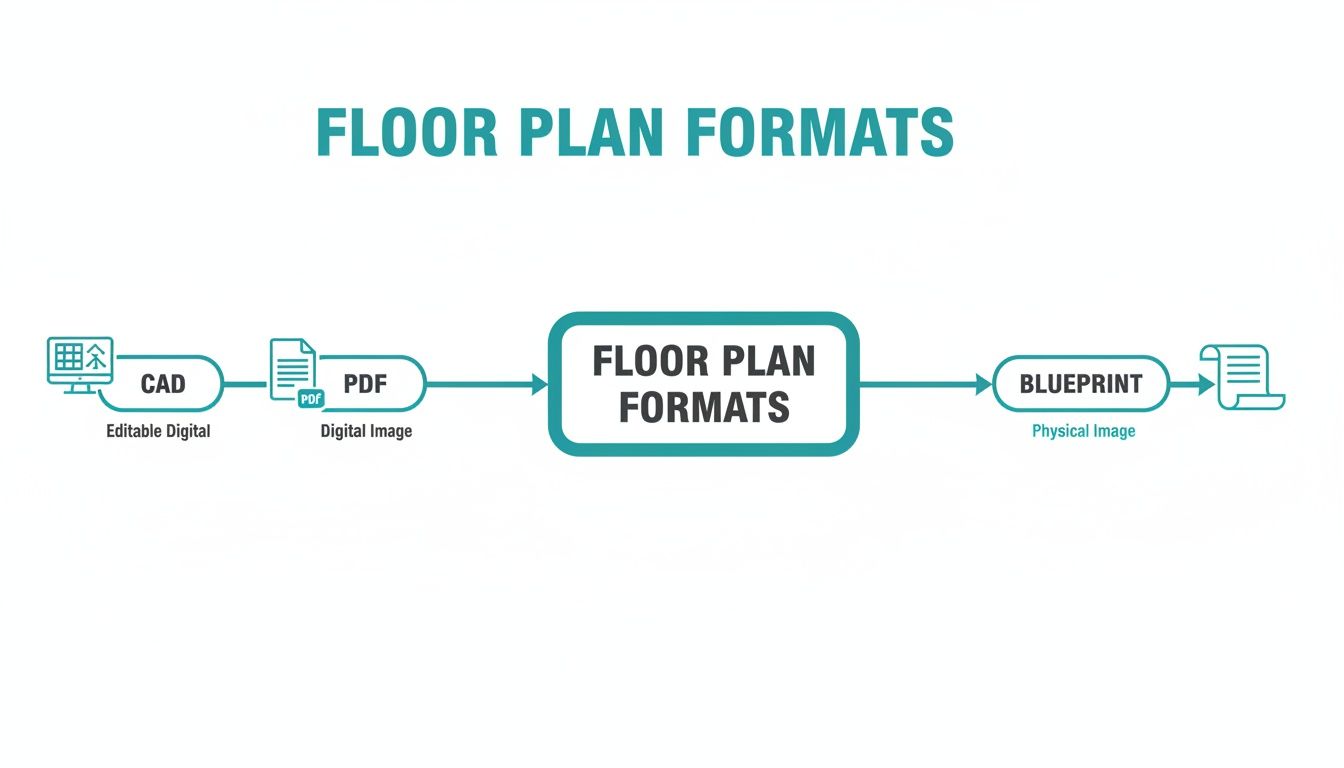
From static paper blueprints to dynamic CAD files, each format holds the architectural DNA that a digital navigation system like Waymap translates into a user-friendly experience.
The Clustered Village or Hub Design
Newer shopping centers often feel more like a village or cluster. This design breaks the mall into smaller, themed districts connected by open plazas and walkways. You might find one area for luxury fashion, another for family entertainment, and a third for dining, each with its own distinct atmosphere.
This approach is great for encouraging exploration and can make people want to stay longer. But its sprawling, non-linear nature makes it the most difficult layout to navigate by far. Without clear, constant guidance, it's easy to feel lost and miss entire sections of the mall simply because you couldn’t find your way to them.
The history of UK shopping centers provides a perfect real-world example of these challenges. When the Bull Ring in Birmingham first opened in 1964, its multi-level floor plan was ahead of its time. As it grew over the decades to its current size, its complexity ballooned. Navigation in large, complex venues is a well-documented challenge for many visitors.
This is where solutions like Waymap become so important. By providing precise, audio-guided directions via a smartphone, we can turn potential frustration into a smooth journey. You can learn more about how these pioneering mall designs have evolved by reading these insights from Historic England.
The Strategic Role of Amenities
It’s not just about the main layout; the placement of amenities is another crucial piece of the floor plan's psychology.
- Food Courts: These are often on upper levels or in central atriums, pulling people up and through the entire venue.
- Restrooms: They're strategically placed as convenient stopping points, but rarely near the main entrances, which encourages you to travel deeper into the mall.
- Elevators and Escalators: Their location dictates the vertical flow, funneling visitors towards specific, high-value areas.
Each layout is a trade-off between intuitive navigation, operational efficiency, and commercial exposure. While architects design these spaces for an ideal flow, the reality for many visitors—especially those with disabilities, pushing strollers, or who are simply in a hurry—is often confusion. This is precisely the gap that hardware-free digital wayfinding fills, making any layout, no matter how complex, easy and stress-free to navigate.
Meeting Accessibility Mandates and Regulatory Compliance

An effective shopping center floor plan does far more than just guide shoppers from A to B; it fulfills a fundamental duty of care. In the UK, the Equality Act 2010 makes it a legal requirement for service providers to make "reasonable adjustments" so people with disabilities aren't at a significant disadvantage. This duty goes way beyond simply installing a ramp and an accessible toilet.
For a shopping center, true compliance begins with the bones of the building—the layout itself. A space that looks great on paper can, in reality, create significant barriers for visitors. A confusing, multi-level shopping mall floor plan can quickly turn what should be a simple shopping trip into a stressful and exhausting challenge for many people.
And it isn't just about physical access. True inclusivity is about considering the entire visitor journey, from the moment someone arrives until they leave.
Beyond Ramps and Elevators
It's a common mistake to think about accessibility only in terms of physical structures. While features like ramps and elevators are absolutely vital, they're only one piece of the puzzle. A genuinely welcoming environment has to account for a much wider spectrum of human needs.
Consider some of the less obvious barriers that can be built right into a floor plan:
- Corridor Width: Are the walkways genuinely wide enough for a wheelchair user, a mobility scooter, or someone with an assistance animal to get through comfortably, especially during busy times?
- Cognitive Load: How much mental effort does it take just to get around? Maze-like layouts, poor signage, and a lack of clear landmarks can be overwhelming for visitors with neurodiverse conditions like autism or anxiety.
- Sensory Overload: Bright, flashing lights, constant loud announcements, and a cacophony of background noise can create an unbearable environment for people with sensory sensitivities. Providing designated quiet rooms is a crucial reasonable adjustment.
At Waymap, we believe accessibility is not a feature to be added later; it is a core operational principle that begins with how a venue’s space is mapped and managed. A floor plan is the starting point for creating an environment where everyone feels confident and welcome.
The evolution of UK shopping centers highlights this challenge perfectly. Early malls often had an intuitive flow with a central atrium, but many modern centers have become vast, sprawling complexes that can be disorienting. Given the number of people with disabilities, the need for better navigation has never been clearer. You can dive deeper into this design history by reading about how Britain's shopping centres have changed over time.
The Commercial Case for Inclusivity
While meeting legal duties is non-negotiable, the rewards of creating a genuinely accessible venue go much further. When a shopping center is easy and stress-free for everyone to navigate, it unlocks significant commercial benefits.
By designing for inclusivity from the ground up, you can:
- Expand Your Customer Base: The collective spending power of disabled people and their families—often called the "purple pound"—is substantial. An accessible venue is one that attracts and retains this valuable market.
- Enhance Your Reputation: A real commitment to inclusivity builds a powerful brand and fosters goodwill in the community, addressing a major component of modern Environmental, Social, and Governance (ESG) goals.
- Increase Dwell Time and Spend: It's simple: when visitors feel comfortable, confident, and unstressed, they stay longer, explore more shops, and ultimately spend more money.
Looking at your shopping mall floor plans through an accessibility lens isn't just about checking boxes. It reveals opportunities for improvement that make the experience better for every single person who walks through your doors. It turns the legal duty of care from a simple checklist into a powerful strategy for operational excellence and commercial growth, ensuring your venue isn't just open to all, but truly welcoming to all.
Bringing Your Floor Plan to Life With Digital Wayfinding
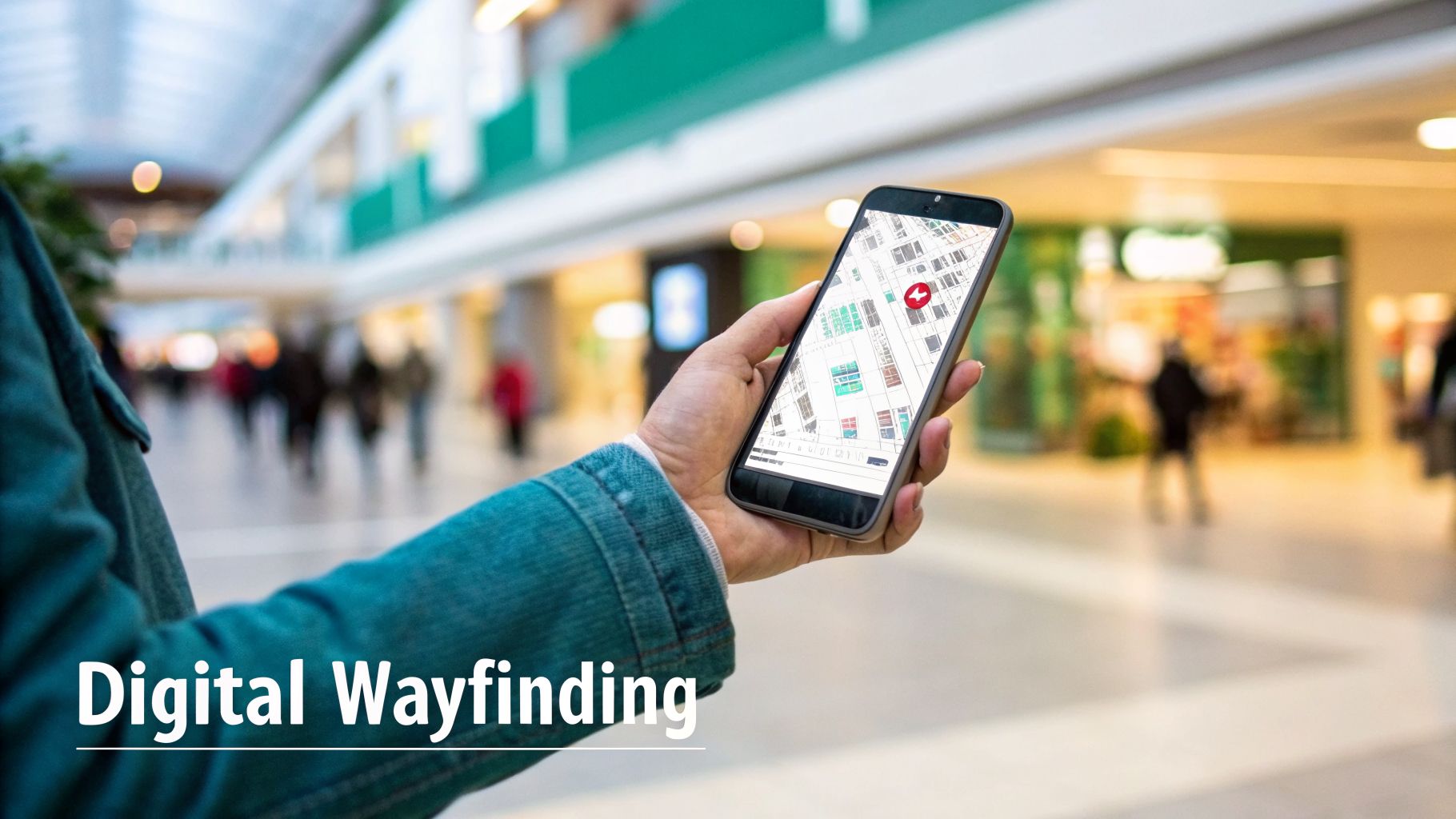
A floor plan, whether it’s a CAD file on a server or a paper blueprint in a drawer, is just a snapshot. It’s an excellent architectural record of how a shopping center was designed, but it’s completely disconnected from the bustling, ever-changing reality of the building itself.
This is the fundamental gap we need to bridge. The solution lies in turning that basic shopping mall floor plans file into an intelligent, interactive digital map. It’s a process that brings a static drawing to life, transforming it into a powerful tool for both visitors and your operations team.
At Waymap, we do this by creating a highly accurate "digital twin" of your venue. But our approach to getting there is very different from what you might be used to.
A Hardware-Free Approach to Navigation
Most indoor navigation systems depend on a network of physical hardware. They often require installing hundreds of Bluetooth beacons or attempting to use patchy Wi-Fi signals to estimate a user's location. This traditional model comes with serious drawbacks.
Not only are these systems expensive and disruptive to install, but they also create a constant maintenance headache. Beacons fail, get moved, or have their signals blocked. The result is an unreliable experience for shoppers and a persistent problem for your operational teams to solve.
We built Waymap to be completely hardware-free. Our proprietary algorithm doesn't need beacons, Wi-Fi, or even a GPS signal to function. It uses the motion sensors already inside every smartphone—the accelerometer and gyroscope—to provide highly accurate, step-by-step audio guidance.
This method delivers a far more reliable and scalable solution. By eliminating the dependence on external hardware, we remove a major point of failure and drastically reduce the total cost of ownership for venue managers. You can dive deeper into the tech behind this in our guide to indoor positioning systems.
The Benefits for Venue Managers and Operations Teams
Adopting a software-first, hardware-free wayfinding solution gives you a host of advantages that go well beyond just helping a lost shopper. It completely changes how you manage your space.
Instant Map Updates: When a tenant moves out or a pop-up shop arrives for the weekend, you can’t afford to wait for signage to be updated. Our system lets you update the digital map instantly, so visitors always have the correct information.
Reduced Reliance on Physical Signage: Static signs are costly to produce, install, and change. A dynamic digital map reduces this dependency, saving money and ensuring your navigation is never contradictory or out of date.
Access to Anonymized Visitor Flow Data: Understanding how people actually move through your center is invaluable. Our platform provides anonymized data on footfall patterns, popular routes, and potential bottlenecks, giving you the insights to optimize layouts and boost efficiency.
This data-driven approach means you can make smarter decisions about tenant placement, marketing, and where to put amenities, all based on real-world behavior. Of course, this must all be done while keeping regulatory standards in mind, from accessibility to safety. For example, the principles behind OSHA compliant floorplan design offer good insight into creating safe environments in large commercial spaces.
From Static Document to Living Asset
Ultimately, this is about a shift in perspective. A shopping center floor plan shouldn't be a fixed document filed away in an office. It should be treated as a living, breathing asset that you can actively manage to drive your business goals.
By embracing a hardware-free digital wayfinding solution, you create a more resilient, adaptable, and visitor-friendly environment. It’s a system that not only meets the immediate needs of your visitors but also provides the long-term operational intelligence needed to thrive. This is how you truly bring your floor plan to life.
Turn Your Floor Plan Into an Operational Advantage
So far, we’ve tracked the journey of a shopping mall floor plan from its origins as a static blueprint to its potential as the living heart of your venue’s day-to-day operations. We’ve seen how different layouts can guide visitor behavior, and how the right digital tools can connect architectural design with real-world experience.
Here’s the key takeaway: a confusing layout, lost visitors, and the pressure to meet accessibility rules aren't separate problems. They are all different aspects of the same challenge. The way forward isn't to patch each issue individually, but to find a single, unified solution that addresses them all at once.
From a Headache to a Strategic Asset
This is exactly where Waymap comes in. We turn your floor plan from a source of operational headaches into a real strategic advantage. We do more than just put a blue dot on a map; we give you a complete operational edge.
Our technology was built from the ground up with visually impaired users in mind. This "accessibility-first" approach means our navigation achieves a level of precision that other systems simply can't match. When you design for the highest possible standard, everyone benefits.
A system precise enough to guide a blind user to a specific door is more than capable of guiding any visitor to any shop, restroom, or exit with complete accuracy. This is the core of our philosophy—truly inclusive design creates a superior experience for every single person who walks through your doors.
The Compelling Business Case
Investing in an intelligent navigation system isn't a cost center. It's a direct route to business growth and smarter operations. The case for it is straightforward and benefits multiple areas of your business.
- A Better Visitor Experience: When people can find their way around easily, they feel more relaxed. They stay longer and are far more likely to explore new areas. This has a direct link to increased dwell times and, ultimately, higher retail spending.
- Meeting Your Accessibility Duties: By providing a genuinely accessible environment, you’re not just complying with the Equality Act 2010; you're protecting yourself from legal risks and boosting your reputation as an inclusive destination. It's a significant plus for your Environmental, Social, and Governance (ESG) credentials.
- Lower Total Cost of Ownership: Our unique hardware-free model means you don't need to install or maintain expensive beacons or upgrade your Wi-Fi. This translates to quicker setup, lower upfront costs, and a huge reduction in ongoing operational spend.
It’s time to stop seeing your floor plan as just a static document. It’s an untapped opportunity. It holds the key to a better visitor experience, stronger compliance, and smoother operations. With the right technology partner, you can unlock that potential, turning your venue into a place that’s genuinely welcoming for everyone.
Your Big Questions on Mall Floor Plans, Answered
When you're running a shopping center, floor plans aren't just lines on a page; they're the blueprint for your entire operation. We often get asked how to bring those plans to life, especially when faced with older documents or the unique challenges of a busy retail space.
Let's tackle some of the most common questions we hear.
What If We Only Have Old Blueprints or PDFs?
This is a situation we encounter frequently, and it’s not the barrier you might think. While modern CAD files are a great starting point, they're not a necessity. Our mapping experts are experienced in working with whatever you have.
Think of your old blueprints or PDFs as the first layer. We can use high-quality scans of those documents to build a brand new, highly accurate digital map from the ground up. It’s a meticulous process, but the result is a perfect “digital twin” of your venue, ready to provide precise navigation. The quality of your original files doesn't limit the quality of the final product.
How Do You Handle Constant Tenant Changes on the Map?
Keeping maps current with tenant turnover is a classic headache for operations teams. Static signs are expensive and slow to update, leading to visitor frustration when they can't find a new shop or are directed to one that has closed. This is exactly where a dynamic digital system excels.
With a simple, secure management portal, your own team has the power to make instant updates. A new store opens? A pop-up appears for the weekend? An elevator is out of service? You can reflect that change in moments. The update goes live instantly for every visitor using the app, ensuring the information they have is always correct.
How Can Navigation Work in Basements or Areas with No Signal?
This is the very problem Waymap was designed to solve. We know that GPS is useless indoors, and relying on Wi-Fi or Bluetooth beacons is a recipe for unreliable, patchy coverage—not to mention a maintenance challenge.
Our technology is completely different. It works without any external signals at all. Instead, it uses the motion sensors already built into every smartphone – the accelerometer and gyroscope. By combining the data from those sensors with our highly accurate digital maps, we can deliver step-by-step audio directions that are precise enough to guide someone through the most complex, multi-level buildings, even with zero phone signal. It guarantees a smooth journey for every single visitor.
Ready to see your floor plans as more than just a document, but as a powerful tool for improving your visitor experience and your bottom line? At Waymap, we build hardware-free, ultra-accurate indoor navigation that works everywhere, for everyone.
