
Inside Dubai Mall: Navigate the World's Largest Centre
Meta description: Inside Dubai Mall is less about choosing attractions and more about reliable navigation through a vast, multi-level centre. This guide explains how to get around, where wayfinding breaks down, and why accessibility matters.
Walking inside Dubai Mall can feel less like entering a shopping centre and more like stepping into an indoor city. You may know exactly where you want to go. The aquarium, the ice rink, Fashion Avenue, the cinema, or the Metro link. The problem usually isn't destination choice. It's getting there without doubling back, missing a level change, or losing confidence halfway through a crowded concourse.
That's why a useful guide to inside Dubai Mall needs to do more than list attractions. It needs to explain movement. For visitors, that means understanding where routes become confusing and why some journeys feel longer than they should. For venue operators, it means recognising that navigation isn't just a convenience layer. It affects accessibility, dwell patterns, congestion, and whether people can use the space as intended.
The Overwhelming Scale of an Indoor City
A first visit often starts the same way. You enter with a rough plan, spot a directory, orient yourself for a moment, then realise your destination is not just “ahead”. It's across a huge interior, possibly on another level, with several decision points between here and there.
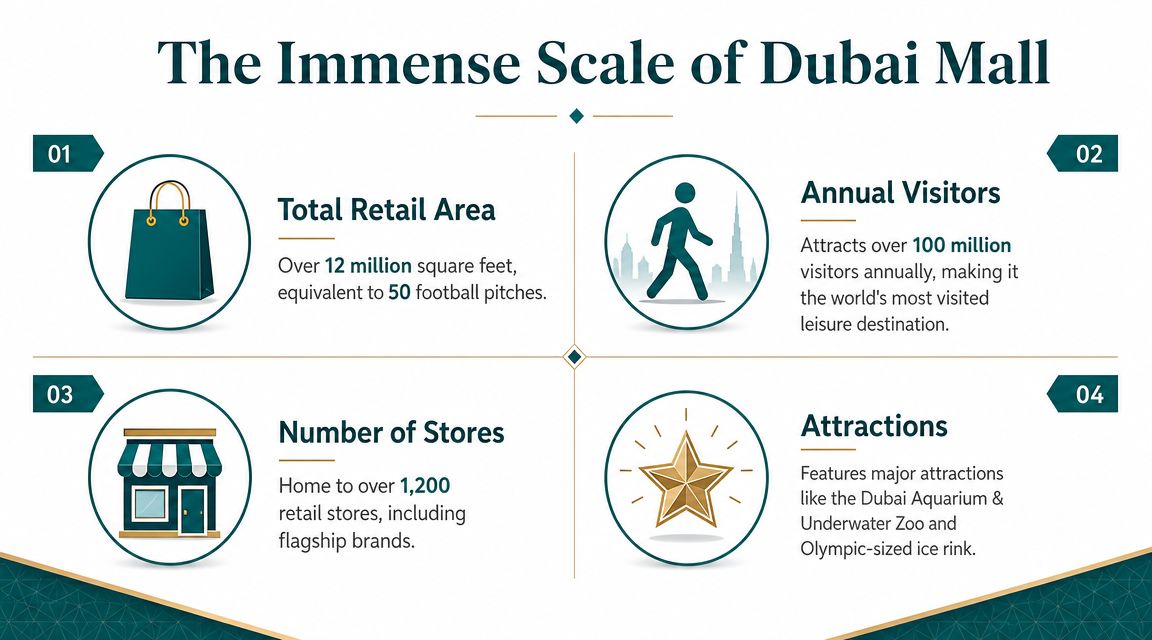
That reaction is justified by the scale. Dubai Mall opened on 4 November 2008 and has grown into one of the world's largest retail complexes, with about 1,200 retail outlets, more than 160 food and beverage outlets, four levels, and an internal floor area of 548,127 m² (5.9 million ft²). Guinness World Records identifies it as the largest shopping centre by total area in its record category, which is the right starting point if you want to understand why wayfinding is such a serious operational issue inside the building (Guinness World Records on Dubai Mall).
Why the scale changes the visitor experience
In a conventional shopping centre, people can usually recover from a wrong turn quickly. In a venue this large, a small mistake compounds. An escalator takes you to the wrong side of a level. A landmark looks closer than it is. A corridor leads to luxury retail when you were trying to reach family attractions. You're still inside the same building, but the walk behaves more like urban travel.
That matters for families, tourists, older visitors, wheelchair users, and anyone trying to keep to a timetable. It also matters for operators studying flow, leasing, and signage strategy. Large venues often focus on attraction density and tenant mix. The harder problem is route clarity.
What operators can learn from a centre this large
Dubai Mall is a strong benchmark for other major venues because its scale exposes where static wayfinding starts to struggle. A floor plan may be accurate and still not be useful in motion. That's one reason mall operators looking at shopping centre floor plans and visitor navigation increasingly treat mapping as an active service layer rather than a fixed asset.
For retail teams thinking about layout, adjacencies, and circulation, the broader discussion around retail growth strategies is useful because growth inside major destinations depends on how people move, not just what brands are present.
Practical rule: In a mega-venue, “near” is a misleading word. Visitors need route confidence more than they need another attraction list.
Why Is Navigating a Mega-Mall So Difficult?
The hard part of navigating a mega-mall isn't its footprint alone. It's the number of decisions the building forces on you while you're moving. A visitor rarely walks in a straight line from entrance to destination. They move through level changes, sightline interruptions, crowd clusters, retail distractions, and partial landmarks.
Multi-level buildings break simple mental maps
Building an internal map is swift when a place is legible, typically featuring one entrance, one corridor, one anchor store. Dubai Mall doesn't behave like that. It has multiple levels and distinct zones with their own character, so a direction that seems obvious on a flat map can fail in practice once vertical movement enters the journey.
A common mistake is trusting a 2D plan too directly. If the destination appears directly above or beside your current location on a screen, that doesn't mean the route connection is immediate. The actual path may depend on finding the right escalator bank, the right lift, or the correct side of an atrium. That's where the familiar “blue dot” model starts to frustrate people. Seeing your approximate location isn't the same as understanding how to continue, especially in a building with complex geometry and indoor signal limits. Wayfinding teams exploring this issue in depth should look at why blue-dot navigation often falls short indoors.
Dense visual environments create cognitive overload
Dubai Mall is designed to be stimulating. That works for retail theatre. It doesn't always work for orientation.
Visitors process a lot at once:
- Storefront competition: Every frontage wants attention, so visual hierarchy gets crowded.
- Architectural variety: Distinct zones help branding, but they can also interrupt route continuity.
- Crowd movement: People don't just occupy space. They block sightlines and pull others off course.
- Destination overlap: Retail, dining, entertainment, and transit sit within the same envelope.
In smaller venues, overhead signs can restore order. In mega-venues, the sign may be visible but still not sufficient. The visitor then does what people always do when confidence drops. They slow down, stop abruptly, consult a phone, ask staff, or follow the crowd.
Indoor navigation fails when context is missing
A direction such as “go straight and turn left” only works if the user knows what counts as straight, and which left matters. In a wide concourse with branching paths, kiosks, barriers, and multiple vertical connectors, that instruction is too thin.
Better wayfinding doesn't just tell people where they are. It tells them what matters next.
That's why navigation inside Dubai Mall is difficult even for experienced travellers. The building asks for real-time judgement, not just route recall. For visitors, that's tiring. For operators, it's a sign that signage alone won't carry the load.
How Current Wayfinding Technology Addresses the Challenge
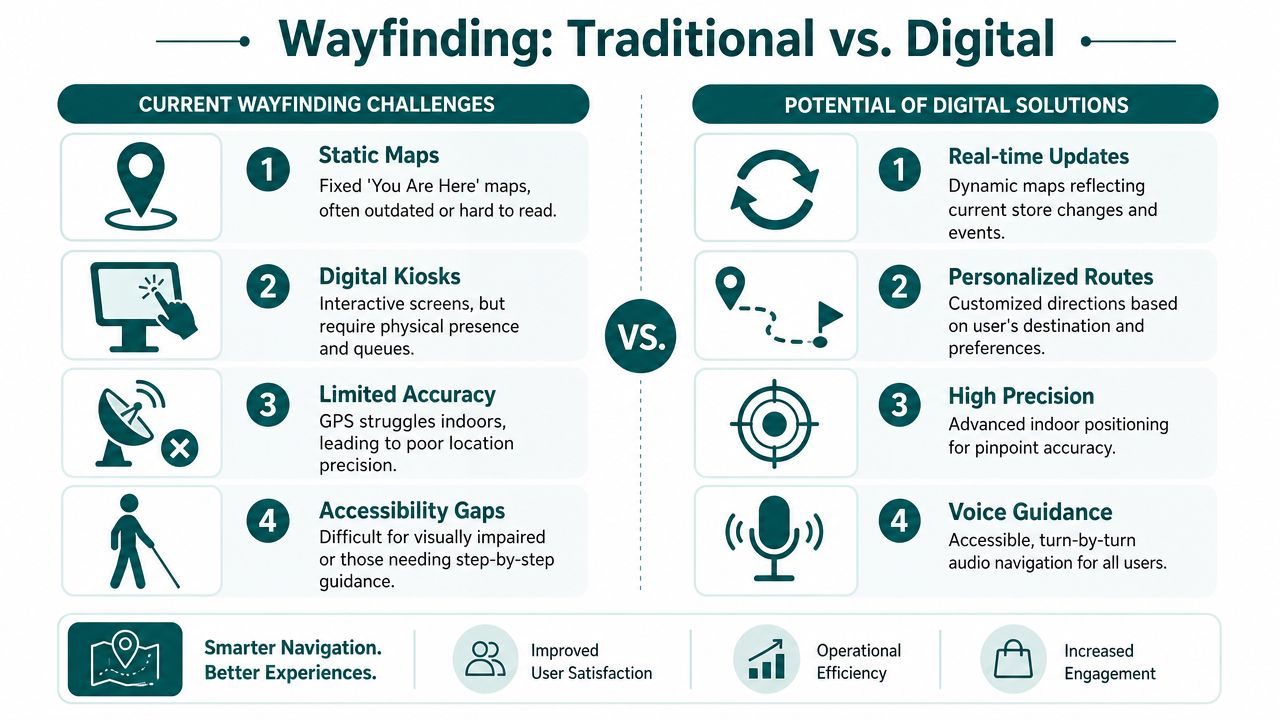
Most large malls rely on a stack of wayfinding tools rather than one complete system. Overhead signs provide broad orientation. Digital kiosks help with search. Printed or on-screen maps support planning. Mobile navigation adds a personal layer when it works.
Each tool solves part of the problem. None solves all of it.
What the standard tools do well
Static signage still matters. It handles reassurance, confirms district names, and helps with emergency information. Digital kiosks are useful when a visitor is stationary and wants to search for a store or attraction. Human staff remain important for exceptions, especially when someone has a detailed question or needs route adaptation.
That said, these tools share a weakness. They usually interrupt movement. A visitor has to stop, interpret, memorise, and then continue. In a busy retail environment, that's a fragile process.
Where digital positioning improves the experience
Independent case-study material on Dubai Mall reports that beacon-based positioning can update a shopper's smartphone location twice a second, while also surfacing traffic patterns and dwell time for operators (Dubai Mall beacon case study). That refresh rate matters because indoor navigation needs to keep pace with real movement, especially around escalators, attraction entrances, and fast-changing retail edges.
For visitors, that can mean route guidance that feels much more responsive than a static map. For operators, it adds a second value layer. The navigation system becomes a source of behavioural insight, not just guest assistance.
A useful operational comparison looks like this:
| Tool | Visitor benefit | Operational drawback |
|---|---|---|
| Static signs | Immediate reassurance | Limited personalisation |
| Kiosks | Searchable information | Requires stopping and queuing |
| Beacon-based mobile guidance | Frequent position updates | Depends on installed hardware |
The trade-off most venue teams run into
The weakness of beacon-based systems isn't conceptual. It's operational. Hardware has to be installed, monitored, maintained, and kept aligned with the venue's changing reality. In a very large shopping environment, that adds a layer of estate management many teams underestimate at procurement stage.
That burden gets heavier when layouts evolve, units change hands, or footfall patterns shift. The guidance may be good. The maintenance model may still be awkward.
Language support is another practical detail. Dubai receives an international mix of visitors, so route guidance often intersects with multilingual support. For visitor-facing teams dealing with spoken queries, tips for seamless Arabic English conversations can be a useful operational aid alongside navigation tools.
A Journey-Based Guide to Key Zones and Attractions
The most useful way to understand inside Dubai Mall is by thinking in journeys, not categories. People rarely arrive saying, “I want the retail district.” They say, “How do I get from the Metro link to the aquarium?” or “What's the clearest route from the cinema to the Souk?”
Dubai Mall positions itself as an international retail and lifestyle destination with over 100 million visitors a year, more than 1,200 stores, major attractions including the aquarium and an Olympic-size ice rink, plus direct access to Dubai Metro via the Link Bridge (Dubai Mall about page). That mix is exactly why route planning matters. Visitors are not moving within a single retail loop. They're switching between transit, leisure, dining, and shopping.
From the Metro link to the Dubai Aquarium
This is one of the most common first-time visitor journeys. The transit connection makes arrival straightforward. The handoff from transit to indoor destination-finding is where people can lose time.
Use this route logic:
- Enter with a destination fixed early. Don't wait until you're deep inside the main circulation areas to decide where you're going.
- Confirm the level before the route. Many wrong turns start with a correct district but the wrong floor.
- Treat major attractions as anchors, not shortcuts. You may be able to see a landmark before you can reach it directly.
If you're planning ahead, a Dubai Mall map focused on practical movement is more useful than a simple attraction roundup.
From a main entrance to Fashion Avenue
This route often looks easier than it is because the environment feels premium and open. In practice, open sightlines can be deceptive. A destination that appears close may require a curved approach or a change in level.
What usually works:
- Follow district identity, not brand recognition. Flagship stores can distract from the actual circulation path.
- Use escalators with intent. Don't take the first visible vertical connector unless you've confirmed it serves your route.
- Pause at junctions, not mid-flow. If you need to recheck your direction, step aside before doing it.
From the cinema to the Souk or dining zones
People often run into route ambiguity, as entertainment areas and dining clusters generate lingering traffic. Families pause, groups split, and the walking line becomes inconsistent.
If a route crosses entertainment, food, and retail traffic at once, assume it will feel slower and less legible than the map suggests.
A quick visual walkthrough can help before you travel deeper into the centre:
A better way to plan your visit
Instead of organising your trip by “things to see”, group destinations by likely path overlap. For example, pair transit-connected arrivals with nearby anchor attractions. Pair dining with the zone you'll already be walking through. Avoid unnecessary backtracking across levels.
That approach reduces fatigue and makes the mall feel far more manageable, even when it's busy.
What Are the True Accessibility Barriers Inside Dubai Mall?
The biggest accessibility mistake in large venues is assuming that step-free means accessible. It doesn't. Lifts, ramps, and wide entrances matter, but they don't answer the core question many visitors face: can I reliably reach the place I need to get to?
That gap is especially obvious inside Dubai Mall. Much of the public discussion focuses on attractions, luxury retail, and scale. Far less attention goes to the practical problem of moving through a complex, multi-level environment if you are blind, low-vision, using a wheelchair, or pushing a buggy.
Step-free is only one part of navigability
A wheelchair user may have an accessible route in theory but still face long, indirect paths to lifts, congested transition zones, and uncertainty at key junctions. A pushchair user often encounters the same friction. The route exists, but it isn't necessarily clear or efficient.
For blind and low-vision visitors, the barrier is sharper. Visual spectacle can become visual noise. Large atriums distort acoustic cues. Staff directions may be well meant but vague. “Go past the big store and turn near the café” isn't dependable when the environment is crowded and landmarks repeat.
A practical checklist for venue teams includes:
- Vertical movement: Are step-free routes easy to find before a user reaches a staircase or escalator?
- Decision points: Do route instructions distinguish between similar-looking junctions?
- Temporary disruption: Can visitors still find their way when crowding or pop-up activity changes normal flow?
Why this matters well beyond one mall
The UK relevance is direct. An estimated 16 million disabled people live in the UK, and the Equality Act 2010 places duties on service providers to anticipate access needs rather than waiting for complaints, as reflected in the accessibility framing discussed in this Dubai Mall attractions article that highlights the navigation gap.
That's important because major venues often treat accessibility as a facilities issue. In practice, it is also a navigation issue, a service design issue, and a reputational issue. If a visitor can enter the building but can't travel through it with confidence, the environment is only partially accessible.
The underserved user problem
The overlooked question isn't “what's accessible inside Dubai Mall?” It's “can different users reach any point of interest reliably when signage and crowding fail?”
That's the standard operators should test against. It's also why broad mall mapping matters. A venue map is only useful if it supports real movement, which is why thinking about maps in malls as an accessibility tool is more productive than treating them as a decorative directory.
Accessibility in a mega-venue starts at the route, not the ramp.
How Infrastructure-Free Technology Solves Indoor Navigation
The operational challenge in a place like Dubai Mall is clear enough. Visitors need guidance that works while they move. Operators need a system they can maintain without turning navigation into a hardware estate project.
That's where infrastructure-free indoor navigation changes the equation.
What infrastructure-free actually means
Instead of depending on Bluetooth beacons, Wi-Fi triangulation, or GPS, this approach uses the phone's own motion sensors and mapped routes to determine movement through the building. In Waymap's case, that means dead reckoning from device-native sensors, with sub-3-metre accuracy in infrastructure-free environments and no pre-mapping requirement for venues dealing with frequent change, according to the publisher information provided for this article.
That combination matters in malls because layouts, tenant fronts, and temporary activations change. A system that avoids installed hardware reduces operational drag for estates, facilities, and digital teams.
Why venue teams prefer less hardware
There are several reasons infrastructure-heavy deployments become difficult over time:
- Maintenance ownership is messy. Someone has to monitor batteries, failures, and exceptions.
- Retail environments change often. Navigation logic must keep up with refits, closures, and temporary layouts.
- Capital approval is harder than software approval. Installed hardware can trigger a different procurement path.
For accessibility and ESG leaders, there's another factor. Compliance obligations under frameworks such as the Equality Act 2010 and standards such as BS 8300 are easier to address when navigation can be updated quickly instead of waiting for a physical refresh cycle.
What this looks like in practice
Waymap has been deployed in named public environments including Westfield London, where the relevance is obvious. Large, busy, mixed-use retail spaces don't just need digital maps. They need reliable door-to-door guidance that works in signal-poor conditions and supports blind and low-vision users as well as the general public.
A venue team comparing approaches should ask three practical questions:
| Question | Hardware-based answer | Infrastructure-free answer |
|---|---|---|
| How much must be installed? | Physical estate required | No installed navigation hardware |
| Who maintains it? | Facilities and technical teams | Primarily map and service management |
| How quickly can it adapt? | Slower when hardware changes are involved | Faster when updates are software-led |
For operators evaluating this model, the reliability, scalability and maintenance case for infrastructure-free wayfinding is the core commercial argument, not just the technical one.
Frequently Asked Questions About Navigating Dubai Mall
How do you get around inside Dubai Mall efficiently?
The most efficient approach is to plan by journey, not by attraction list. Pick your next destination before you start walking, confirm the level first, and avoid unnecessary backtracking across major concourses.
Is inside Dubai Mall hard to navigate for first-time visitors?
Yes, it can be difficult for first-time visitors because the centre is large, multi-level, and busy. The challenge usually comes from route decisions inside the building rather than from finding out what attractions exist.
What is the best entrance for Dubai Mall?
The best entrance depends on your destination. If you're arriving by public transport, the Metro connection is the most logical starting point, while other entrances may make more sense if your priority is a specific retail or dining zone.
Can wheelchair users move around Dubai Mall?
Dubai Mall includes step-free features, but practical movement still depends on route clarity. The main issue is often not whether a lift exists, but whether the step-free route to it is obvious, direct, and workable in crowd conditions.
Is Dubai Mall accessible for blind or low-vision visitors?
It can be challenging for blind and low-vision visitors because large indoor spaces rely heavily on visual cues. In a crowded, visually dense environment, signage alone often doesn't provide enough support for reliable independent navigation.
How long does it take to walk between major attractions inside Dubai Mall?
Walking time varies by route, level changes, and crowd conditions. Two destinations that look close on a map may involve a longer real journey if the route depends on a specific escalator, lift, or corridor connection.
Does GPS work properly inside Dubai Mall?
Indoor GPS is often unreliable in large enclosed venues. That's why visitors commonly need a combination of mall signage, digital maps, and more specialised indoor navigation tools.
Why does indoor navigation matter so much in a mega-mall?
Indoor navigation matters because the user problem is movement, not discovery. In a venue this large, people don't just need to know what is available. They need confidence that they can reach it.
If you're responsible for accessibility, visitor experience, or digital wayfinding in a large venue, Waymap shows how precise indoor navigation can work without GPS, Wi-Fi, or installed hardware, while supporting blind and low-vision users alongside the wider public.

