
Dubai Malls Map: A Guide to Smart Indoor Navigation
Navigating a Dubai mall can feel like exploring a small city. With sprawling floors and thousands of shops, finding a simple, effective way to get from point A to point B is key to a good day out. This guide breaks down the different maps you’ll encounter and introduces a better way to find your way around.
Why Traditional Dubai Mall Maps No Longer Work
Dubai's mega-malls are impressive. Venues like The Dubai Mall or Mall of the Emirates are more than just shopping centers; they're massive entertainment hubs. But their sheer scale is also their biggest challenge—one that traditional maps can’t seem to solve.
For most of us, a visit starts with a sense of wonder that can quickly turn into confusion. You find yourself squinting at a static directory board, trying to memorize a route with four different turns, only to get lost after the first one. It’s a familiar feeling, and it highlights the gap between these complex spaces and the basic tools we're given to navigate them.
The Limits of Standard Navigation
Even the digital maps on our phones have their own set of problems. They’re great for getting a general idea of the layout, but they often let you down when you need them most. The usual issues with conventional mapping tools include:
- Signal Loss: GPS wasn't built for the indoors. The moment you walk through the doors, the concrete and steel block the signal, meaning that "blue dot" on your screen becomes wildly inaccurate, if it shows up at all.
- Lack of Detail: A simple floor plan can't tell you about a temporary shop closure, a pop-up event blocking your path, or the best accessible route that avoids a flight of stairs.
- Information Overload: Trying to follow a tiny line on a small screen while dodging crowds and strollers is more distracting than it is helpful.
This screenshot of The Dubai Mall on Google Maps shows the problem perfectly. You get a sense of the enormous scale, but that's about it.
While it’s a great bird's-eye view, its ability to give you real-time, step-by-step directions inside the building is limited due to indoor positioning problems.
The heart of the issue is simple: a map designed for cars on open roads doesn't work in a multi-level, labyrinthine shopping center. A truly useful Dubai malls map has to be precise, reliable, and simple to use, whether you have a signal or not.
This guide will walk you through the mapping options currently available and explain how new infrastructure-free technology is creating a much smoother and more inclusive experience for every visitor.
Your Guide to Dubai Mall Navigation: What Works and What Doesn't
Stepping into one of Dubai's colossal shopping centers, the map you choose can be the difference between a great day out and a frustrating hunt for a single store. Not all navigation tools are created equal; each has its own quirks, benefits, and very real limitations.
To get around, you have four main options. You can use the classic static directories, download a PDF map, try your luck with a standard GPS app, or download the mall’s own official app. Let's look at what you can expect from each.
This chart sums up the visitor's journey. Get it right, and you're a happy shopper. Get it wrong, and you're looking for an information desk in a sea of people.
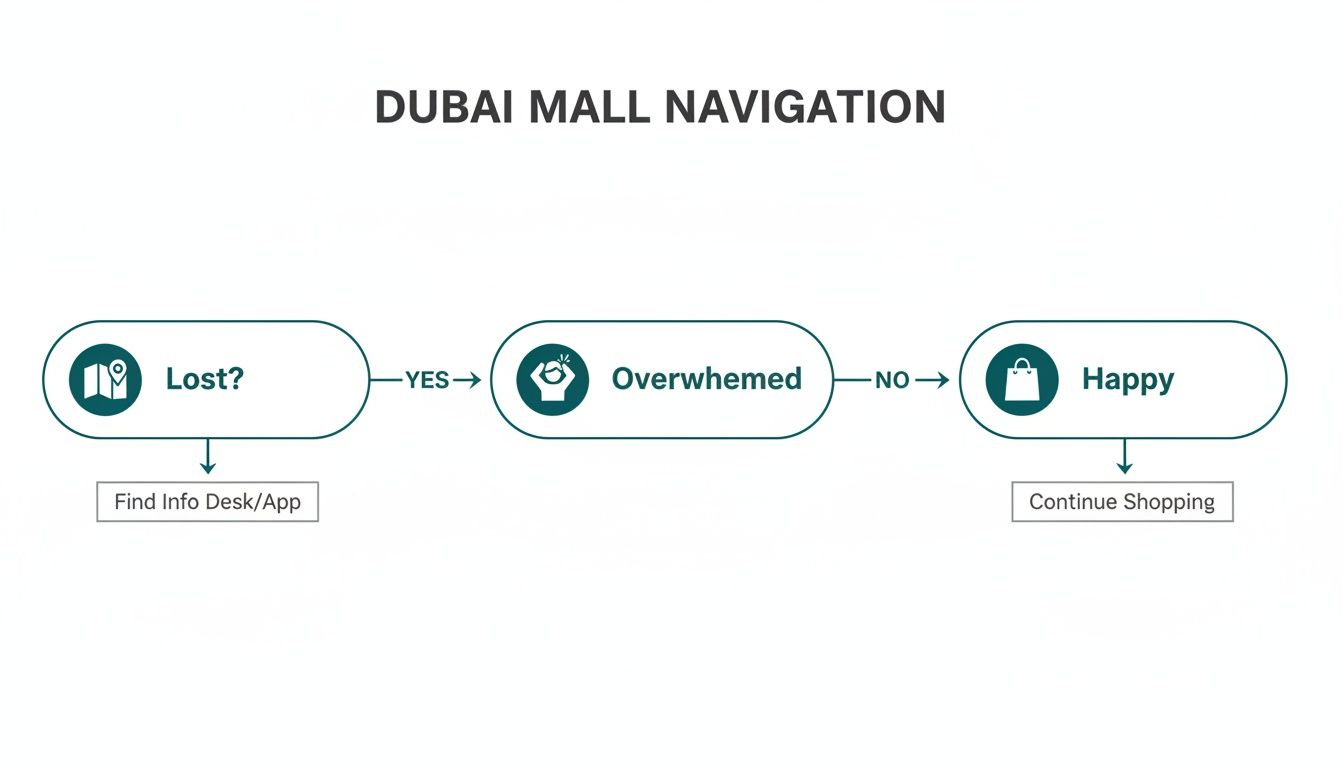
It highlights a simple truth: when you feel lost, the experience sours fast. That’s why getting wayfinding right is so important.
To give you a clearer picture, here’s a quick comparison of the most common tools you'll find.
Comparison of Dubai Mall Navigation Tools
| Map Type | Key Features | Best For | Common Limitations |
|---|---|---|---|
| Static Directories/Kiosks | Large, illuminated boards at key points. | Getting a quick, big-picture view of the mall layout. | Static information; requires memorizing the route. |
| Downloadable PDF Maps | Digital floor plan on your device. | Pre-planning your trip before you arrive. | Not interactive; doesn't show your live location. |
| Google/Apple Maps | Familiar interface with indoor layouts. | Finding the general area of a store on a specific floor. | Unreliable GPS signal leads to an inaccurate "blue dot". |
| Official Mall Apps | Interactive maps using Wi-Fi or beacons. | Accessing store-specific offers and directory searches. | Inconsistent location accuracy; requires a separate app download. |
As you can see, each option has its trade-offs. The perfect tool for planning at home isn't the one you want when you're trying to find the nearest restroom in a hurry.
Static Directories and Kiosks
These are the large, glowing maps and touch-screen kiosks you find near entrances and major intersections. They’re the old guard of mall wayfinding.
They're great for a quick glance to get your bearings or to see which zone an anchor store is in. The best part? No phone or data needed.
But their biggest failing is that they’re attached to the wall. You find your store, and then you have to perform mental gymnastics to remember the route. In a place with multiple levels and winding corridors, that’s a tall order.
Downloadable PDF Maps
Many malls offer a PDF map on their website. Think of it as the digital version of the paper brochure they used to hand out.
It’s handy to have on your phone, and it’s genuinely useful for planning your visit from your hotel. You can figure out which entrance to use or map a rough path through your must-visit shops.
The problem is, a PDF is just a static image. It can't tell you where you are, so you’re left trying to match your surroundings to a diagram. Pinching and zooming on a complex map is also a clumsy experience on a phone screen.
Standard GPS Apps Like Google or Apple Maps
Apps like Google Maps and Apple Maps have attempted to map indoor spaces, and you can often pull up a floor plan for large Dubai malls. They even try to give you that familiar "blue dot" showing your location.
The interface is one you already know, which is a huge plus. They’re fine for seeing that a store is somewhere on the first floor.
However, their reliability drops the second you step inside. The GPS signals that power them are easily blocked by concrete and steel, causing the blue dot to drift, jump, or disappear. This makes any kind of turn-by-turn direction a game of chance.
The fundamental issue for most digital maps inside a mall is their dependence on signals that don't work well indoors. Once that signal is lost, your precise location is gone. You're left with a perfect map that has no idea where you are on it.
Official Mall Apps
Most of Dubai’s premier malls have their own dedicated apps. These usually package an interactive map with store directories, special offers, and event listings. To determine where you are, they rely on a network of Wi-Fi hotspots or Bluetooth beacons.
The upside is that these apps are built specifically for the venue, so the content can be rich and up-to-date with the latest promotions. The searchable directory is a definite improvement over a static board.
But accuracy remains a major weakness. Beacon and Wi-Fi positioning can be patchy, with your location jumping around or being off by several meters—enough to have you walk past the shop you were looking for. Plus, you have to download yet another app for a place you might only visit a few times. You can explore more about the pros and cons of different indoor navigation technology in our comparison article.
The Hidden Complexities of Indoor Wayfinding
Ever noticed how the GPS on your phone works perfectly outdoors, but the second you step inside a shopping center, it gives up? It’s a frustratingly common experience, and it points to the single biggest problem in finding your way around indoors.
The culprit? The very materials that make these mega-malls so impressive. All that concrete, steel, and coated glass are fantastic for construction, but they're also brilliant at blocking the weak satellite signals that GPS needs to work. This instantly creates digital ‘dead zones,’ turning your smartphone into a navigational paperweight.
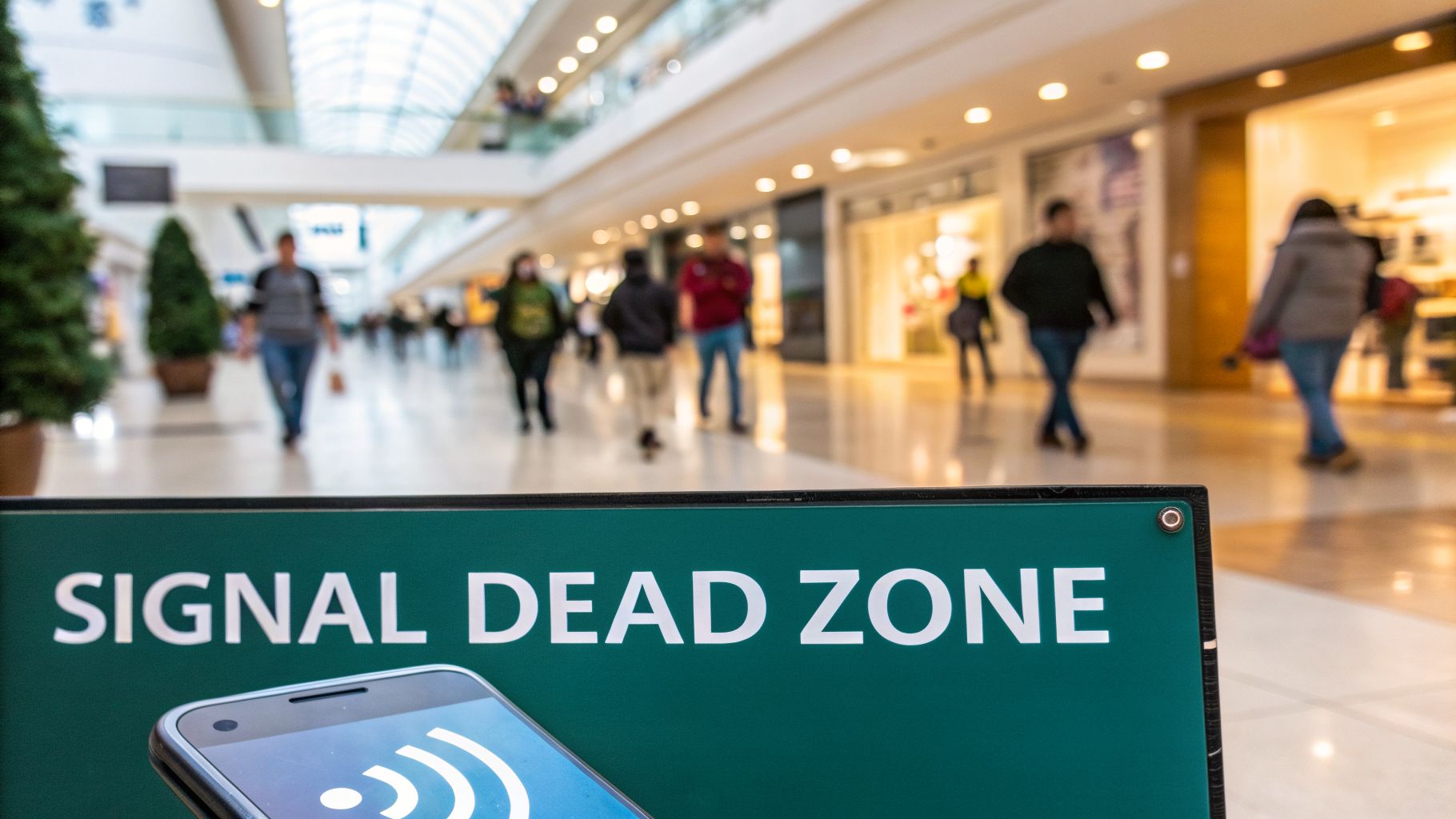
This complete signal loss is the core technical hurdle every indoor navigation system has to clear. It’s precisely why trying to use a standard mapping app on a Dubai malls map so often ends with that maddening, drifting blue dot that has no real clue where you are.
Beyond GPS: The Limitations of Common Fixes
To work around these GPS blackouts, venues have experimented with other technologies, most commonly Wi-Fi positioning and Bluetooth beacons. They’re clever ideas, but each comes with its own drawbacks for both the shopper and the mall operator.
Wi-Fi Triangulation: This approach tries to estimate your location based on the strength of nearby Wi-Fi signals. The trouble is, accuracy is inconsistent. Signals bounce off walls and are absorbed by crowds, often leaving your position off by several meters.
Bluetooth Beacons: These are small, battery-powered devices placed throughout a building. Your phone picks up their signal to figure out where you are. While they can be more precise than Wi-Fi, they require a massive physical network—thousands of beacons in a large mall—and every single one needs its battery changed and maintained.
The bottom line is that these hardware-heavy systems are expensive to install, a headache to maintain, and often deliver a patchy experience for visitors. A single dead beacon can create a new dead zone, and signal drift never quite goes away.
This isn’t just a Dubai problem. In the UK, where shopping centers are major social hubs, these same navigation issues frustrate millions. This is where Waymap’s algorithm comes in, achieving 1-meter accuracy using only the sensors already in a smartphone—no GPS, Wi-Fi, or beacons required. For mall managers, this means the potential to cut signage maintenance costs by up to 50%, since digital maps can be updated instantly for multilingual guidance, which also helps boost ESG scores.
The Human Side of Getting Lost
But the technology is only half the story. We also have to think about the human factors that make navigating huge malls so draining. Even with a perfect map, the environment itself can be disorienting.
Confusing architectural layouts, with their winding corridors, multiple levels, and sprawling floor plans, can disorient anyone. Add overwhelming signage and the sensory overload from noise and crowds, and a simple shopping trip can quickly turn into a stressful experience.
To get to the heart of these hidden complexities, you have to understand core organizational principles like Information Architecture. A space that is well-organized, both physically and digitally, is the foundation of a good visitor journey.
Ultimately, these technical and human-centered challenges show why a smarter solution is needed. A genuinely useful indoor navigation system must be completely independent of unreliable signals, simple for operators to manage, and feel intuitive for every person who walks through the door.
How True Indoor Navigation Changes the Visitor Experience
Think about the last time you were in one of Dubai's enormous malls. You’re surrounded by incredible sights, but you’re staring down at a map on your phone, trying to figure out if you missed a turn. Current mapping tools often turn an exciting outing into a stressful one.
True indoor navigation flips that experience on its head. It’s about feeling as confident finding your way around a massive shopping center as you do walking through your own home.
This is all possible without installing a single piece of new hardware. The technology uses the sensors already built into your smartphone to deliver precise, step-by-step audio directions. No beacons, no hunting for a Wi-Fi signal, and no dead zones where GPS gives up. The result is a ‘heads-up, hands-free’ journey that lets you enjoy the atmosphere instead of being glued to a screen.
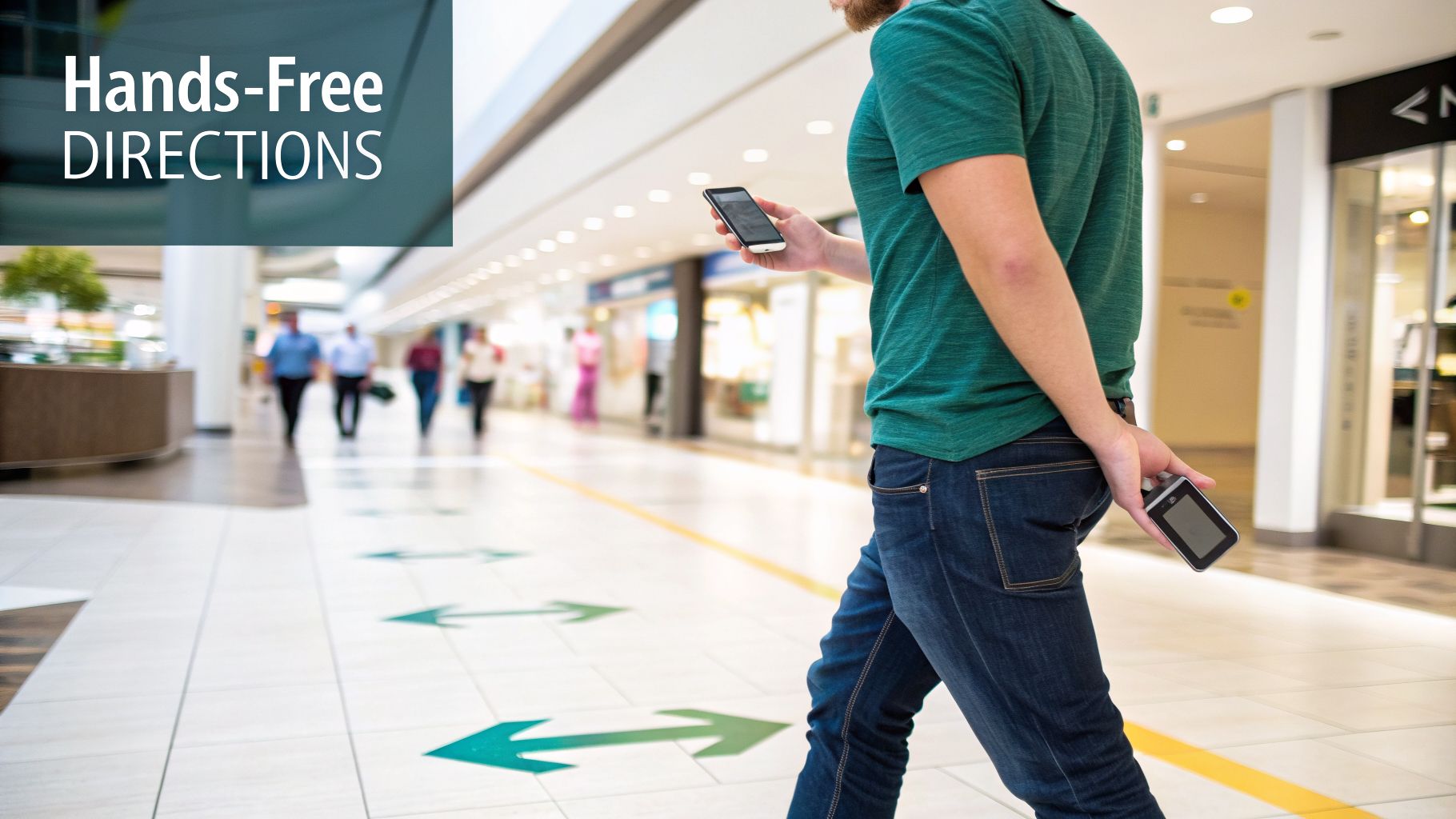
It’s a direct solution to the classic problems of signal loss and confusing layouts. For the first time, visitors can get directions they can actually rely on, turning a potentially frustrating trip into an empowering one.
A Smooth Journey for Every Visitor
A truly smart Dubai malls map isn't just about getting from A to B. It’s about the quality of the journey itself, and that means understanding the different needs of every person who walks through the doors.
A family rushing to find a restaurant before their movie starts needs the most direct route. A tourist searching for a specific luxury brand wants to find it without feeling lost and frustrated. A shopper juggling heavy bags just wants to locate the nearest taxi stand without any hassle.
Proper indoor navigation handles all of this by providing clear instructions that build confidence and cut down on the feeling of being overwhelmed.
The real goal is to make the technology disappear. What’s left is a simple feeling of empowerment. Visitors know they can trust the directions, so they're free to relax and take in the environment—which is the whole point of their visit.
This move from a screen-first to an audio-first approach is crucial. It means people can keep their eyes up, watching the storefronts, their children, and their surroundings. It makes the entire visit safer and far more pleasant.
Redefining Accessibility in Public Spaces
Nowhere is the impact of precise indoor navigation felt more strongly than in accessibility. For millions of people, navigating large, unfamiliar public spaces is a genuine barrier.
We're seeing this play out in the UK, where shopping center managers face similar challenges to those in Dubai. According to Scope, a UK disability charity, 77% of disabled people admit they avoid unfamiliar indoor venues because of poor wayfinding. Waymap's sensor-fusion technology—which uses the phone's gyroscope, accelerometer, barometer, and compass—delivers audio directions that adapt to a person's unique gait and work entirely without external signals. You can learn more about how our technology supports venues on the Waymap website.
This unlocks a new level of independence for many people:
- For visitors with visual impairments: Audio-first directions offer the freedom to navigate a complex mall safely and on their own terms, without needing to ask for help.
- For wheelchair users: The system can automatically create routes that only use ramps and lifts, guaranteeing a journey free of barriers.
- For visitors with cognitive disabilities: Simple, one-step-at-a-time instructions can reduce sensory overload and make a busy environment feel manageable.
By building accessibility into the core of the navigation experience, malls can become truly welcoming spaces for everyone. It’s a powerful way to meet modern ESG (Environmental, Social, and Governance) goals and cement a venue's reputation as an inclusive, forward-thinking destination. Creating that exceptional experience starts with understanding how people move through your space, a topic we cover in our guide to improving shopping mall floor plans.
The Business Case for Smarter Mall Wayfinding
A world-class visitor experience is what every mall strives for, but for operators and facilities managers, any new investment has to make solid business sense. Moving to a smarter wayfinding system is not just a "nice-to-have" for shoppers; it's a strategic move with real, measurable benefits.
The first, most obvious win is eliminating the need for physical hardware. Many older indoor navigation systems are built on a complex web of Bluetooth beacons or Wi-Fi points. These aren't just expensive to buy and install; they become a constant drain on time and money with endless maintenance, battery changes, and troubleshooting.
An infrastructure-free solution sidesteps all of that. By using the sensors already packed inside every visitor's smartphone, the entire layer of costly hardware vanishes. This brings the total cost of ownership down and frees up facilities teams from a major headache, letting them focus on what matters most.
Agility in a Dynamic Retail Environment
The retail world in Dubai is never static. Shops move, new brands appear for a pop-up weekend, and event spaces are constantly rearranged. Trying to keep up with all that change using physical signs is a losing battle.
This is where a dynamic digital map really shines.
- Instant Updates: When a store relocates, you can update the map in minutes, not weeks. Visitors get the right information instantly, which cuts down on frustration and means tenants don't lose valuable foot traffic.
- Temporary Wayfinding: Hosting a seasonal market or a special exhibition? You can create and publish custom routes in a flash, guiding people exactly where you want them to go without putting up a single temporary sign.
- Operational Efficiency: If an area needs to be closed for cleaning or maintenance, the map can reflect that immediately, automatically finding a new route for visitors and avoiding any dead ends or confusion.
This kind of agility means the map in a visitor's hand always matches the reality on the ground—something that is both expensive and practically impossible to achieve with old-school signage.
Enhancing Brand Reputation and ESG Performance
Beyond the numbers on a spreadsheet, a modern approach to wayfinding helps build a stronger, more respected brand. Today, how a company performs on Environmental, Social, and Governance (ESG) metrics is a huge part of its public image and long-term success.
True inclusivity isn't just an add-on feature; it's a core principle. When a venue provides a genuinely accessible navigation tool, it sends a clear message that it truly welcomes every person in the community.
This commitment to accessibility addresses the 'Social' aspect of ESG in a big way. It opens the doors to a group of customers who might have stayed away before because of the challenges of getting around. This isn't just a local issue; UK shopping centers face the same problem. According to research by Purple, navigation difficulties are behind 15% of abandoned shopping trips by disabled visitors.
Precision is key to solving this. Navigation that can achieve 1-meter accuracy without any extra hardware, like Waymap, is what’s needed to close this gap. This focus on inclusive design isn’t just about doing the right thing; it grows the potential customer base and builds incredible loyalty.
By investing in wayfinding that works for everyone, mall operators are making a smart decision for both their community and their bottom line. Find out more about how Waymap can benefit retail venues in our dedicated article.
Building the Accessible and Intelligent Malls of the Future
The next generation of shopping centers is on the brink of a major shift. They’re evolving into fully connected, deeply personal, and truly accessible spaces. At the heart of this change is precise indoor navigation—a technology that moves far beyond a simple Dubai malls map to create a venue that actually responds to its visitors.
Picture this: a shopper gets a notification for a special offer on their favorite coffee just as they’re walking by the café. Or imagine an operations team seeing anonymous, real-time movement patterns and adjusting crowd flow during peak hours to keep things moving smoothly. This is the kind of smart integration that becomes possible when you have an accurate picture of what’s happening in every corner of the building.
Creating a Truly Smart Venue
This isn't just about adding a layer of tech for convenience. It's about building public spaces that are genuinely more inclusive and run more efficiently. An intelligent mall uses technology to improve the experience for both visitors and staff.
This means:
- Data-Driven Operations: When you understand how people move through a space, you can make smarter decisions on everything from cleaning schedules to where you station staff. It’s about putting resources where they’ll have the biggest impact.
- Enhanced Visitor Safety: In an emergency, knowing someone's precise indoor location can help guide them to the nearest exit and give first responders critical, time-saving information. Of course, an intelligent mall must also have comprehensive security systems in place to keep its visitors and assets safe.
- Personalized Experiences: Location-aware services can deliver the right information at the right time. Think directions to the nearest prayer room, or an alert about a flash sale happening in a shop just ahead. It makes every visit feel unique.
When all these elements work together, you get a seamless, stress-free environment for every person who walks through the doors.
At its core, this shift is about building venues that don't just accommodate people, but actively welcome them. It’s about making sure that every individual, regardless of their ability, can explore and enjoy the space with complete confidence and independence.
Dubai's mall operators have a clear opportunity here to set a new global standard. By adopting infrastructure-free technologies that work for every visitor, they can boost their operations, meet ambitious ESG goals, and cement their reputations as world-class destinations.
The future of retail isn’t just about what you sell—it's about the experience you create. The malls that thrive will be the ones that are truly open to all.
A Few Common Questions About Dubai Mall Maps
When you're faced with one of Dubai's enormous shopping centers, a few questions naturally come to mind. Getting the right answers can be the difference between a frustrating day and a fantastic one, so let's clear up some of the common queries about finding your way around.
Which Dubai Mall Has the Best Interactive Map?
Most of the major malls, like The Dubai Mall or Mall of the Emirates, have their own official apps complete with interactive maps. These are generally decent for a quick look at the store directory or checking what events are on.
But when it comes to actually guiding you, their indoor positioning can be hit-or-miss. For truly reliable, step-by-step audio directions that don't depend on an unreliable Wi-Fi or GPS signal, you need a more advanced sensor-based system. A solution like Waymap, for example, delivers a much more dependable and smooth experience for every visitor.
Can I Use Google Maps Inside Dubai Malls?
Yes, you can open Google or Apple Maps in many Dubai malls, but be prepared for significant limitations. You’ll see the indoor floor plans, but that little "blue dot" showing where you are has a habit of drifting, jumping around, or just being wrong.
That's because the structure of the building—all that concrete and steel—blocks the GPS signals these apps need to work properly. So, while they're okay for getting a general sense of things, like which floor a shop is on, they're far from reliable for precise, turn-by-turn directions when you compare them to a dedicated indoor navigation tool.
How Does Better Mapping Improve Mall Accessibility?
This is where advanced indoor navigation truly shines—it’s a major step forward for genuine accessibility. It cuts through the barriers that can make huge, unfamiliar places stressful, or even impossible, for many people to navigate.
A truly smart map isn’t just about directions; it’s about reducing anxiety and building confidence for visitors by offering clear, simple instructions in what can be a complex environment. It’s about making the entire mall genuinely welcoming for everyone, regardless of their ability.
Think about what this means in practice:
- For visitors with visual impairments, audio-first directions give them the freedom to explore a massive mall independently and safely.
- For wheelchair users or parents with strollers, a smart map can instantly plot accessible routes that stick to ramps and lifts, steering clear of any stairs.
Ultimately, this kind of technology helps to create a far more inclusive and enjoyable day out for all.
Ready to make your venue truly navigable for everyone? Discover how Waymap delivers infrastructure-free, step-accurate navigation that enhances visitor experience and boosts operational efficiency. Learn more at Waymap.
