
Hearing Aid Compatibility: Boost Venue Accessibility in 2026
Meta description: Hearing aid compatibility helps venues, airports, stations, stadiums and campuses deliver clearer visitor audio, better service access and stronger inclusive design. Here's how to choose the right mix of loops, Bluetooth and digital navigation.
If you manage a station, stadium, shopping centre or airport, you've seen the problem even when nobody files a complaint. A visitor reaches a ticket counter, gate change screen or boarding area. The public address system is active, people are moving in every direction, and staff are trying to help. But the person in front of you still can't reliably hear what matters.
That isn't a niche edge case. It's a day-to-day operational issue that affects navigation, customer service, queue flow and confidence in the venue itself. Hearing aid compatibility matters because accessibility breaks down fastest in the exact places large venues are busiest, loudest and least forgiving.
At Waymap, we look at this through a practical lens. Venue operators don't need abstract accessibility slogans. They need to know which hearing systems work, where they fail, what standards require, and how to build an experience that still works when announcements are missed, hardware ages, or layouts change.
Why Hearing Accessibility is a Critical Challenge in Public Spaces
A crowded concourse is hard enough for anyone. For a visitor with hearing loss, it can become a chain of small failures that add up quickly. The platform announcement is muffled. The ticket kiosk audio is inconsistent. The member of staff behind glass is audible, but not clear. By the time that visitor reaches the right service point, they're already under strain.
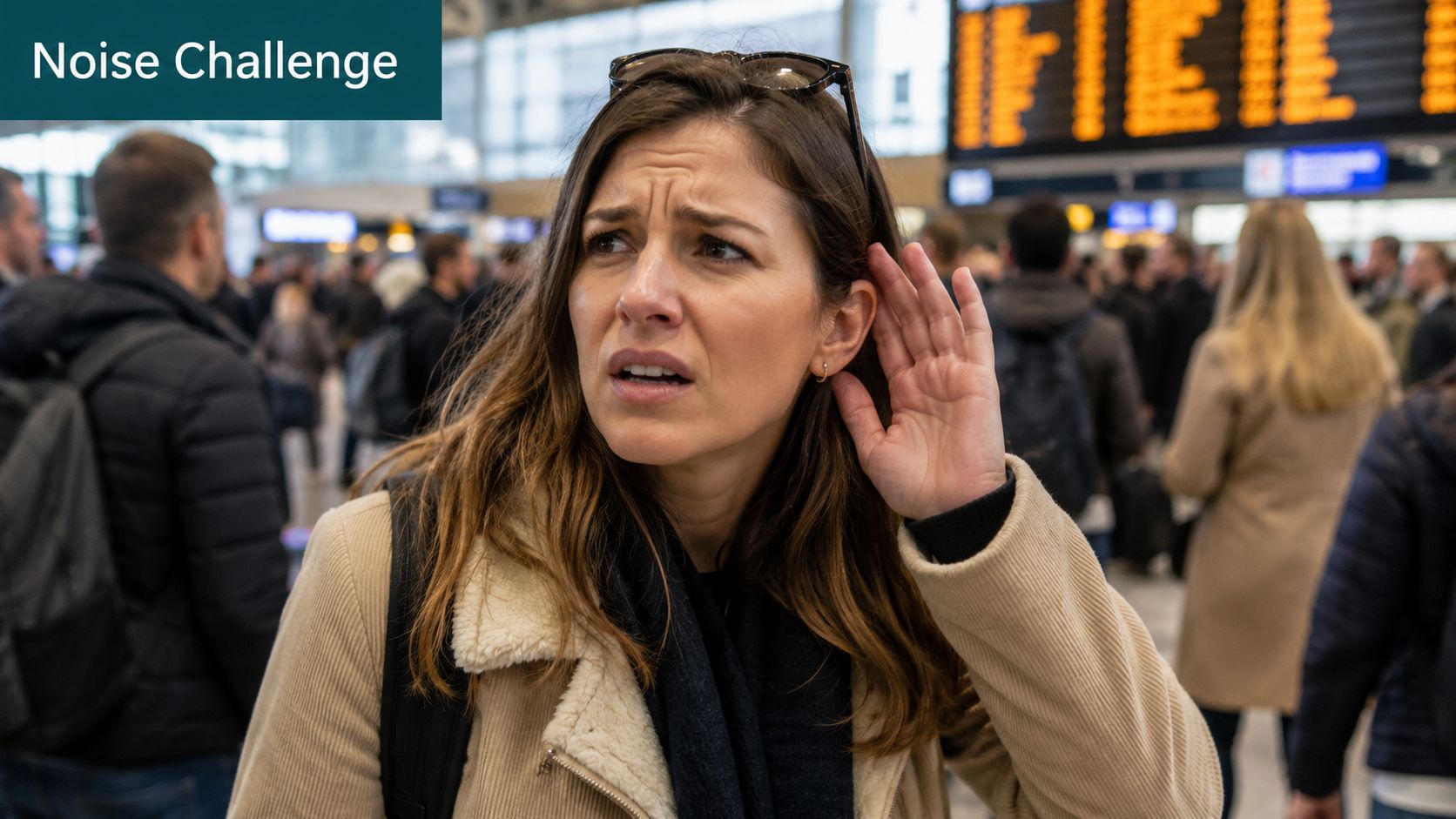
In public environments, hearing access isn't just about volume. It's about clarity at the moment of decision. A loudspeaker can be technically working and still fail the person who most needs it. That's why hearing aid compatibility sits alongside visual signage, staff communication and route guidance as part of a complete accessibility strategy.
Why this affects far more people than most venues assume
The scale is easy to underestimate. In the UK, 96% of hearing aid users report their devices improve their quality of life, yet adoption still lags, and the same market overview notes that the Lancet Commission identified untreated hearing loss as the single largest modifiable risk factor for dementia, which makes accessible technology a public health issue rather than a convenience issue (UK hearing aid market overview).
That has direct consequences for operators. If your venue depends on audible calls, counter interactions or spoken wayfinding, hearing access affects whether visitors can complete basic tasks independently and with dignity.
Operational reality: A visitor doesn't experience accessibility in separate categories. They experience one journey. If hearing fails at any point, the whole journey feels broken.
Where venue teams usually spot the issue first
Managers often notice hearing access problems in the same places:
- Service counters: Glazed screens, background noise and poor microphone discipline reduce speech clarity.
- Transit decision points: Platform changes, gate calls and disruption updates are often delivered fastest by audio.
- Self-service points: Kiosks and tablets may offer audio, but that doesn't mean the audio works well with hearing aids.
- Emergency procedures: Audio-only instructions create obvious risk during incidents. For estates teams reviewing broader inclusion planning, this guide to emergency evacuation for persons with disabilities is a useful companion resource.
Good inclusive design starts before the equipment list. It starts by mapping where hearing is essential to completing a task. That same mindset sits behind inclusive design principles in the built environment, where accessibility is treated as a system, not a bolt-on.
What Is Hearing Aid Compatibility
Hearing aid compatibility means a phone, audio source or public listening system works with hearing aids or cochlear implants in a way that reduces interference and improves usable sound. In practice, that usually means one of two things. Either the device avoids creating disruptive noise for the hearing aid, or it sends a cleaner signal into the hearing aid than the surrounding environment can provide.
Why simple amplification isn't enough
Think about trying to hear one person speaking at a loud concert. Turning everything up doesn't solve the problem. It makes the music louder too. The goal is improving the signal-to-noise ratio, so the voice you need stands out from the noise you don't.
That's why direct audio pathways matter. A hearing aid user often benefits more from a clean, well-coupled signal than from a louder loudspeaker. Venues miss this point when they assume accessible audio just means “increase volume”.
What compatibility usually involves in practice
At venue level, hearing aid compatibility shows up through a few common mechanisms:
- Telecoil coupling: An induction loop creates a magnetic signal that compatible hearing aids can receive on the T setting.
- Acoustic compatibility: A handset or speaker system avoids producing interference and remains intelligible near the hearing aid microphone.
- Wireless streaming: Some hearing aids pair directly with supported phones or accessories over Bluetooth-based systems.
The reason this matters operationally is simple. Different visitors arrive with different hearing technology, settings and confidence levels. A venue that relies on only one path to audio access is usually building in avoidable failure.
Better hearing access doesn't come from one “best” technology. It comes from giving people more than one workable route to the information they need.
Why venue managers should care about the distinction
A counter loop, a compatible handset and a smartphone-connected hearing aid don't solve the same problem. One helps at a fixed location. One helps on a call. One helps only if the user's personal device, operating system and hearing aid all cooperate.
That's the practical definition worth using. Hearing aid compatibility isn't a badge. It's whether a visitor can hear the right information, in the right place, without needing specialist intervention from staff.
Comparing Key Hearing Assistance Technologies
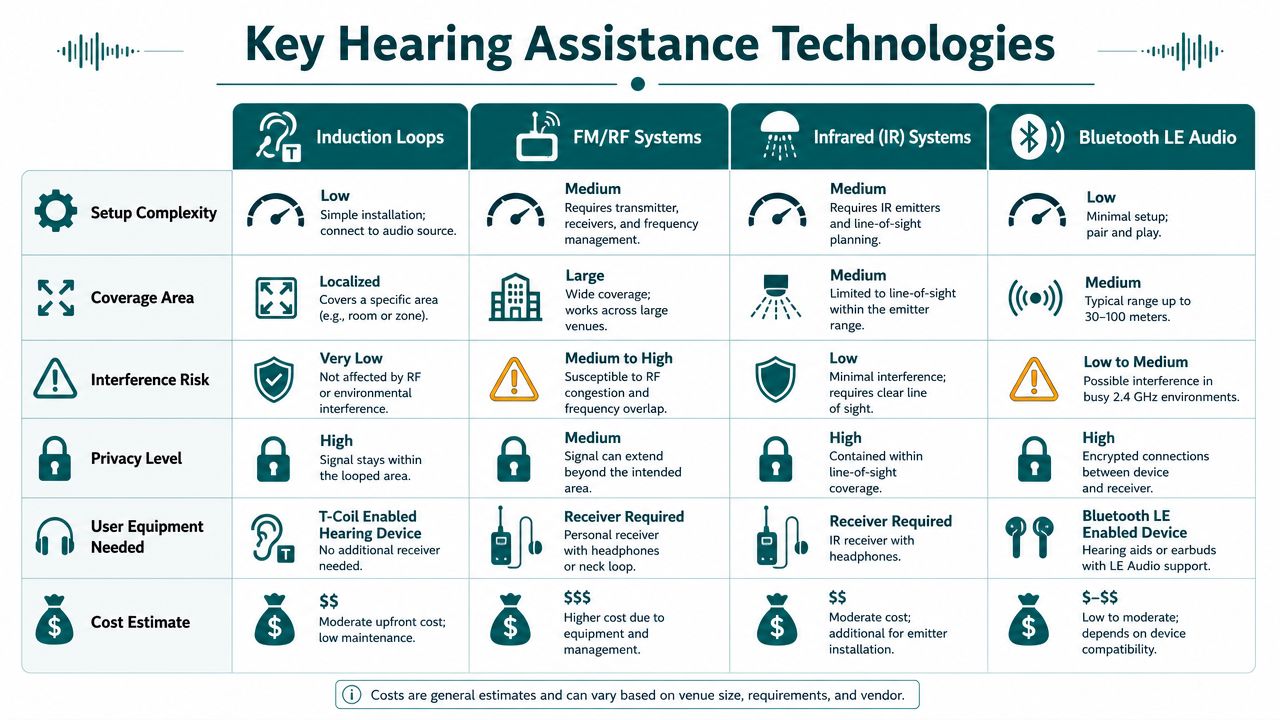
Choosing hearing support for a large venue isn't about chasing the newest feature. It's about balancing universality, maintenance burden, privacy and how people move through the space.
When induction loops are still the strongest public-space option
Induction loops remain one of the most dependable choices for public counters, reception desks, help points and performance spaces. They work well because they don't require the user to borrow extra kit if their hearing aid has a telecoil setting enabled. For high-throughput environments, that matters.
Their weaknesses are familiar to operators too. Coverage is fixed. Installation quality matters. Signage is often poor. Many venues install a loop, then fail to test whether speech is intelligible at the actual user position.
Where FM and similar managed systems fit better
FM or DM-style systems can perform well where staff support is expected and user equipment can be issued, explained and maintained. They're often useful in guided settings such as tours, lectures or assisted service environments.
For open public venues, though, they create friction:
- Collection and return: Users may need to request and wear separate receivers.
- Battery and charging routines: Staff need to own maintenance, not just procurement.
- Hygiene and logistics: Shared equipment adds a service process many front-line teams struggle to sustain.
That doesn't make them wrong. It makes them situational.
Where Bluetooth and MFi help, and where they don't
Bluetooth-based hearing aid connectivity has improved day-to-day personal listening. It's useful for calls, media and some app-based guidance. But operators should be careful not to confuse personal device convenience with universal venue accessibility.
The UK gap is clear. Over 70% of NHS-provided hearing aids in the UK are MFi-enabled, but 55% of UK users report call connectivity failures on non-MFi devices like public transit announcement systems. A 2024 NHS Digital audit also found that 31% of UK smart public kiosks lack MFi compatibility (NHS hearing aids and implants information).
That has two implications for venues:
- MFi is not the same as universal compatibility.
- Public infrastructure can't assume the visitor's own ecosystem will bridge every gap.
Practical rule: If a hearing solution depends on the visitor arriving with the right brand combination, pairing confidence and battery state, it isn't sufficient as your only public-access method.
A quick decision view for venue managers
| Technology | Best for | Strength | Common weakness |
|---|---|---|---|
| Induction loop | Counters, fixed service points, auditoria | Broad compatibility for telecoil users | Fixed coverage and variable installation quality |
| FM or DM systems | Staff-supported events or guided experiences | Controlled audio delivery | Requires issued equipment and staff process |
| Bluetooth or MFi-style streaming | Personal listening on supported devices | Strong for individual device use | Not universal across public infrastructure |
| HAC mobile handsets | Customer service and phone contact | Cleaner call experience on compatible phones | Solves handset use, not whole-venue listening |
For support teams handling accessibility queries, the hard part is often not installation but explaining the mix clearly to visitors and staff. That's where strong end user support processes become part of the accessibility system, not an afterthought.
How Digital Wayfinding Completes the Accessibility Puzzle
A hearing loop can improve speech at a counter. It can't guide someone to the counter in the first place. It can't tell them they've overshot the lift, taken the wrong branch in a concourse, or reached the wrong platform entrance.
That's where digital wayfinding changes the accessibility model. Static hearing systems help at fixed points. Navigation tools help between fixed points, which is where many visitors lose confidence.
Why audio access still fails without route guidance
Large venues often assume that if the help point, counter or gate is accessible, the job is done. It isn't. A visitor may still need to find that accessible point through noise, crowding and route changes. If they miss one spoken instruction, the whole path can unravel.
For hearing aid users, this matters even when their devices work well. Public address systems are broad communication tools, not personalised journey tools. They don't adapt to the person's position, walking speed or wrong turn.
What works better in high-change environments
From an operator's perspective, the strongest navigation layer is one that doesn't depend on extra physical infrastructure across every corridor and interchange. Hardware-heavy systems create familiar problems:
- Maintenance exposure: More installed kit means more inspection, replacement and fault finding.
- Change management: Refits, temporary closures and layout changes quickly date physical setups.
- Operational ownership: Nobody wants a system that sits awkwardly between estates, IT and customer experience.
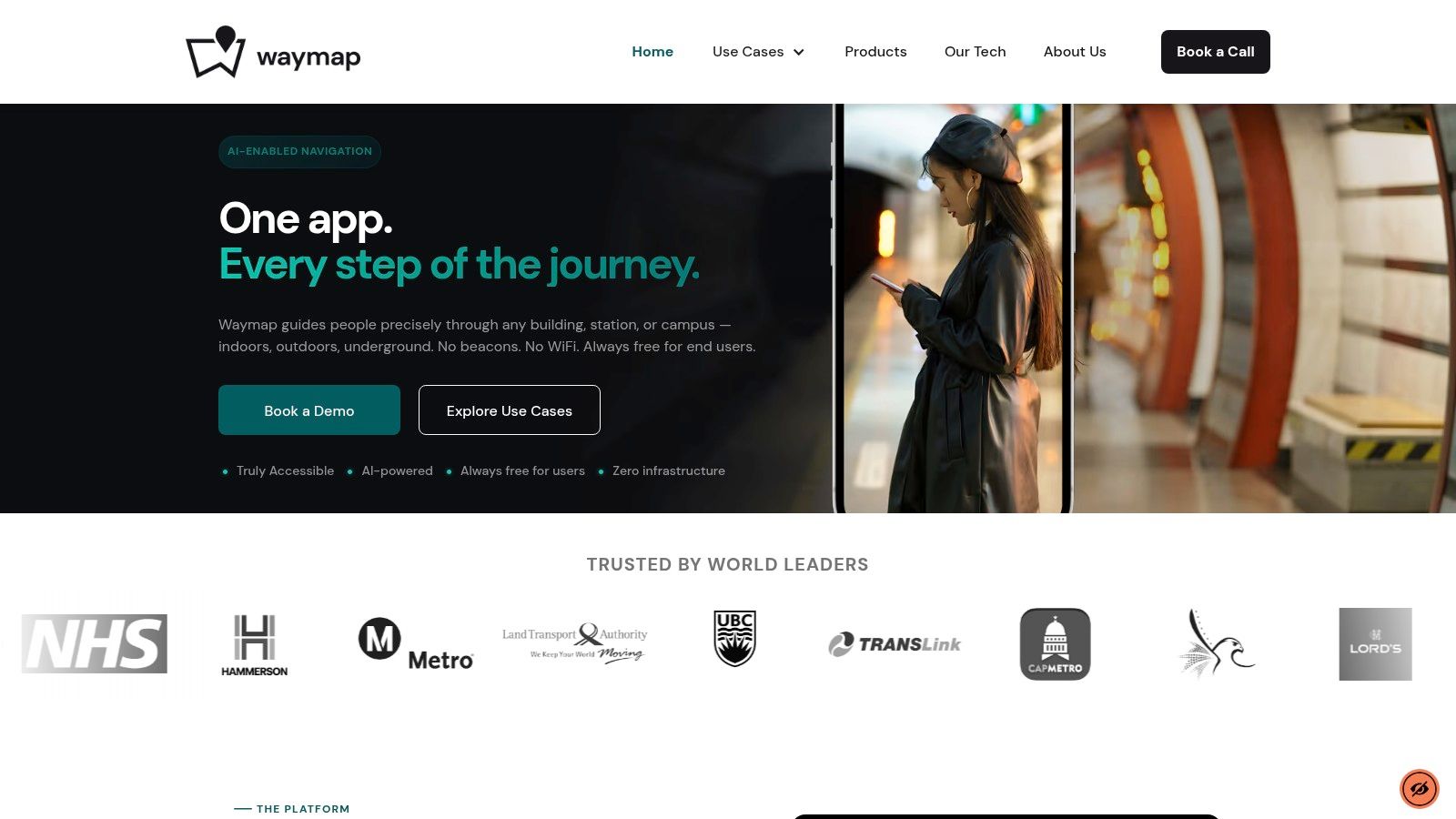
Wayfinding that uses dead reckoning from the phone's native sensors addresses that friction differently. It can provide step-accurate guidance in infrastructure-free environments without relying on Wi-Fi, GPS or beacons. That's particularly useful in signal-poor spaces such as underground networks, large interchanges and complex indoor sites.
Named deployments matter because they show the model works under pressure. In environments such as WMATA, the value isn't just the user interface. It's the ability to support navigation in a large, busy network without adding a maintenance estate of beacons across the system. For operators assessing digital navigation pathways, the practical benchmark is whether the service continues to help people when the environment is crowded, noisy and operationally messy.
Good navigation doesn't replace hearing accessibility. It closes the gap between accessible points, reduces reliance on overheard announcements and helps visitors recover independently when they miss spoken information. For teams assessing this category, a dedicated wayfinding app for complex venues is part of the accessibility conversation, not a separate digital extra.
Meeting UK Legal and Accessibility Standards for Hearing
UK operators don't need to guess whether hearing accessibility belongs on the agenda. The legal and standards framework already points in that direction. The key question is how to turn broad duties into concrete venue decisions.
What the Equality Act 2010 means in practice
Under the Equality Act 2010, service providers and operators are expected to make reasonable adjustments so disabled people are not placed at a substantial disadvantage. In hearing access terms, that usually means thinking beyond standard speech and ambient audio.
A venue that relies on spoken announcements, glazed service points or audio-led self-service should ask a simple question. Can a person with hearing loss complete the same task with a comparable level of independence?
That's a stronger test than “do we have a loop somewhere”.
Why standards matter even when the law stays broad
Technical and design standards such as BS 8300 and BS EN 17210 help translate broad accessibility duties into built-environment practice. They're useful because they push teams away from one-off fixes and towards an end-to-end user journey.
For hearing access, that usually means reviewing:
- Arrival and entry points: Are visitors told clearly where assisted listening is available?
- Service interfaces: Do counters, kiosks and reception points support clear communication?
- Circulation routes: Can visitors still find their way if they don't catch an announcement?
- Fallback options: Is there a second route to the same information?
Compliance is the floor. An equitable visitor journey is the target.
Why digital and physical access need to match
One common failure is to improve the physical venue while leaving digital touchpoints behind. If your booking flow, accessibility information page or visitor instructions are unclear, the site can still fail before the customer arrives. This practical guide to accessibility website design is worth reviewing alongside any physical accessibility programme.
Another legal point matters for operators working with clinical or retail hearing services on site. The UK government states that the clinical function of assessing, testing and prescribing hearing aids is protected, which means only qualified professionals can legally prescribe a hearing aid for sale or use in the regulated context (UK government policy statement on hearing aids). For venues, that's a reminder to focus on environmental accessibility, not on stepping into clinical advice.
Teams planning upgrades often find that hearing access overlaps with wider design obligations. This is where building code compliance for accessible environments becomes useful as a management discipline, not just a project sign-off task.
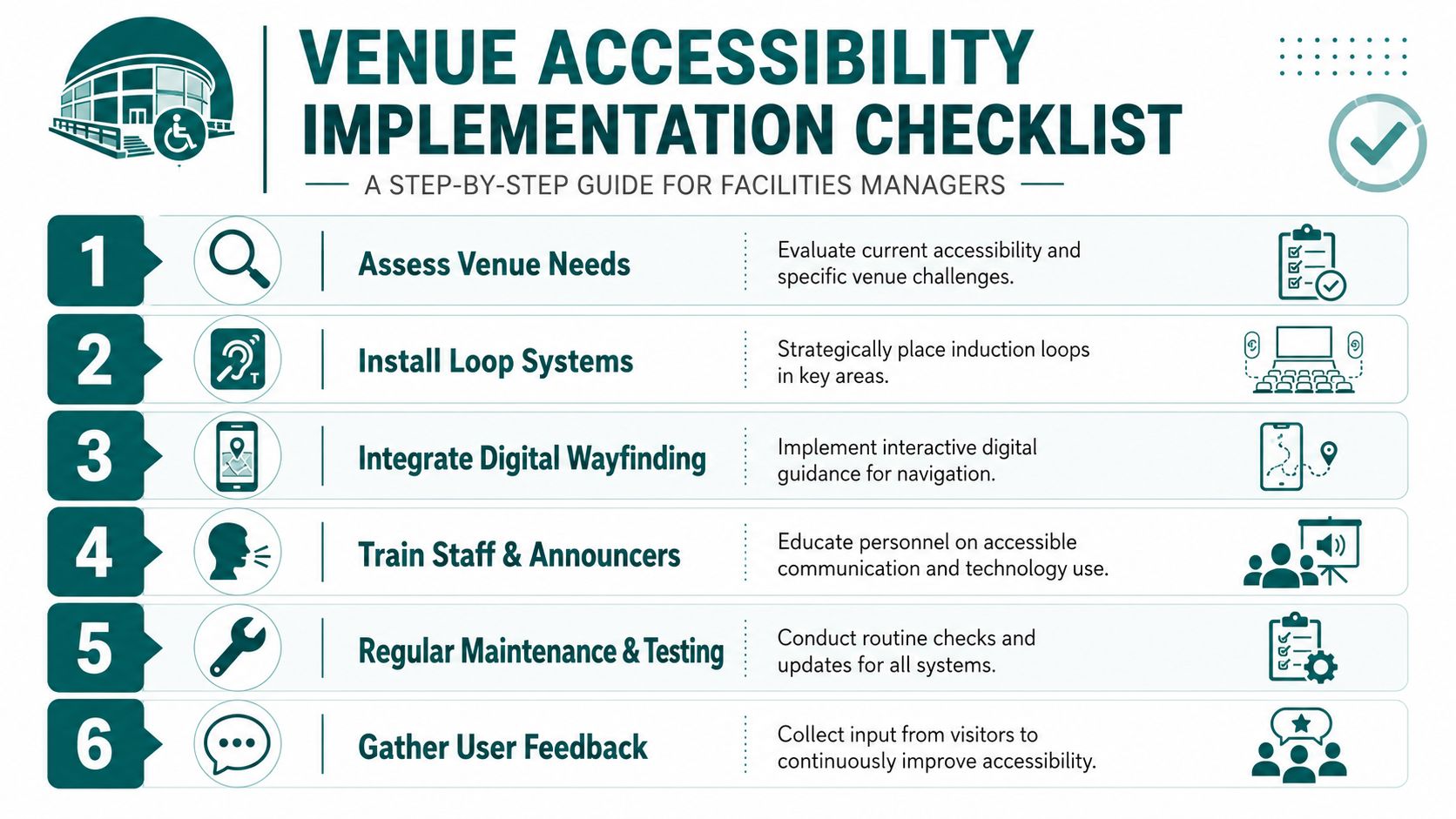
A Practical Implementation Checklist for Your Venue
Most hearing access projects fail in one of two ways. Either the venue buys a single technology and assumes coverage is solved, or it installs the right technology in the wrong places and never tests the lived journey.
Start with an operational audit, not a product shortlist
Walk the venue as a visitor would. Track every point where hearing carries essential information.
Focus on:
- Decision moments: Ticket purchase, platform change, gate call, help request, security process.
- Acoustic pressure points: Reverberant halls, glazed counters, escalator landings, open atria.
- Digital dependencies: Kiosks, tablets, public screens, app-triggered audio points.
A known gap deserves special scrutiny here. A 2023 DCMS report noted that 68% of London transit hubs lack HAC-certified kiosks, and 42% of UK hearing aid users report inconsistent audio clarity on tablets and smartwatches. The same reporting highlights that no UK regulator currently enforces a testing standard for these non-cellular devices (UK non-cellular HAC gap reference). Don't assume a kiosk, tablet or wearable-based interaction is accessible just because its speaker works.
Build a mixed system for different zones
A sensible venue plan usually combines several approaches.
- Use induction loops where people stop and speak. Reception, ticket desks, information counters and fixed assistance points are obvious candidates.
- Use staffed portable systems where interaction is managed. Tours, hearings, classrooms and special events often suit this model.
- Use navigation support where the route itself is the barrier. This matters most in interchanges, campuses and large public buildings.
Test the full journey under real conditions
Commissioning shouldn't happen in a quiet room before opening hours and then be forgotten. Test during live operations.
Check for:
- Speech intelligibility: Not just audibility.
- Signage visibility: If people can't find the loop symbol or instructions, the system may as well not exist.
- Staff fluency: Front-line teams need to explain what is available and how to use it.
- Recovery paths: If one channel fails, can the visitor still complete the task another way?
Ask testers to complete real tasks, not just stand near equipment. The useful question is whether they can buy, find, check, board and ask for help without friction.
Treat maintenance and mapping as ongoing operations
Accessibility systems degrade when ownership is vague. Assign named responsibility across estates, customer experience and digital teams. Then document:
- Inspection routines
- Fault reporting
- Temporary closure updates
- Changes to counters, kiosks and routes
If your venue layout changes often, keep your navigation layer editable and current. Teams managing complex estates should also think about how route data is maintained over time. An effective floor mapping software approach helps prevent accessibility information drifting out of date.
Frequently Asked Questions About Hearing Aid Compatibility
What does hearing aid compatibility mean for a public venue
It means your phones, service points and listening systems work in ways that reduce interference and improve usable audio for people with hearing aids or cochlear implants. In a venue setting, that includes fixed assistive listening systems, compatible handsets and clear alternatives when spoken information alone isn't enough.
Are modern Bluetooth hearing aids enough on their own
No. Bluetooth hearing aids help many people with personal devices, but they don't remove the need for public access systems such as induction loops and clear visual or navigational alternatives. Personal connectivity is valuable, but it isn't universal venue coverage.
Is a hearing aid compatible phone the same thing as a fully accessible audio environment
No. More than 90 percent of wireless handsets sold globally are certified as hearing aid compatible under the 2019 ANSI Standard, but that standard mainly addresses interference control and telecoil coupling for phones, not complete interoperability with every public assistive listening context (AccessWireless hearing aid compatibility overview). A good handset helps on calls. It doesn't solve kiosks, announcements or wayfinding.
Do venues have to install induction loops under the Equality Act
The law doesn't prescribe one single technology in every setting. What it requires is reasonable adjustment and equitable access. In many public-facing service environments, induction loops remain one of the most practical ways to meet that duty well, especially at fixed counters and help points.
How does navigation fit into hearing accessibility
Navigation reduces reliance on overheard information. If a visitor misses an announcement or can't follow broad audio in a noisy environment, clear route guidance helps them recover independently and reach the right place without needing to ask repeatedly for assistance.
If your venue is reviewing accessibility across stations, campuses, hospitals, stadiums or retail destinations, Waymap adds a step-accurate navigation layer that works indoors, outdoors and underground without GPS, Wi-Fi or installed hardware. That helps operators support inclusive journeys while reducing the maintenance burden that usually comes with physical wayfinding infrastructure.
