
Step Change Advice That Actually Transforms Operations
A transport COO watches passenger numbers return, yet complaints keep climbing. A venue director knows visitors struggle to find the right entrance, platform, gate, or accessible route, but the transformation roadmap has sat untouched since the last budget cycle. The board wants a step change, while operations is still managing symptoms through signage, staff intervention, and disconnected systems.
That gap is where most transformation programmes fail. Step change advice only matters when it changes the operating model, survives regulatory scrutiny, and gives frontline teams something practical to run. The strongest route is disciplined: define the operational problem, involve the people who carry the risk, prove one outcome in a controlled pilot, then scale what the organisation can support.
Why Most Transformation Programmes Stall Before They Start
The familiar pattern begins with a polished strategy deck. A vendor demonstrates an impressive product to senior executives, the room agrees that the opportunity is obvious, and a pilot is announced. Then procurement raises a question about ownership, legal asks whether accessibility consultation has happened, operations points out that the proposed test conflicts with shift patterns, and the project disappears into governance.
The problem isn't a lack of ambition. It's the absence of operating detail. Leaders often approve a broad intention without defining the baseline, the accountable sponsor, the affected teams, or the conditions that would justify stopping. A project can look strategically important while nobody owns the daily decisions needed to make it work. The case for replacing legacy systems is strongest when it starts with that operational gap, not with a technology catalogue.
Transformation theatre creates activity, not evidence
Four failure points appear repeatedly:
- No baseline: Teams can't prove improvement because they haven't recorded the current complaint pattern, journey completion rate, dwell time, queue length, or staff intervention required.
- No operational sponsor: An executive may support the idea, but a named leader with budget authority and day-to-day access to operations hasn't accepted responsibility.
- Late regulatory input: Accessibility, safety, union, and legal consultation begins after the design is fixed, turning legitimate concerns into delays and rework.
- Pilot-sized rollout: The test covers too many sites, user groups, or workflows, so it becomes expensive before the organisation learns whether the core intervention works.
A transit or venue transformation touches timetables, control rooms, contractors, union agreements, passenger behaviour, safety procedures, revenue controls, and duties under the Equality Act 2010. That is why a demonstration isn't evidence of operational value. A successful demonstration proves that a product can perform in a controlled setting. A successful transformation proves that people can use it repeatedly inside the existing system of work.
Practical rule: If nobody can name the baseline, the sponsor, the constraint, and the decision that follows the pilot, the programme hasn't started.
The board doesn't need another vision statement. It needs a defensible operating hypothesis, a contained test, and a decision path that procurement, legal, finance, and frontline teams recognise as credible.
What a Step Change Really Means for an Operator
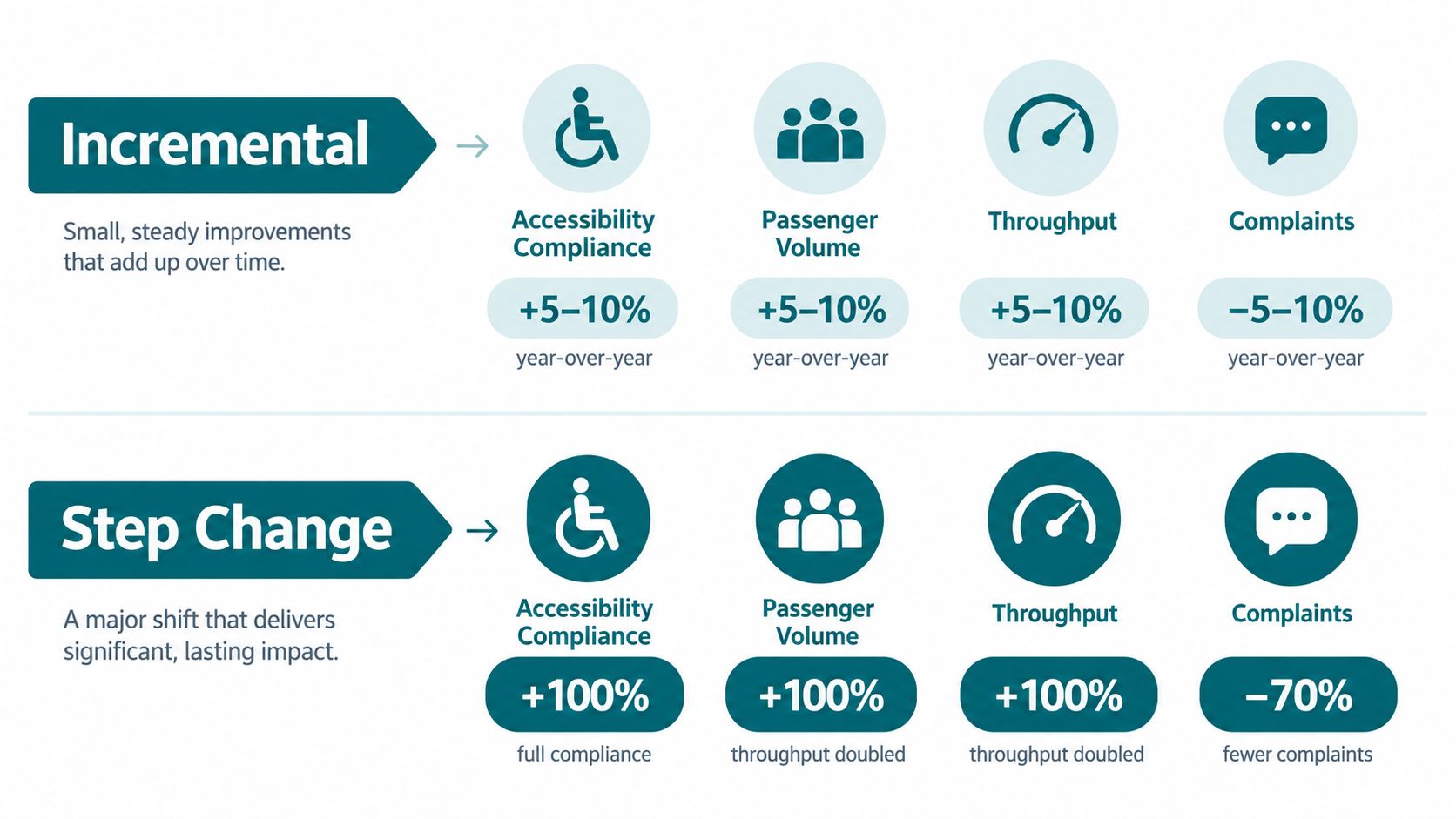
A step change is a new operating baseline, not a small improvement to the old one. It changes the shape of performance by altering how work gets done, how users move through a service, or how staff respond to failure. Continuous improvement makes the existing curve more efficient. Step change advice asks whether the curve itself is still the right model.
That distinction matters because organisations often label any positive movement transformational. A modest reduction in complaints may be useful, but it isn't automatically a step change. A genuine result might involve a major increase in throughput, a substantial reduction in complaint volume, or a material improvement in accessible journey completion within a defined operating period. Those examples are decision thresholds to set during planning, not facts to claim without a measured baseline.
Use a new baseline, not a new slogan
In a station, the difference could be moving from unreliable assistance handoffs to a journey process that consistently takes a passenger from the interchange to the correct platform. In a stadium, it could mean replacing ad hoc directions from stewards with a repeatable wayfinding service that adapts when points of interest or routes change. In a shopping centre, it could mean treating accessible navigation as part of the customer journey rather than as a static map added after the main experience.
A useful definition has four parts:
- A defined problem: For example, passengers lose time locating a step-free entrance, or venue staff repeatedly answer the same route questions.
- A measurable outcome: Select one primary measure, such as completed accessible journeys, queue duration, complaint volume, or staff interventions.
- A named owner: The person must have authority over the process being changed, not just enthusiasm for innovation.
- A new decision standard: The result must be strong enough for the board, regulator, workforce representatives, and service users to understand what changes next.
The label should disappear once the result is established. What remains is a better operating model that teams can defend and maintain.
Planning the Change and Bringing Stakeholders With You
Transport for London's step-free work illustrates the central planning challenge. Providing physical access at a station is important, but an accessible journey also depends on information, assistance, interchange conditions, staff behaviour, and the route between the entrance and the final destination. The Equality Act 2010 makes reasonable adjustments a governance consideration, not a communications afterthought.
The UK evidence reinforces that point. The Motability Foundation reported that disabled people took 38% fewer trips than non-disabled people, a gap that had not changed for over a decade. It also reported that 1 in 5 disabled people were unable to travel because they lacked appropriate transport options, while 40% often experienced issues or difficulties when travelling by train. These figures describe a difference between nominal access and effective access, where the service exists but the journey information or assistance isn't reliable enough. Read Waymap's change management guidance alongside that operational reality, and the implication is clear: design the whole journey, not one accessible asset.
Build the brief around constraints
Start with the evidence already available. Review complaints, assistance requests, incident reports, customer research, staff observations, and existing accessibility audits. Then document the obligations that shape the intervention, including the Equality Act 2010, relevant rail accessibility requirements, and local safety procedures.
Name the sponsor before involving suppliers. The sponsor should be able to convene:
- Operations and control teams, who understand live service conditions.
- Safety and assurance leaders, who identify unacceptable failure modes.
- Union representatives and frontline staff, who know whether the process works across real shifts.
- Disability advisory groups, whose experience should influence the design rather than validate it at the end.
- Procurement, legal, and finance, who need a clear scope and decision route.
The UK Department for Transport's Inclusive Transport Strategy records both progress and limitation. In England, 98% of buses complied with the Public Service Vehicle Accessibility Regulations in 2016/17, compared with 28% in 2004/05, yet only 202 stations provided step-free access, and 75% of rail journeys were not made through step-free stations. The same strategy reported 603 trips per person for people with a mobility difficulty in 2016, up from 569 in 2014, a 5.9% increase. The official strategy shows why asset compliance alone doesn't establish an accessible end-to-end service.
Finish planning with a one-page transformation brief. It should contain the target outcome, baseline, regulatory duties, named constraints, sponsor, stakeholder owners, and a 90-day pilot boundary. That document gives procurement, legal, and operations one definition of success.
Designing a Pilot That Proves the Step Change
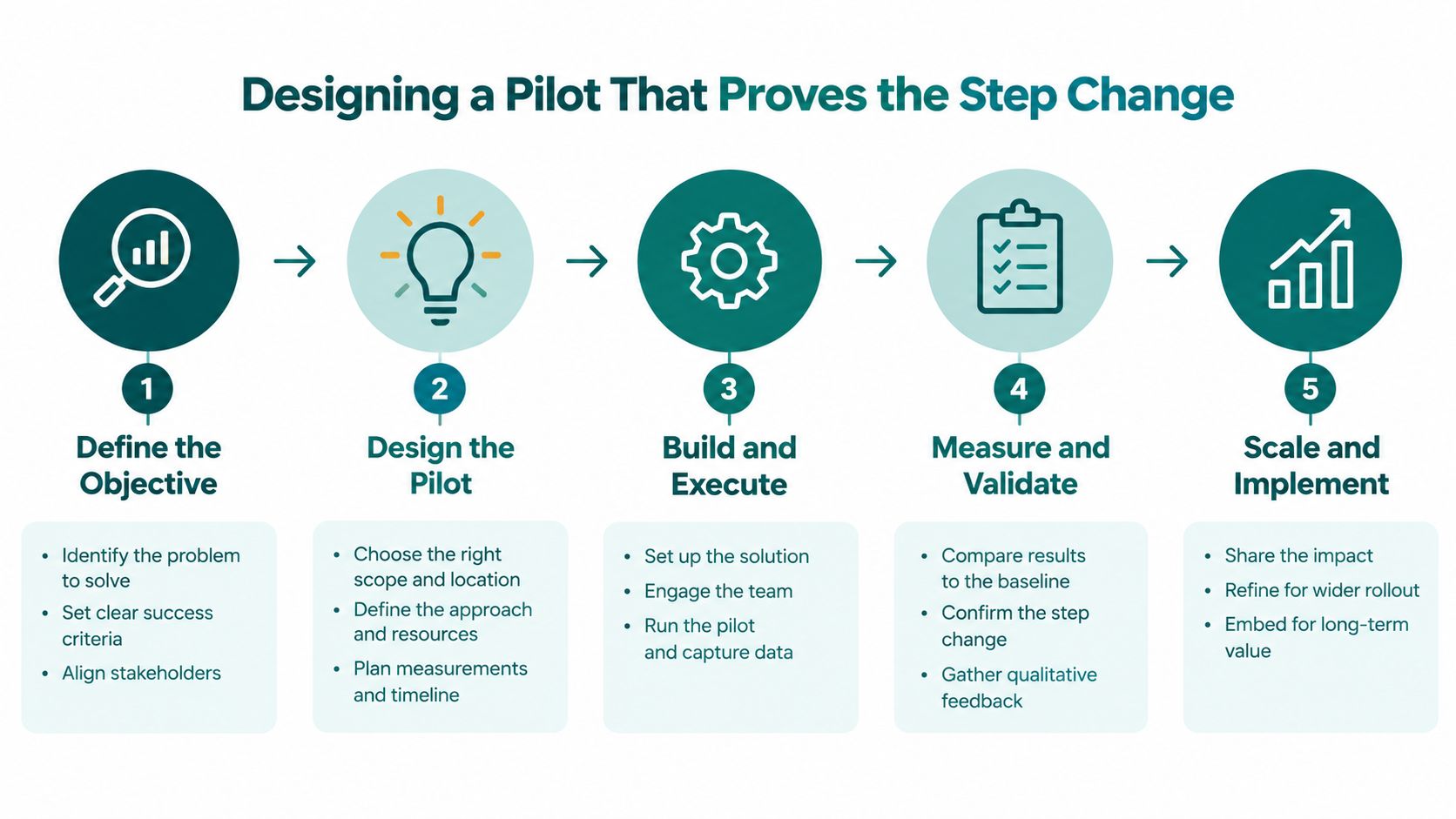
A pilot should be small enough to fail cheaply and important enough to produce a real decision. Start with one station, route, or concourse, not a network. Choose one outcome tied to the operator's hardest KPI, then set a short learning window so evidence arrives before enthusiasm fades.
A practical design sequence looks like this:
- Select one operational pain point. Choose a problem that staff and passengers already recognise.
- Record the baseline. Capture the current measure using an agreed method and period.
- Change one principal variable. Avoid combining a new navigation layer, revised staffing model, signage replacement, and customer campaign in the same test.
- Set the exit criteria before launch. Decide what result supports expansion, what result requires redesign, and what result ends the test.
- Assign a decision owner. The deputy or director receiving the pilot report should be named before day one.
Keep the pilot narrower than your ambition
Transit and venue pilots face procurement rules, union consultation, passenger disruption, and live operational risk. A tight test makes those constraints manageable. A wide launch hides them inside a project plan until the cost of changing direction becomes politically difficult.
The most common trap is scope creep disguised as learning. A second location gets added because the first one looks promising. Another user group is included because a stakeholder asks for it. Extra integrations appear because the technical team has access to them. The pilot gradually becomes a miniature rollout and loses its ability to answer one clean question.
Use a one-page pilot brief with five fields: problem, baseline, intervention, success threshold, and decision date. Include exclusions as well. If the pilot doesn't test installed hardware, don't imply that it does. If it doesn't change the ticketing system, state that plainly. A useful comparison is the staged release approach for mobile apps, where controlled exposure protects users and gives the delivery team evidence before a wider release.
The pilot commission should specify the decision it will support, not just the platform being purchased. For cost and value measures, Waymap's guidance on measuring cost savings offers a useful discipline: define the cost category and measurement method before claiming an operational benefit.
Scaling From Pilot to Enterprise Rollout
A named deployment changes the scaling conversation. Waymap has worked with WMATA, SBS Transit, LTA Singapore, CapMetro Austin, Westfield London, and the Royal Hospital for Children and Young People in contexts where people need precise navigation through complex environments. The relevant lesson isn't that a deployment name guarantees a result. It's that scaling requires translating a site-specific service into a repeatable operating model.
Waymap's technical approach is specific. Its navigation uses dead reckoning from device-native motion sensors, rather than relying on GPS, Wi-Fi, or installed beacons. The platform is designed for indoor, outdoor, and underground routes, and its SmartStep technology provides step-by-step audio navigation, including step-free routes where they are available. Those capabilities can make an infrastructure-free pilot easier to contain, but they don't remove the need for operational ownership.
Standardise before adding sites
When a pilot reaches its threshold, freeze the evidence before reopening the scope. Document the route model, content ownership, escalation process, accessibility review, staff briefing, support workflow, and metric definitions. The executive reporting pack should answer the same questions at every site.
Regional procurement rules can introduce different contract paths. Multi-union environments may require distinct consultation. A successful first test can also create political pressure to add every site immediately, which is precisely when delivery quality starts to decline.
Use waves organised by operating area, not geography. For example, deploy first across comparable interchanges, then across venues with similar visitor flows, rather than treating each region as a separate technology project. Set a capacity ceiling for the deployment team. When that ceiling is reached, pause new sites and finish adoption work at the existing ones.
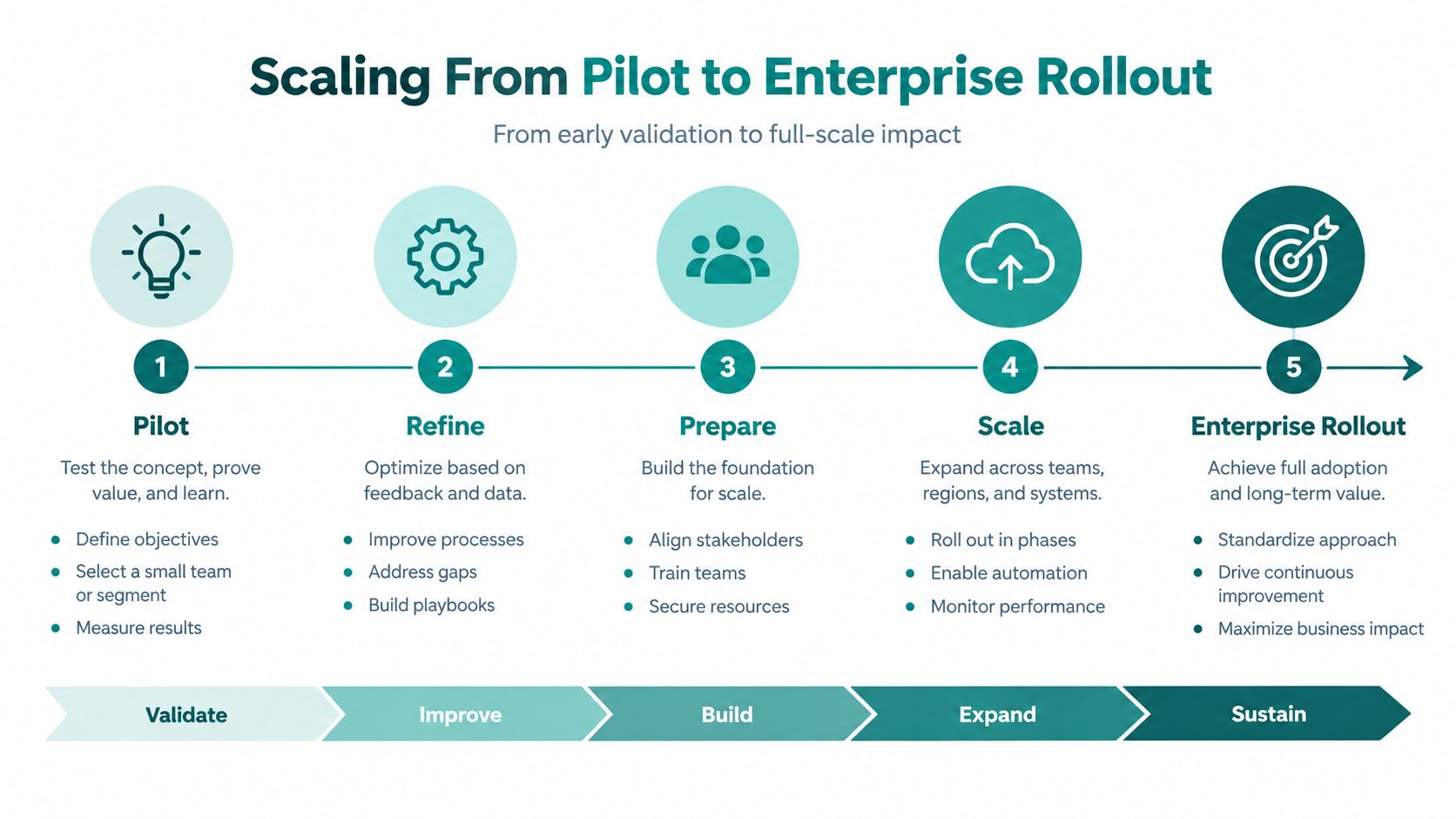
A rollout also needs a reporting cadence. Weekly operational reviews should focus on defects, staff feedback, and route changes. Monthly executive reviews should focus on the agreed outcome, risks, cost, and the next wave decision. Waymap's implementation best practices provide a useful reference for turning deployment activity into an operating routine.
The blunt conclusion is that scaling is usually a staffing problem dressed up as a technology problem. If nobody owns content updates, stakeholder response, training, and assurance, adding sites only multiplies unresolved work.
Why Infrastructure-Free Pilots Change the Risk Calculus
Infrastructure-heavy programmes are often treated as the safe option because physical assets feel permanent. That permanence is exactly the risk. Once hardware is fixed to a platform, concourse, turnstile, or ceiling, the operator inherits maintenance, replacement, access, survey, and refresh obligations. A physical decision can constrain future service design long after the original project team has moved on.
An infrastructure-free pilot reverses the order of commitment. Use existing devices and networks to test the operating outcome first, then decide whether physical works are justified. For navigation, Waymap's sensor-based approach can support routes without GPS, Wi-Fi, or installed hardware, which is relevant in underground environments, heritage buildings, busy stations, and venues where layouts change.
The trade-off must be explicit. Software-first testing can't validate the reliability of a cabinet, beacon, turnstile, platform modification, or building-management integration. It can validate the user journey, content process, staff response, and evidence needed for a later capital decision. That makes it a lower-risk way to learn, not a permanent substitute for physical work where physical work is required.
| Dimension | Infrastructure-Heavy Rollout | Infrastructure-Free Pilot |
|---|---|---|
| Initial commitment | Requires surveys, installation planning, access arrangements, and capital approval | Tests the service using existing devices, maps, and operational processes |
| Reversibility | Physical decisions are costly to remove or change | The intervention can be adjusted or stopped with less disruption |
| Evidence produced | Validates installed-asset operation and physical integration | Validates user journeys, workflows, content, and service demand |
| Maintenance exposure | Adds hardware inspection, replacement, and site-access responsibilities | Concentrates maintenance on software, route data, and operating ownership |
| Next decision | Often assumes expansion before evidence is complete | Creates evidence for a structured procurement or capital decision |
The safer first move is the one that preserves your next decision.
For a transport authority or venue operator, this matters during budget scrutiny. Finance directors want evidence that a problem is material and that the proposed intervention works. Regulators want a credible account of accessibility and safety. Frontline teams want a process that doesn't create avoidable work. An infrastructure-free pilot can bring those groups into the decision before the organisation commits to an installed-asset estate. The case for infrastructure-free wayfinding is therefore about preserving optionality, not avoiding investment forever.
Your First 30 Days and the Mistakes to Avoid
A general manager or venue operations director can start without waiting for a new board programme. The first month should produce a measurable problem statement, a small group of accountable stakeholders, and a commissioned pilot.
Week one and week two
Pick one pain point with a baseline. It might be missed connections at a named station, time spent finding an accessible entrance, or queue length at a specific gate. Don't choose “improve accessibility” as the measure. Choose the observable behaviour that shows whether access has improved.
Then identify two internal sponsors. One should control the operational process, and the other should control the customer, accessibility, or estates perspective. Brief one external regulator, disability advisory body, or accessibility lead before the design settles. This is co-design, not a press exercise.
Week three and week four
Scope a 60-day pilot around one success metric, even if the wider transformation brief allows a longer learning horizon. Commission the pilot, not the platform. The supplier should know the decision to be made, the evidence required, the exclusions, and the person who signs off the next step.
Avoid these predictable errors:
- Starting with a vendor demo: Define the operational problem before seeing the solution.
- Treating engagement as communications: Ask staff and disabled users to shape the workflow, not merely approve the message.
- Testing across several sites: Keep the first pilot contained so the result remains attributable.
- Confusing a rebrand with transformation: A new name, app screen, or campaign doesn't establish a new operating baseline.
- Skipping measurement: Without a baseline, later improvement is opinion.
Questions leaders ask before they approve a pilot
What is the difference between step change and continuous improvement in transit operations? Continuous improvement tunes an existing process, while a step change establishes a materially different operating baseline and measures it against the previous one.
How long does a typical step change pilot take at a venue or station? A practical first test should be bounded to a short period, with the brief setting a 60-day delivery window and a 90-day governance boundary where the organisation needs more time for evidence and review.
Which regulatory frameworks shape pilot scope? UK projects commonly consider the Equality Act 2010, while international or cross-border work may also involve ADA Title III, PRM-TSI, BS 8300, BS EN 17210, PAS 78, and the UN Convention on the Rights of Persons with Disabilities. The applicable framework depends on the jurisdiction, asset, service, and user need.
Can a step change work without replacing signalling, ticketing, or building-management systems? Yes, if the pilot tests a service layer that can operate alongside existing systems and the brief clearly excludes integration claims it hasn't tested.
Which metrics do boards and regulators accept? Use measures tied to the stated problem, such as dwell time, passenger satisfaction, complaint volume, accessibility completion rate, staff interventions, or successful route completion. The evidence is credible when the definition, baseline, collection method, and decision threshold are documented.
When does a step change need board sign-off? Board approval is usually appropriate when the work commits material capital, changes enterprise risk, alters contractual obligations, or affects multiple operating areas. Operational delegation may be suitable for a contained pilot within an approved budget and existing safety controls.
For UK transport leaders, the wider context is hard to ignore. The Department for Transport data shows that compliance milestones can coexist with incomplete end-to-end access. Your first 30 days should therefore test whether passengers and guests can complete the journey, not whether the organisation has produced another accessibility asset.
Waymap provides step-by-step navigation indoors, outdoors, and underground through its app and web experience, using smartphone motion sensors and detailed maps rather than GPS, Wi-Fi, or installed hardware. If your team needs to test accessible wayfinding as an operational step change, visit Waymap to discuss a focused pilot for your station, venue, campus, or public facility.
