
The Ultimate Guide to Maps of Hospitals in 2026
Arriving at a sprawling hospital complex, already anxious about an appointment, only to be met with a confusing maze of corridors is a common and deeply stressful experience. For many, this is the start of their patient journey.
This daily reality costs hospitals dearly. It leads to missed appointments, frustrated patients, and clinical staff being pulled away from their duties to act as human signposts. For large healthcare estates, like those managed by NHS trusts, effective maps of hospitals are no longer just a "nice-to-have"; they are critical infrastructure for operational efficiency and patient care. Waymap provides the technology to transform this challenge into a seamless experience.
Why are accurate digital hospital maps a necessity?
It’s time to stop thinking of maps as simple amenities. We must see them for what they really are: essential tools for patient safety, operational efficiency, and regulatory compliance. Digital mapping is finally solving the notorious navigation challenges in healthcare, delivering a clear return on investment.
The benefits ripple out far beyond the patient. For hospital staff, from clinicians rushing to a call to porters moving vital equipment, clear navigation means less time giving directions and more time focused on care. It's a direct route to better productivity and a smoother-running hospital.
How do digital maps enhance operational and digital strategy?
Hospitals are unique, complex environments with specialised needs, right down to the specific requirements for healthcare IT asset disposition. This highlights just how important precise spatial awareness is. Accurate digital maps act as a foundational layer for countless hospital systems, enabling better asset tracking, smarter staff allocation, and faster emergency response.
An accurate, accessible digital map is the backbone of a modern hospital's patient experience. It’s the first step in reducing anxiety and empowering visitors to navigate with confidence and independence.
Tom Pey, Founder, Waymap
For estates and facilities managers, going digital solves persistent headaches. When a clinic relocates or a corridor is temporarily closed for maintenance, a digital map can be updated instantly from a central dashboard. This vital information reaches everyone who needs it, preventing the bottlenecks and confusion that outdated, printed signs inevitably create.
Ultimately, investing in modern mapping is an investment in a smarter, safer, and more efficient hospital.
What are the different types of hospital maps?
For facilities managers or CIOs in healthcare, understanding the available navigation options is the first step toward a smart investment. The choices range from traditional static signs to powerful digital systems, and each one has a massive impact on your budget, daily operations, and patient stress levels.
We’ve all seen the traditional approach to hospital wayfinding: a confusing patchwork of static signs, campus maps, floor plans in the lobby, and perhaps a crumpled paper handout. They seem simple, but they share one critical, unavoidable flaw: they're fixed in place and almost immediately out of date.
The Problem with Static Signs in Dynamic Environments
Every time a clinic moves, a wing is refurbished, or a corridor is temporarily closed for cleaning, static signs become a liability. Updating them is a slow, expensive process involving reprinting and physically replacing signs across the entire estate. This lag time means your maps often don’t match reality, leading to more confusion, not less.
Worse, these one-size-fits-all maps fail on accessibility. They cannot show a wheelchair user a step-free route, point someone to the nearest accessible toilet, or offer audio cues for a visitor with sight loss. They operate as if every user has the same needs, falling well short of crucial standards like those in the Equality Act 2010.
This is where the contrast between old and new methods becomes incredibly stark.
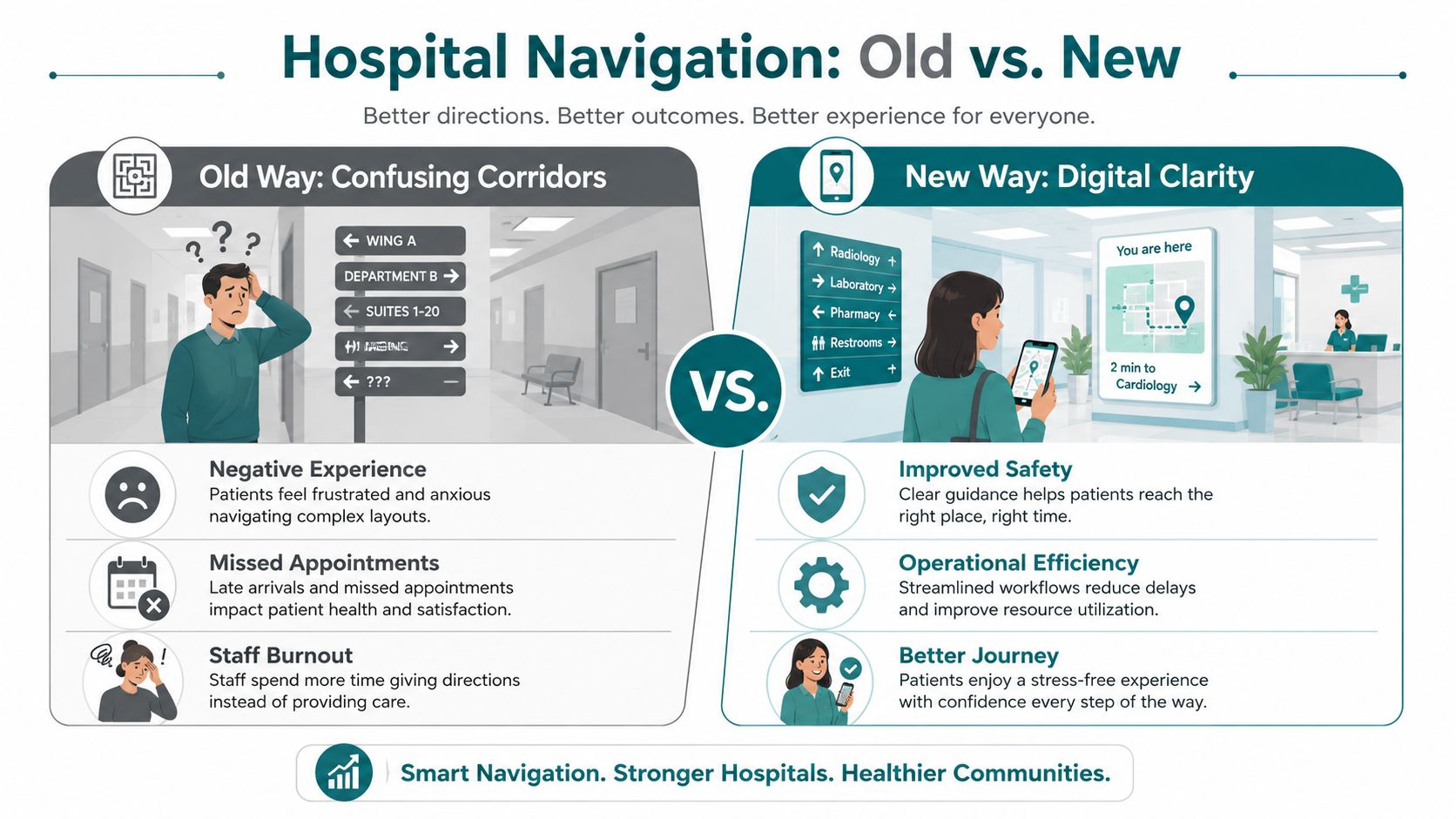
Swapping the confusion of static signage for the clarity of a digital system directly fixes the biggest failures of traditional wayfinding. You’re not just providing a map; you’re improving safety, reducing stress, and making the entire hospital run more smoothly.
How do modern and traditional wayfinding systems compare?
Digital mapping isn't just a minor upgrade; it's a complete change in thinking. When you move your hospital's layout from a printed sign to a software platform, it becomes instantly updatable, deeply personalisable, and far more useful for everyone.
Let’s put the two approaches side-by-side to see the real difference.
Hospital Wayfinding Systems Comparison
| Feature | Traditional Static Signage | Modern Digital Mapping |
|---|---|---|
| Updateability | Slow and expensive. Requires re-printing and manual replacement. | Instant. Updates are pushed live from a single dashboard. |
| Accessibility | Very poor. Fails to account for different mobility or sensory needs. | High. Customised for step-free routes, audio guidance, and more. |
| Patient Experience | Often stressful and confusing, contributing to late or missed appointments. | Personalised and supportive, lowering anxiety and improving patient flow. |
| Cost | High recurring costs for printing, installation, and labour. | Lower total cost of ownership, especially with software-only solutions. |
This comparison makes it obvious why so many CIOs and facilities managers are shifting away from static signs. The old way isn't just inconvenient—it actively works against the goals of a modern, patient-centred healthcare facility.
To understand the technology further, explore our deep dive into digital floor mapping software. For any large estate, and especially within the NHS, the business case for a dynamic, infrastructure-free solution like Waymap is simply becoming too compelling to ignore.
How do digital maps elevate the patient and staff experience?
A trip to the hospital is rarely a relaxing experience. For patients, it’s often a day filled with anxiety, and the last thing anyone needs is the added stress of getting lost in a sprawling, unfamiliar building. Digital maps of hospitals are changing this entirely.
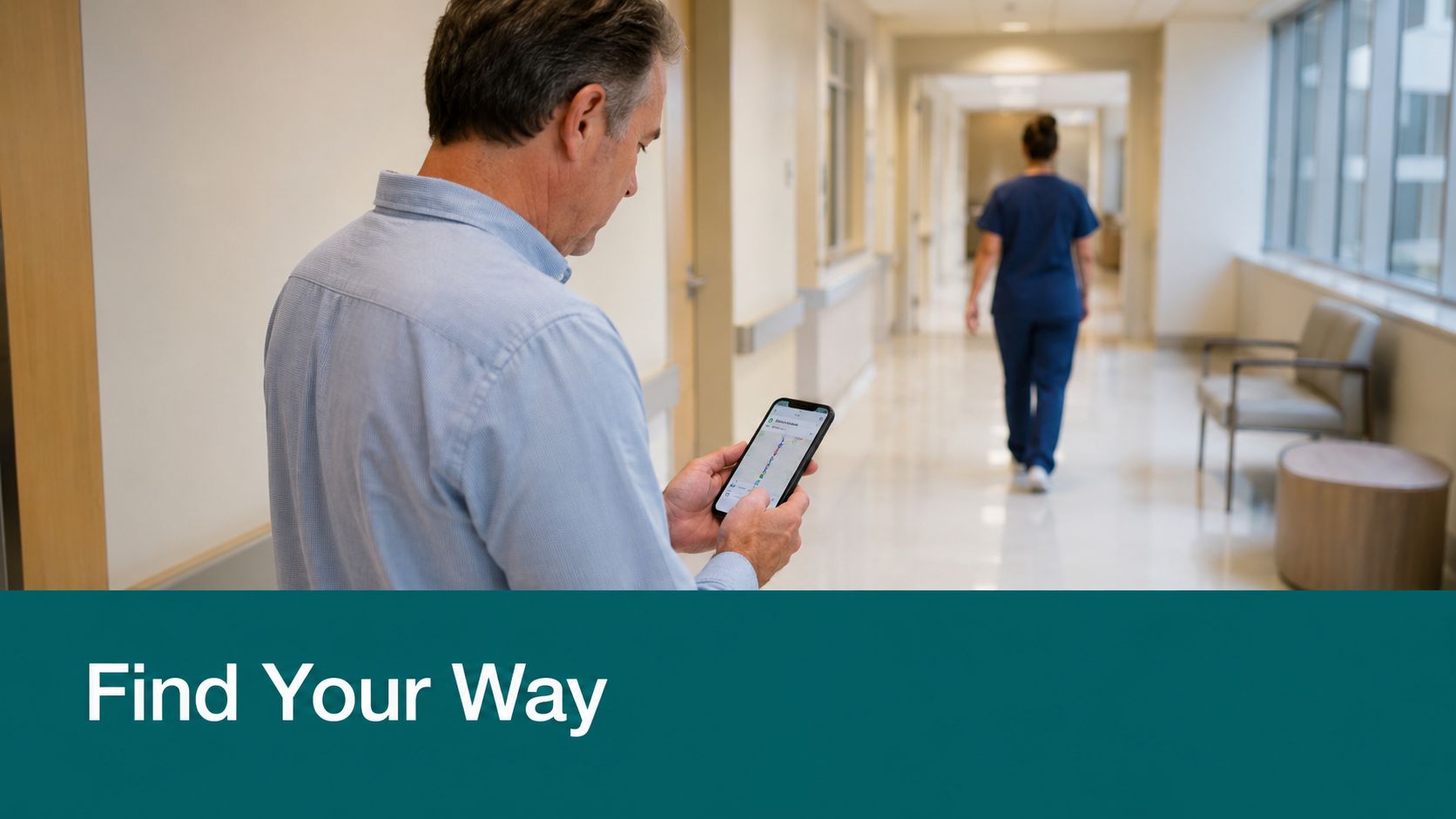
By delivering clear, turn-by-turn directions straight to a smartphone, these maps help cut through the confusion. They replace that feeling of being lost with a sense of confidence.
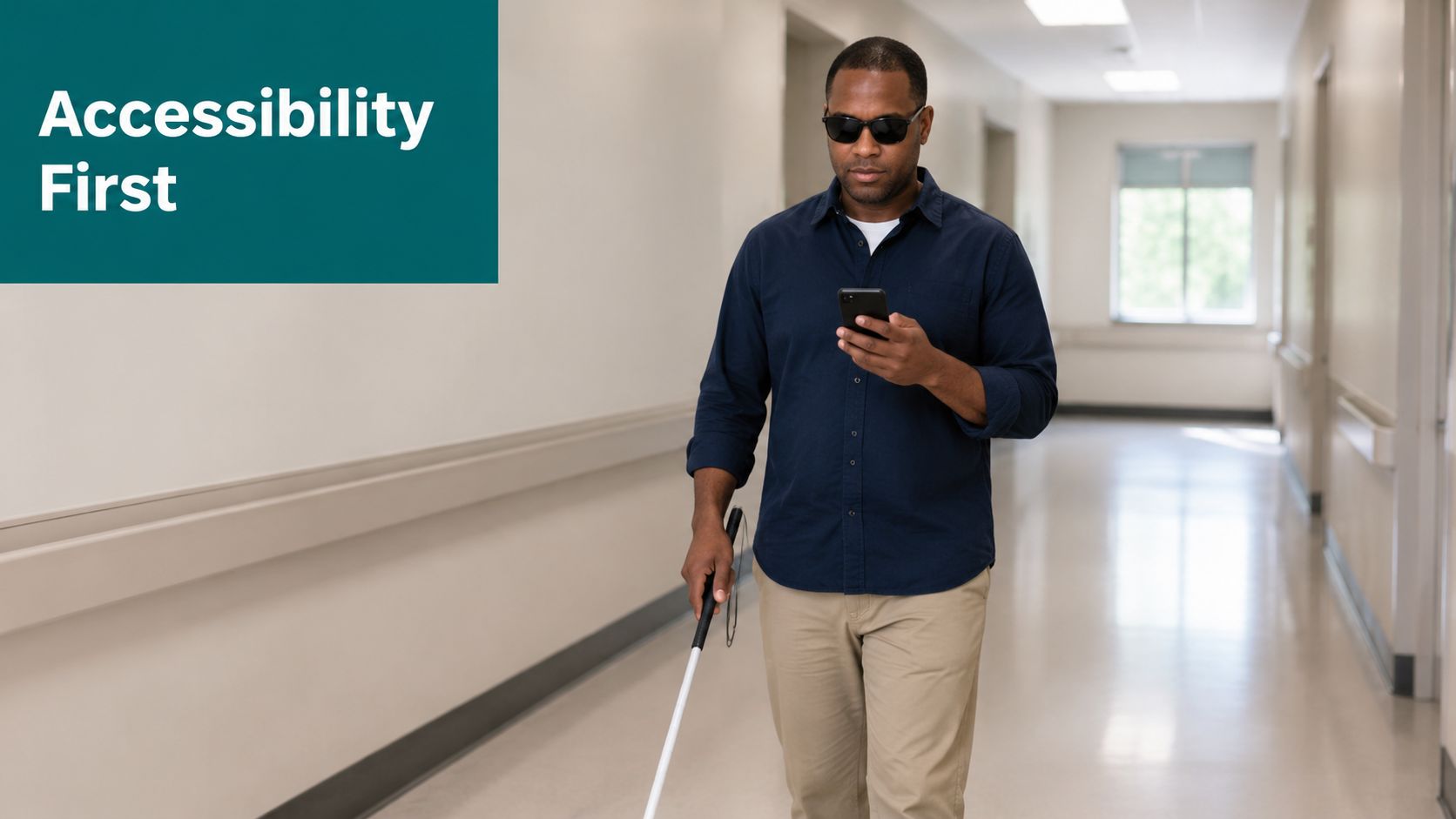
Think about a visually impaired patient arriving for an important appointment. In the past, they might have had to find a staff member and ask for help. Now, an audio-first navigation app can guide them with step-by-step instructions—from the main entrance, into the correct lift, down the right corridor, and right to the clinic door. It’s a level of independence that simply wasn’t possible before.
This shift from confusion to confidence isn't just a desirable feature. It’s a crucial part of boosting patient satisfaction scores and creating a healthcare environment that truly feels welcoming and accessible to everyone.
For hospital staff, the benefits are just as significant, measured in reclaimed time and smoother operations. Every moment a nurse, doctor, or porter spends giving directions is a moment they can't spend on patient care or other vital duties. Digital wayfinding hands that task over to technology, freeing up your most valuable resource: your people.
Driving Operational Excellence and Efficiency
The effect on day-to-day operations is immediate. We've all seen the chaos that ensues when a clinic has to move temporarily or a wing closes for maintenance. With old-fashioned static signs, this creates instant bottlenecks and frustration for patients and staff alike.
A digital mapping system, on the other hand, gives an estates manager the power to update the entire hospital's layout from a single dashboard.
These updates are pushed out instantly to every user, rerouting them around closures and preventing disruption before it even starts. This agility helps the whole facility run more smoothly, saving time and reducing stress across the board.
This move towards dynamic, digital solutions is a huge leap forward in managing large healthcare facilities. You can find out more about what goes into a great wayfinding app by reading our own insights. By empowering both patients and staff, digital maps are quickly becoming an essential tool for the modern hospital.
How can advanced maps help meet accessibility mandates?
For any hospital or estates manager, ensuring regulatory compliance is a fundamental part of the job. It's about much more than just ticking boxes. In the UK, the Equality Act 2010 lays out clear legal duties to make services accessible to everyone, a principle reinforced by design standards like BS 8300 for creating inclusive environments.
Trying to meet these obligations with static signs alone is a losing battle. A printed sign on a wall can't provide a step-free route for a wheelchair user or offer real-time audio guidance for a blind visitor. This is where advanced digital maps of hospitals step in, offering a robust and modern way to go beyond the legal minimum and deliver true accessibility.
Future-Proofing Compliance Without Costly Infrastructure
The reality for many NHS estates managers is a constant struggle with tight budget cycles and restrictions on capital spending. This often makes installing physical infrastructure, like Bluetooth beacons, a non-starter. Such systems demand a huge upfront investment and create a constant operational headache for maintenance and replacement, especially in a hospital that’s always changing.
This is precisely the challenge that infrastructure-free technology was designed to solve. Waymap offers a much smarter alternative by using a proprietary method called dead reckoning.
Waymap’s technology uses a device's own sensors—the accelerometer and gyroscope in a smartphone—to calculate movement and direction with sub-3-metre accuracy. It works without needing GPS, Wi-Fi, or any installed hardware, turning a significant capital expenditure barrier into a simple software deployment.
This software-only approach provides a far more scalable and affordable path to compliance. By using existing digital floor plans, a hospital can quickly roll out a sophisticated and genuinely accessible navigation layer for everyone. It’s an approach that aligns perfectly with the government's digital health strategy and visibly strengthens a hospital’s ESG credentials. You can learn more about the importance of thorough accessibility testing for digital solutions.
This powerful capability is built on the surprisingly robust data infrastructure that’s already in place. Across England and Wales, over 1,200 hospitals are systematically mapped within the UK's national health geography datasets. The Office for National Statistics confirms that seven NHS England Regions (NHSER) and 42 Integrated Care Boards (ICBs) manage these detailed hospital location maps, which are authoritatively provided by Gov.uk and hosted on platforms like ArcGIS Online.
Waymap taps into these precise datasets to guide blind and low-vision users to the exact hospital doors, transforming existing data into a powerful tool for independence and inclusion.
Making the Case for Infrastructure-Free Navigation
Hospital estates managers know the conversation around new technology always comes back to two things: budget and operational impact. This is where advanced wayfinding projects often stall. Getting approval for capital to install hardware like Bluetooth beacons is a tough sell within tight NHS budget cycles.
Even if funding is secured, the real work has only just begun. These systems create a massive operational headache. Hardware must be installed, calibrated, maintained, and eventually replaced across a busy, ever-changing hospital environment.
This is precisely where an infrastructure-free approach rewrites the rules. By eliminating the need for physical hardware, you remove all the associated costs and complications.
What are the economic benefits of a software-only solution?
Waymap’s software-only approach offers a practical and powerful alternative. Our world-first algorithm combines a smartphone's sensor data with your existing digital maps to provide pinpoint-accurate indoor navigation. The bottom line? There is no hardware to buy, install, or maintain—ever.
This completely changes the total cost of ownership. What was once a major capital project becomes a straightforward software rollout that’s faster, more affordable, and infinitely easier to scale.
This approach was proven at the Royal Hospital for Children and Young People in Edinburgh. They successfully rolled out a digital wayfinding solution without any disruptive or costly infrastructure, demonstrating that this modern model works even in the most complex healthcare settings.
How does this align with national digital health goals?
This shift towards smarter, software-based systems is also perfectly in step with the broader public sector strategy. With roughly 95% of NHS hospitals in the UK already using digital mapping systems, the groundwork is already there. The Office for National Statistics' Health Geography Portal notes that 42 Integrated Care Boards (ICBs) manage this data, making sure maps stay current as services change.
Waymap’s technology taps into this existing mapping infrastructure to deliver its heads-up, hands-free audio navigation. This not only makes deployment faster and cheaper but also helps meet crucial accessibility mandates for blind and low-vision users.
The timing couldn’t be better. The UK government's digital health investment is targeting enhanced hospital mapping systems by 2026, and the NHS Digital Strategy requires that 90% of hospital maps be accessible to users with visual impairments. Infrastructure-free solutions are the most logical way to get there.
By sidestepping the immense costs and logistical hurdles of hardware, hospitals can meet and exceed these digital and accessibility goals faster and more efficiently. The focus shifts from managing physical assets to delivering a better experience.
This modern approach simplifies the decision-making process for budget-conscious managers, delivering long-term value without the long-term headaches. To learn more, take a look at our detailed breakdown of the reliability and scalability benefits of infrastructure-free solutions.
Frequently Asked Questions About Hospital Mapping
When we talk to hospital leaders about digital mapping, the same practical questions always come up. Let's tackle them head-on.
How long does it take to deploy a digital hospital map?
The timeline depends entirely on the technology chosen. With traditional, hardware-based systems, deployment can take many months. With an infrastructure-free system like Waymap, however, deployment is remarkably fast. Because there are no beacons or other hardware to install and calibrate, a hospital can be accurately mapped and live in a matter of weeks. We work with your existing digital floor plans and datasets, which dramatically shortens the time to get a fully working system into the hands of your patients and staff.
What is the real cost of a hospital mapping solution?
The cost is directly tied to the type of system you invest in. Beacon-based solutions often come with a hefty upfront bill for hardware, followed by ongoing operational costs for maintenance, battery replacements, and recalibration. For NHS trusts, this model presents significant budget challenges.
A software-only, infrastructure-free solution like Waymap removes those hardware costs entirely. It operates on a predictable subscription model, resulting in a much lower total cost of ownership and sidestepping the difficult process of securing large capital spending approval.
How do digital maps help meet accessibility regulations?
Advanced digital mapping is a powerful, practical way to meet and exceed the requirements of legislation like the Equality Act 2010 and design standards such as BS 8300. These systems are designed from the ground up to support users with disabilities. It’s about providing genuine, equitable access through features like:
- Audio-First Navigation: For blind and visually impaired users, precise turn-by-turn audio directions are a core feature of the Waymap platform.
- Step-Free Routing: The system automatically plans routes that avoid stairs and other barriers, making navigation seamless for wheelchair users and anyone with mobility challenges.
- Accessible Facility Highlighting: Maps can clearly point out the locations of accessible toilets, entrances, hearing loops, and parking spaces, removing guesswork and anxiety.
By personalising the journey for every individual, digital maps ensure your hospital is welcoming and accessible to all.
What is the return on investment for hospital wayfinding?
The ROI for a modern wayfinding system is measured in both direct financial savings and crucial improvements to the patient experience. Financially, the returns are clear:
- Fewer Missed Appointments: When patients can find their way without stress, they are far more likely to arrive on time. This directly protects a key revenue stream.
- More Efficient Staff: Reclaiming the time your clinical and operational staff spend giving directions allows them to focus on their core duties, boosting productivity.
The experiential value is just as important. A calm, stress-free arrival leads to higher patient satisfaction scores, which are an essential metric for healthcare providers. For a deeper look into common queries, you can explore our full company FAQ.
Ready to transform your hospital's navigation? Waymap offers an infrastructure-free solution that delivers precision, accessibility, and operational efficiency without the cost and complexity of hardware. Contact us today to schedule a demonstration.
