
How To Navigate An Airport: Operator Insights

Airport wayfinding stops being a passenger inconvenience once it starts disrupting flow, increasing staff intervention, and excluding people who can't rely on visual cues. That point has already arrived in UK aviation. For operators, a key question isn't how to move through an airport as an individual traveller. It's how to design an airport that remains easy to get around under pressure, across terminals, and for people with very different needs.
Most existing systems still assume that overhead signs, flight boards, and a mobile app are enough. They aren't. They break down when people are stressed, when terminals are crowded, when gates change, and when a traveller can't use sight as their primary navigation channel. A workable strategy has to start with the passenger journey, but it has to end with operational design.
Why Airport Navigation Is A Solvable Operational Challenge
Heathrow handled a record 83.1 million passengers in 2023, and 28% of travellers reported getting lost or disoriented, according to a 2024 Civil Aviation Authority passenger survey (Statista chart reference). For an operator, that's not a soft experience issue. It's a flow problem, a staffing problem, and an accessibility problem.

When people get lost, the cost doesn't sit neatly in one line item. It shows up as bunching at information points, slower dispersal from security, higher pressure on assistance teams, and avoidable friction between airport, airline, and passenger. The common operational mistake is to treat those symptoms separately.
Why signs fail long before they disappear
Static signage works for repeat users in stable environments. Airports are neither. Terminals change, retail layouts distract, and passengers arrive with different languages, stress levels, and mobility needs. A sign can confirm direction. It can't adapt to missed turns, cognitive overload, or a traveller who needs spoken guidance rather than visual scanning.
That's why airport teams need to treat wayfinding as a service layer, not a graphics package. The practical shift is from “Did we install enough signs?” to “Can people reach the right place reliably?”
Poor navigation is usually framed as user error. In practice, it's often a design failure that the operator can measure and fix.
The strongest operators already know this. They test journeys, not just signage. They watch where people hesitate, where they reverse direction, where they ask staff the same question, and where transfer passengers break away from intended routes. Good user research techniques help expose those patterns before they become chronic operational drag.
What a solvable model looks like
A solvable wayfinding model has three parts:
- Clear baseline information that confirms terminal, process, and route before arrival
- Context-aware guidance inside the terminal, especially at decision points after security and during transfers
- Accessible delivery for travellers who can't rely on maps, screens, or small print
For venue operators assessing options, that usually means moving beyond signage-only thinking and understanding the role of digital guidance, accessibility, and indoor positioning systems as part of core infrastructure.
How Pre-Trip Planning Reduces Day-Of Terminal Chaos
The first preventable failure happens before the passenger enters the building. If someone arrives at the wrong terminal, the airport inherits the problem immediately.
A Civil Aviation Authority study found that pre-arrival checks using an airport app can improve navigation success rates by 25%. The same data notes that 30% of airport delays stem from passengers arriving at the wrong terminal in multi-terminal hubs. That combination matters because a digital prompt issued before travel is far cheaper than fixing confusion at the kerb, check-in zone, or information desk.
The terminal decision has to happen before the journey starts
Many airport teams still depend on airline messages and confirmation emails to carry terminal information. That creates inconsistency. Airlines communicate differently, and passengers often don't read those details until they're already en route.
A better operator approach is to make terminal certainty unavoidable in the airport's own channels. Official apps, booking-linked flight lookups, pre-arrival notifications, and mobile web pages should all answer the same question in plain language: where do I need to go, and what happens when I get there?
The most useful pre-trip information does three things well:
- Confirms the terminal by flight number
- Shows the correct landside arrival point
- Explains the next immediate action, such as bag drop, check-in, or direct security entry
What works better than generic reminders
“Check your terminal” is weak advice because it leaves too much interpretation to the passenger. Operationally, you want directive content, not a suggestion.
A stronger format looks like this:
- Flight-specific routing: Match the passenger's flight to the correct terminal rather than asking them to infer it.
- Mode-specific arrival guidance: Drivers, rail passengers, coach users, and assisted travellers don't enter through the same path.
- Exception handling: If terminal assignments change, push updated guidance early enough to affect behaviour.
Practical rule: If a passenger can still make a wrong-turn decision after reading your pre-arrival message, the message isn't doing its job.
Many operators underestimate their own influence. If you reduce wrong-terminal arrivals, you don't just help passengers. You reduce queue volatility, protect check-in throughput, and free staff to handle exceptions that require human intervention.
From Security Screening to Gate Finding The Critical Path
Security is where navigation pressure compounds. At major hubs like Gatwick, congestion during peak hours can lead to security queues averaging 45 minutes (FAA passenger and cargo statistics reference used in the verified data). By the time passengers emerge airside, many are already stressed, time-conscious, and less able to process cluttered information.
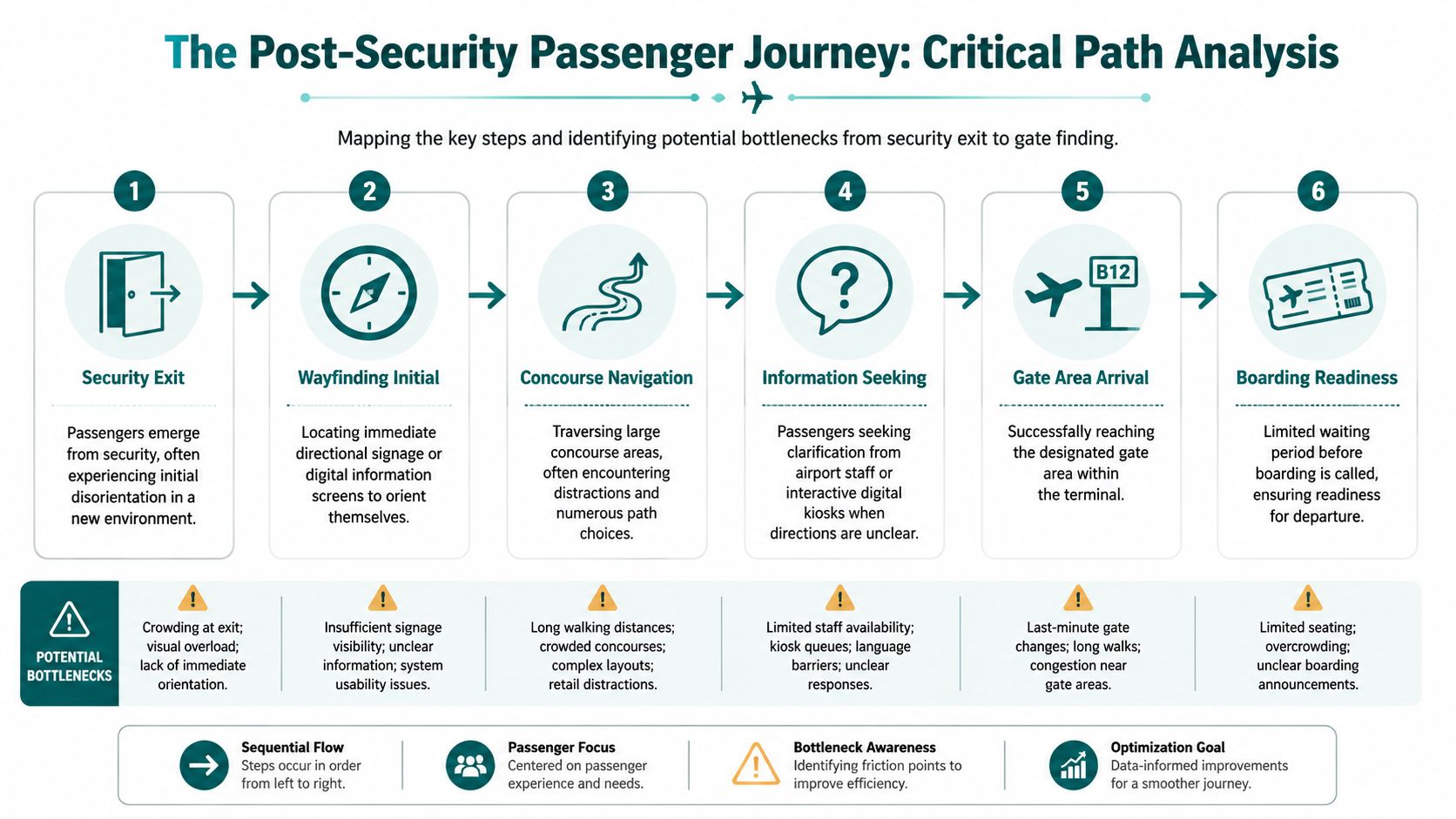
The industry often assumes that the difficult part is getting people through screening. It isn't. The hard part is what happens next. Passengers leave a controlled queue and enter a retail-heavy environment where route choices multiply, gate information may still be pending, and every screen competes for attention.
Why the post-security environment causes avoidable errors
The journey from security exit to gate area usually breaks down at a few predictable points:
- Initial orientation: Passengers need immediate confirmation of where they are after screening.
- Concourse choice: Large terminals present multiple corridors, piers, lifts, and escalators.
- Information overload: Flight boards, retail messages, and promotional displays compete with directional content.
- Late gate assignment or changes: Travellers hesitate, wait too long, or head the wrong way.
That is why “how to move through an airport” can't be answered with a generic sign hierarchy alone. The traveller is making a sequence of decisions under pressure. Every one of those decisions needs clarity.
What operators should map, not assume
Airports should actively map the critical path after security, not just the physical layout. That means tracking where people pause, where they ask staff for gate directions, and where they miss the first directional cue.
A practical review usually focuses on these moments:
| Journey point | Common failure | Better operator response |
|---|---|---|
| Security exit | No immediate orientation | Provide a clear “you are here” reference and route priorities |
| Main concourse split | Competing visual messages | Separate commercial displays from directional decisions |
| Waiting for gate announcement | Passengers drift too far | Keep route reminders visible near dwell zones |
| Final gate approach | Underestimated walking time | Signal distance and walking effort in plain language |
The worst wayfinding environments aren't always the largest ones. They're the ones that ask people to decode too much at once.
The gate-finding problem is also uneven. Frequent flyers can absorb ambiguity because they've built a mental model of the airport. Infrequent travellers, families, international visitors, and passengers with cognitive or sensory impairments often can't.
What actually improves the critical path
Operators get better results when they combine physical and digital guidance rather than trying to make one system do everything. Signs still matter. So do flight information displays. But neither should be expected to deliver personalised, turn-by-turn recovery when a passenger has already made a wrong turn.
The scalable answer is a layered system:
- Static signs for universal structure
- Live operational data for gate and route changes
- Personal guidance on the phone for the last mile through complex airside environments
That combination reduces dependence on staff directions and gives passengers a way to recover without stopping the flow around them.
What Makes Inter-Terminal Transfers So High-Risk
Transfers expose the weakness of airport wayfinding faster than any other journey type. UK airport connections pose a 28% disorientation risk, and a Manchester Airport operational review found that 1 in 5 passengers miss connecting flights due to signage overload and confusion. For multi-terminal operators, that's a direct warning that static connection signage isn't enough.

A transfer passenger isn't navigating one environment. They're moving through a chain of environments with changing rules. Deplaning leads to flight connections, then sometimes immigration, then re-screening, then a train, bus, shuttle, or long concourse walk, then another gate search. If any one instruction is vague, the whole chain becomes fragile.
Why yellow signs aren't a transfer strategy
Most airports rely on connection signs because they're standardised and familiar. The problem is that transfer journeys aren't standard. Some passengers are through-checked. Some need to reclaim bags. Some are crossing terminals. Some don't speak English confidently. Some are already late.
A static sign can point towards “Flight Connections”. It can't answer the next question, which is usually the one that matters most. Do I keep walking, change level, board a shuttle, clear immigration, or re-screen first?
For operators, that ambiguity drives three bad outcomes:
- Passengers seek staff help at exactly the busiest moments
- Airline and airport teams inherit disputes about missed connections
- Assistance services absorb navigational demand they weren't designed to carry
The same problem is visible in large transfer hubs globally, which is why operators often study practical routing examples such as Dubai International Airport terminal mapping when reviewing their own transfer complexity.
The transfer path needs active guidance
The operational answer is to treat transfers as dynamic journeys, not signposted corridors. Travellers need instructions that adjust to their actual path and recover if they deviate. That is especially important when transfers involve mode changes between concourses or terminals.
This short explainer is useful because it shows how quickly transfer decisions stack up once a passenger lands.
What works best is a system that can tell a passenger where they are, what comes next, and what to do if conditions change. What doesn't work is expecting them to reconstruct the route from a sequence of disconnected signs while the clock is running.
Can Audio Navigation Solve The Accessibility Gap
Yes. Audio navigation can solve a large part of the accessibility gap, but only if it works precisely indoors and doesn't depend on GPS or installed hardware that fails in operational reality.

An estimated 2 million people in the UK live with sight loss, yet only 25% of airport wayfinding is accessible via audio or haptic feedback. Standard guides that rely on visual maps and departure screens leave disabled users 40% more likely to miss flights due to navigation stress, according to a 2025 RNIB survey (background reference included in the verified data). That gap exists because most airport wayfinding is still designed around sighted behaviour.
Visual-first systems exclude people by design
Operators often assume accessibility can be added through assistance desks, wheelchair services, or staff escorting. Those services matter, but they don't replace independent navigation. A blind or low-vision traveller still needs to know where they are, when to turn, whether they've passed a lift, and how to reach a gate without relying on a passing member of staff.
That's also why many mainstream airport apps fall short. They may present a map, but they still require visual interpretation. For digital teams working on broader accessibility in mobile products, resources on AI for creating accessible mobile apps can be useful context, but airports need more than accessible interfaces. They need reliable positional guidance inside the building.
What a workable audio model requires
A functional audio wayfinding system in an airport must do four things:
- Locate the traveller indoors without GPS
- Give step-by-step spoken directions
- Recover from wrong turns
- Support independence in signal-poor areas such as corridors, underpasses, and terminal connectors
This is the point where hardware-heavy approaches often struggle. Beacons create maintenance overhead. Wi-Fi positioning drifts. QR and map-based systems still ask the user to orient visually.
Accessibility fails when the fallback is “ask a member of staff”. That's support, not independent navigation.
A different model uses smartphone motion sensors and detailed mapped geometry to infer movement and position. On that basis, Waymap's guidance for visually impaired users is relevant because it describes a hardware-free approach built around heads-up audio directions rather than visual map reading. For airport operators, the technical value is straightforward. It avoids dependency on beacons or GPS blackspots, and it gives blind and low-vision passengers a navigation channel designed for the way they travel.
Why this matters beyond compliance
Better accessible navigation improves more than disability provision. It reduces escort dependency, clarifies route design for everyone, and helps operators meet Equality Act expectations through the built environment itself rather than through ad hoc human workarounds.
When an airport can provide precise non-visual navigation, it stops treating accessibility as a separate process. It makes it part of the core journey.
How Better Wayfinding Becomes A Competitive Advantage
Operators sometimes treat wayfinding as a finishing layer. It isn't. It's part of throughput, service quality, and commercial performance.
A navigable airport moves people with less friction. Staff spend less time repeating basic directions. Passengers arrive at gates with less stress and fewer last-minute disputes. Accessibility teams can focus on genuine support needs instead of compensating for poor spatial design. Those outcomes matter because they affect cost, resilience, and reputation at the same time.
The commercial case is stronger than many teams assume
Passengers who feel lost don't dwell well. They rush, cluster near information points, and avoid exploring. Passengers who trust the route are more likely to use the terminal as intended. That doesn't mean flooding the building with more signs. It means reducing uncertainty at the moments that shape behaviour.
Three competitive effects matter most:
- Operational efficiency: Fewer avoidable direction queries and less disruption around key choke points
- Accessibility credibility: Stronger evidence that the airport supports independent travel, not just assisted travel
- Brand confidence: A venue that is easier to understand feels better organised overall
What separates high-performing operators
The strongest venues don't ask whether digital guidance should replace signage. They ask how each layer should perform its own job. Static signs establish structure. Live operational systems reflect changing conditions. Personal navigation closes the gap between the two.
If passengers still need local knowledge to move confidently through your terminal, the wayfinding system isn't finished.
That's the competitive difference. Airports compete on routes, retail, service standards, and efficiency. But they also compete on whether people can use the building without confusion. In a crowded market, that's not a cosmetic issue. It's part of the offer.
Frequently Asked Questions About Modern Airport Navigation
How do passengers usually get lost in airports?
They usually get lost at transition points. The most common problem areas are terminal arrival, security exit, inter-terminal transfer, and final gate approach. Those are the moments when people need a decision, not just general information.
Is better signage enough to fix airport wayfinding?
No. Better signage helps, but it won't solve missed turns, late changes, accessibility barriers, or signal-poor indoor spaces on its own. Airports need a layered model that combines physical signs, live operational data, and personal guidance.
What's the biggest preventable navigation failure before departure?
Arriving at the wrong terminal is the biggest preventable failure. It creates avoidable delays before the passenger even enters the main flow of the terminal and puts immediate pressure on staff and check-in areas.
Why do passengers struggle after security even when signs are present?
They struggle because the post-security environment is cognitively demanding. People are stressed, gate information may still be changing, and the concourse often mixes retail messaging with directional information. Signs may exist, but they're competing for attention.
Why are airport transfers harder than standard departures?
Transfers are harder because the journey has more stages and less tolerance for error. A passenger may need to pass through connections signage, immigration, re-screening, a shuttle or train, and a new gate area under time pressure. Static signs rarely provide enough context for that sequence.
Can accessible navigation rely on staff assistance instead of technology?
No. Staff assistance is important, but it isn't a substitute for independent navigation. If a blind or low-vision traveller can only complete the journey by asking for help, the wayfinding system is still incomplete.
What should operators look for in an indoor navigation solution?
They should look for reliable indoor positioning, support for accessible guidance, low operational overhead, and the ability to update routes and points of interest without major infrastructure work. The system also needs to cope with real terminal conditions, including signal-dead zones and route changes.
Does airport wayfinding have value beyond accessibility?
Yes. Better wayfinding improves passenger flow, reduces repetitive staff intervention, and strengthens the overall service experience. Accessibility is a critical reason to invest, but it's not the only one.
If your venue is reviewing how people move through complex indoor spaces, Waymap shows what a hardware-free navigation layer can look like in practice. We work with operators that need precise guidance indoors, outdoors, and underground, especially where accessibility, operational resilience, and maintainability all matter at once.
