
Navigating Dubai International Airport (DXB) with Confidence

Navigating one of the world's busiest airports can seem daunting, but with the right tools, it’s surprisingly straightforward. The first step to using any Dubai International Airport map is knowing which of the three main terminals you’re flying from or to. Each has a distinct layout and serves different airlines.
Quickly Find Your Way Around DXB
Dubai International Airport (DXB) is massive, but don't let its size intimidate you. The key to a stress-free trip is understanding its basic layout. The airport is split into three terminals—Terminals 1, 2, and 3—and each serves a specific group of airlines.
Before you even glance at a map, the most important thing to do is check your ticket to see which terminal you need. This immediately narrows your focus and makes any map far more useful.
Get Oriented with Terminals and Map Types
Once you know your terminal number, you can find a map. The official Dubai Airports website has excellent interactive maps that let you search for gates, shops, and services right from your phone or computer. They’re perfect for planning your route before you leave home.
If you’d rather have something that works offline, you can also find downloadable PDF maps. Save one to your device, and you’ll have a reliable guide, even if you don't have an internet connection when you land. And for those looking for detailed, step-by-step audio directions, new navigation tools are changing how we navigate complex indoor spaces. You can see how this technology makes complex venues easy to navigate by exploring Waymap's accessible navigation app.
Here’s a glimpse of the airport's official interactive map, which gives you a great bird's-eye view of the terminal layouts.
This digital tool lets you select your terminal and switch between different levels, making it simple to find what you need or plan your walk from check-in to your departure gate.
A Quick Comparison of DXB Terminals
To help you get your bearings quickly, here’s a simple rundown of what to expect at each of DXB's terminals. Think of this as your quick-reference guide.
Dubai International Airport (DXB) Terminal Overview
This breakdown should give you a clear idea of where you need to be and what to expect when you get there. Knowing your terminal is the first and most important step to a smooth journey through DXB.
Navigating Each Terminal Like a Pro
To understand Dubai International, it helps to think of it not as one enormous airport, but as three distinct, interconnected hubs, each with its own layout and flow. Getting to know Terminals 1, 2, and 3 is the first step to using any Dubai International Airport map with confidence.
No matter which terminal you're in, the basic approach to finding your way is always the same. It comes down to three simple steps.
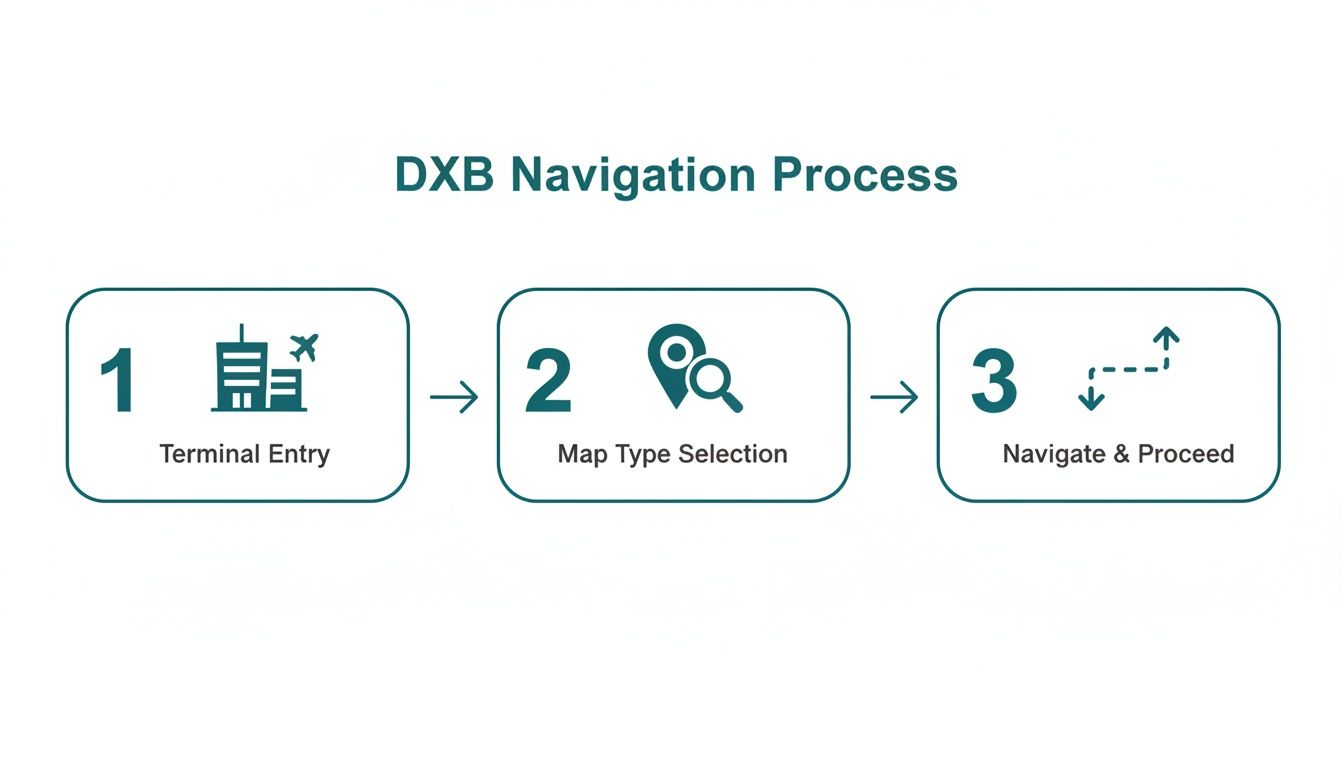
This simple framework—know your terminal, pick your map, then get moving—cuts through the complexity and makes even one of the world's busiest airports feel manageable.
Terminal 1: The Global Crossroads
Terminal 1 is the main hub for over 60 international airlines. If you’re flying with a major carrier that isn't Emirates or flydubai, this is likely your starting point.
Your journey here is split into two stages. You’ll start in the main terminal building for check-in and security, then take a quick automated train to Concourse D for your gate.
- Check-in and Security: These are on the departures level of the main building. The layout is linear, with check-in desks clearly signposted.
- Concourse D: After passport control, follow the signs for the airport train. It takes you straight to Concourse D, a modern space with all departure gates for T1, plus shops and dining.
Because Terminal 1 is split across two buildings, always build in extra time for that train transfer. It’s a smooth ride, but it does add another leg to your journey.
Terminal 2: The Regional and Budget Hub
Sitting on its own, physically separate from Terminals 1 and 3, is Terminal 2. This is the primary home of flydubai, along with other regional airlines and low-cost carriers.
Its layout is much simpler and more compact, which makes navigation easier. Check-in, security, and the gates are all under one roof, making for a quicker trip from curb to gate—ideal for the shorter-haul flights that typically depart from here.
Remember, if you need to transfer between T2 and the other terminals, you'll need to use the airport shuttle bus, so be sure to factor that into your timing.
Terminal 3: The Emirates A380 Hub
As the exclusive domain of Emirates and its partner flydubai, Terminal 3 is an architectural marvel and the largest airport terminal in the world. It was purpose-built to handle the massive passenger numbers that come with Emirates’ large A380 fleet.
Terminal 3 is directly linked to three enormous concourses:
- Concourse A: This is the world’s first facility designed specifically for the A380. It’s so large it has its own internal train to connect it to the main part of Terminal 3.
- Concourse B: This was the original concourse for T3 and is directly accessible from the main terminal building. It’s where you’ll find incredible lounges, including the Emirates Business and First Class lounges.
- Concourse C: Although part of the Terminal 3 complex, Concourse C also services international flights from other airlines and acts as a link to Terminal 1.
The sheer scale of Terminal 3 cannot be overstated. Walking from check-in to a distant gate can take a surprisingly long time. You'll often find yourself using moving walkways or the internal train just to get around. This is where digital Dubai International Airport maps really prove their value, helping you pinpoint your gate and estimate how long it'll take to get there.
Finding Key Services and Amenities with DXB Maps
Once you’re past security, your airport experience begins. A Dubai International Airport map is more than a simple guide to your gate; it’s your key to unlocking everything the airport has to offer, making your journey smoother and more enjoyable.
Knowing where to find everything—from essentials to a bit of luxury—can turn a stressful layover into a welcome break. Whether you have a last-minute task to sort out or just want to unwind, the airport’s maps are designed to help.

Locating Essential Passenger Services
Before you think about relaxing, you might need to find some of the basics. Airport maps are layered with clear icons for these spots, making them easy to find. Here are the essentials you can pinpoint on any official DXB map:
- Restrooms and Baby Changing Facilities: You're never far from one. These are clearly marked throughout every terminal and concourse.
- Prayer Rooms: Separate facilities for men and women are available across the airport. A quick search on the map will show you the closest room.
- Currency Exchange and ATMs: You’ll find counters for services like Travelex and various bank ATMs in both arrivals and departures halls.
- Mobile Charging and Wi-Fi: DXB provides free, high-speed Wi-Fi throughout the airport. The maps can also guide you to dedicated charging stations, usually located near gates and seating areas.
By getting these necessities out of the way first, you can get organized and plan the rest of your time without feeling rushed or disoriented.
Think of the airport map as your personal guide. Instead of having to ask for directions, you have a visual tool that instantly shows you where to find everything from a pharmacy to a place to grab a local SIM card.
Finding Comfort and Relaxation
For anyone with a long layover, finding a quiet spot to recharge is a top priority. Dubai International is famous for its premium facilities, and maps are your best tool for tracking them down.
Terminal 3, being the main Emirates hub, is packed with world-class lounges, but every terminal has its own pockets of comfort if you know where to look.
Popular Lounges and Relaxation Spots:
- Emirates Lounges: Found in Concourses A, B, and C of Terminal 3, these are exclusive spaces for First and Business Class passengers, plus eligible Skywards members.
- Marhaba Lounges: A great option open to passengers from any airline for a fee. You can find them in Terminals 1, 2, and 3, offering a quiet escape with food and drinks included.
- Transit Hotels and Spas: For the ultimate relaxation, the Dubai International Hotel is located right inside Terminal 3. You can also find wellness spas like Be Relax in Terminals 1 and 3 – perfect for a pre-flight massage.
Using the Dubai International Airport maps to find these spots means you’re making the most of your downtime. Instead of wandering around hoping to find a lounge, you can head straight there, check in, and start relaxing. This transforms your wait time from a chore into a valuable part of your journey, helping you land at your destination feeling rested.
Understanding Your Transport Options to and from the Airport
Once you’ve landed, your final step is getting from the terminal into the city. This is where your Dubai International Airport map becomes essential, pointing you toward the right transport to complete your journey smoothly.
A little forward planning makes all the difference, especially after a long flight. Knowing your airport transfer services is a universal rule for stress-free travel. At DXB, you have plenty of choices, and everything is clearly signposted on airport maps.
Connecting with the Dubai Metro
The Dubai Metro is a fantastic option—it’s fast, clean, and affordable. DXB is well integrated into the public transport network, with dedicated stations in two terminals.
Your airport map will show you exactly how to get to the Metro stations inside Terminal 1 and Terminal 3. Both stations are on the Red Line, which runs through Dubai’s core, stopping at major locations like the Burj Khalifa/Dubai Mall and the World Trade Centre.
To ride the metro, you’ll need a Nol card, Dubai's all-in-one travel card. You can buy one from the machines at the airport metro station. Just follow the train symbols on your map, and you'll be at the platforms in minutes.
One crucial tip: the Dubai Metro doesn't run 24/7. It's always a good idea to check the latest schedule, particularly if you’re arriving late at night or have an early flight.
Finding Taxis and Buses
If you’d rather have a direct, door-to-door ride, official Dubai taxis are always available. The airport maps will guide you to the taxi ranks, which are located just outside the arrivals halls of all three terminals.
Follow the signs for "Taxis," and you’ll find a well-managed queue that leads you to a cream-colored, government-regulated cab. They’re all metered, providing a safe and reliable trip.
For a more budget-friendly journey, Dubai's public buses, run by the RTA (Roads and Transport Authority), also connect to the airport.
- Bus Stops: You'll find the RTA bus stops just outside Terminals 1, 2, and 3. The airport map will pinpoint their exact locations.
- Payment: Just like the Metro, you’ll need a Nol card to pay your fare—cash is not accepted on the bus.
- Routes: Various routes head to different parts of the city. It’s smart to check the RTA's journey planner beforehand to make sure you’re taking the right one.
Driving and Parking at DXB
For those driving themselves, finding the correct car park is straightforward with a map. DXB offers everything from quick drop-off bays to long-stay options.
Both Terminal 1 and Terminal 3 have large multi-level car parks with short-term and long-term sections just a short walk from the main buildings. Terminal 2 has its own car parks right across from the entrance. Using a map helps you navigate the airport roads and find the right parking area for your terminal without any last-minute stress.
Accessible Navigation for Every Traveler at DXB
What truly makes an airport world-class isn't just its scale or passenger numbers. The real measure of excellence is how well it serves every single person who passes through. For anyone with a disability or reduced mobility, a vast, complex space like Dubai International Airport can be daunting. This is where a genuine commitment to accessibility separates the good from the great.
Dubai International Airport already has important services in place, including dedicated check-in areas, priority lanes for security and immigration, and wheelchair assistance that can be pre-booked with your airline. The official Dubai International Airport maps are also useful for basic orientation, clearly marking key facilities like accessible restrooms and elevators.

But real accessibility isn’t just about assistance; it’s about providing the tools for people to travel independently. This is where modern wayfinding technology creates a profound shift, moving people from dependency toward genuine empowerment.
The Power of Audio-Based Navigation
For blind and visually impaired travelers, visual maps and signs are barriers. This is the exact problem Waymap was created to solve. Our technology turns a standard smartphone into a highly precise audio guide, delivering step-by-step instructions that work flawlessly indoors where GPS fails.
It’s like having a personal guide whispering directions in your ear, leading you from the terminal entrance directly to your departure gate, a specific café, or the nearest accessible restroom. It works without needing pre-installed hardware like beacons or cameras, giving you true autonomy.
For a venue as enormous and busy as DXB, this kind of precision is vital. It’s not just about finding the right concourse; it’s about navigating to a specific seat at Gate B27 or finding the quiet room in Terminal 3, all with confidence.
This sense of empowerment is especially critical in such a bustling environment. Dubai International Airport's operational performance is remarkable; in 2023, according to airport operator data, 99.3% of departing passengers waited less than 10 minutes at passport control, and security checks took under 5 minutes for 98.9% of travelers. For an airport serving over 86 million passengers a year, digital wayfinding that supports everyone is essential for maintaining these high standards and ensuring a smooth journey for all.
How Independent Navigation Transforms the Airport Experience
Being able to navigate on your own completely changes the feeling of travel. Instead of arriving with anxiety about finding your way, you arrive with a tool that puts you in control.
- Reduces Stress and Anxiety: Knowing you can find your way without constantly having to ask for help removes a huge layer of travel-related stress.
- Promotes Independence: It empowers you to explore the airport's shops, restaurants, and lounges on your own terms.
- Improves Safety and Efficiency: Precise, real-time directions help you avoid wrong turns and reach your gate with plenty of time to spare.
By offering this level of detail, audio navigation gives a far deeper sense of security and freedom than any static map ever could. You can read more about what Waymap’s technology means for blind people in our detailed article. Ultimately, creating an inclusive environment isn't just about meeting standards; it's about delivering a better, more human experience for every single person.
The Future of Airport Wayfinding for Operators
Ask any airport operator about their biggest daily challenges, and passenger flow will be high on the list. For decades, the industry has relied on static signs, printed maps, and information desks. While dependable, this approach is from a different era. In today’s bustling airports, where thousands of people need to be in the right place at the right time, static guidance is often not enough.
The system can break down when something unexpected happens. A last-minute gate change, a closed-off corridor, or an out-of-service elevator can create a ripple effect of confusion and delays. When that happens, static signs become part of the problem, and staff are forced to act as human signposts, pulling them away from their primary duties.
Beyond Static Signage
The sheer scale of modern air travel makes a smarter approach essential. Take Dubai International Airport (DXB), for example. In 2023, it handled over 86 million passengers. Guiding that many people with fixed signs alone is a monumental challenge. It's clear that reliable, accessible navigation isn't just a "nice-to-have"—it's an operational necessity.
This is where dynamic indoor navigation platforms like Waymap come in. Instead of relying on physical signs, it introduces a digital layer of information that can be updated instantly.
Think of it like this: static signage is a printed road atlas, a snapshot in time. A dynamic system is a live GPS traffic app, adapting to the world as it changes, minute by minute. It transforms wayfinding from a costly piece of infrastructure into a flexible, responsive tool for airport operations.
The Operational Advantages of Dynamic Wayfinding
Integrating a platform like Waymap isn't just about passenger experience; it delivers real, measurable benefits that improve operational efficiency and the bottom line. It’s about running a smarter, more resilient airport.
The key advantages are straightforward:
- Real-Time Updates: Instantly change points of interest, block off routes, or redirect passenger flow around an obstruction. A gate change or a new shop opening can be reflected in the app in minutes.
- Reduced Passenger Confusion: Step-accurate, audio-first guidance in multiple languages drastically cuts down on stress and the stream of questions aimed at staff, freeing them up for more important work.
- Lower Maintenance Costs: Moving to digital wayfinding means less dependency on the costly cycle of designing, printing, installing, and replacing physical signs.
Turning Inclusive Design into a Measurable Advantage
What sets Waymap apart is its infrastructure-free technology, which makes deployment fast and cost-effective. Our system works using just the sensors already built into a smartphone. There's no need to install, power, or maintain thousands of Bluetooth beacons or other hardware.
This makes it one of the most scalable and easy-to-maintain indoor positioning systems on the market.
By using a single solution that serves the general public while also meeting accessibility requirements for visually impaired travelers, airports can solve two problems at once. This approach turns inclusive design from a compliance task into a powerful operational asset that improves flow, boosts satisfaction, and cements the airport's reputation as a forward-thinking, customer-first hub.
Frequently Asked Questions
An airport the size of Dubai International can feel like a small city, so it’s natural to have questions about getting around. We’ve put together answers to some of the most common ones to help you navigate DXB like a seasoned traveler.
Can I Get a Physical Map of Dubai International Airport?
Yes, you can. If you prefer a paper map, you can usually find them at the main information desks, especially in Terminals 1 and 3. They’re great for getting a general sense of the airport’s layout.
That said, for the most up-to-date information, we recommend the interactive Dubai International Airport maps on the official website or mobile app. Airports are constantly changing, and a digital map reflects everything in real-time.
How Do I Get Between Terminal 1 and Terminal 3?
Terminals 1 and 3 are connected airside, which means connecting passengers can move between them without clearing security again.
Look for the 'Connections' signs throughout the terminals. Given the sheer scale of the buildings, your journey will likely involve a ride on the internal airport train that links the different concourses. Always give yourself more time than you think you need; the walking distances alone can be significant.
Navigating these long transfers can be a real hurdle for travelers with reduced mobility or visual impairments. This is where a tool that gives precise, step-by-step audio directions isn’t just a convenience—it’s the key to a stress-free connection.
Are There Accessible Navigation Tools for Blind Travelers at DXB?
While DXB provides essential services like wheelchair assistance and priority lanes, true independence for blind and visually impaired travelers means being able to navigate on their own terms. For them, traditional signs and visual maps are barriers, not aids.
This is precisely the problem that advanced audio navigation systems like Waymap were created to solve. Our app turns any smartphone into a hyper-accurate guide, delivering step-by-step audio instructions that work flawlessly indoors where GPS is unreliable. It gives users the power to find their gate, a specific shop, or the nearest restroom with complete independence.
Ready to experience a new level of independence in complex venues? Waymap provides step-accurate audio navigation that works indoors, outdoors, and underground, all without needing any special hardware.
Discover how we're making the world more navigable for everyone at https://www.waymapnav.com.
