
How to Be Multilingual: A Practical Plan That Works

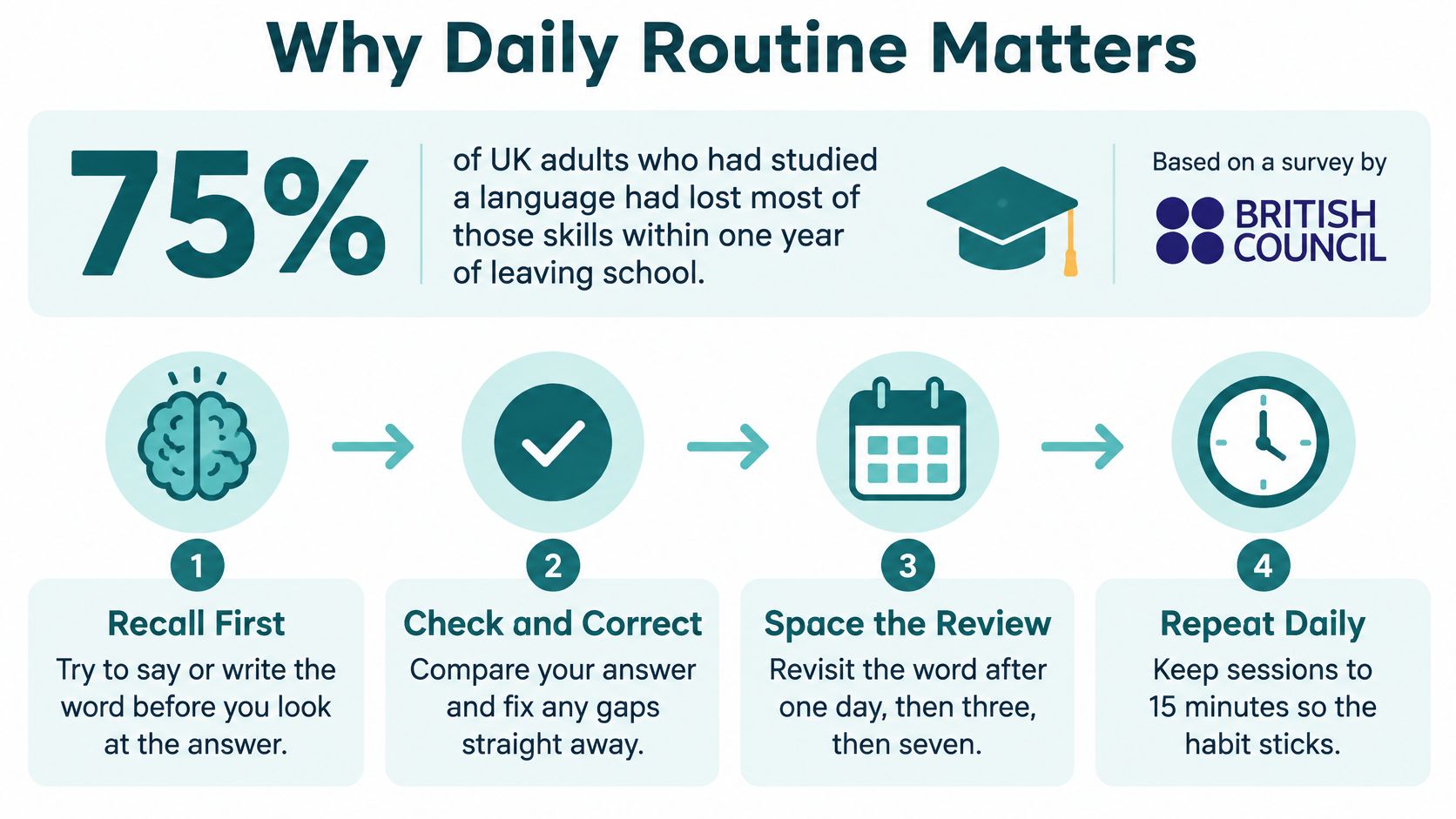
75% of UK adults who had studied a language said they'd lost most of those skills within a year of leaving school, according to a British Council survey on language retention. Learning how to be multilingual isn't just about acquiring another language. It's about keeping it available when you need to understand someone, ask a question or get somewhere.
At Waymap, our perspective starts with participation in real places. A useful multilingual learning plan should work on a commute, in a shop or at a venue, including for people who can't rely on screens or fixed classroom routines. Measure what you can do in practice, then build enough repetition to make that ability dependable.
How to Pick Your Languages and Set a Realistic Goal
Learning how to be multilingual starts with choosing languages for tasks you already face, not with a fluency target. Ordering lunch and understanding directions require a different commitment from negotiating contracts or handling complex professional discussions.
Partial ability is useful when its limits are clear. You might read comfortably in one language, manage everyday conversation in another and use a third within your family. Equal proficiency doesn't need to be the starting point.
The British Academy's evidence programme on language learning reviewed research across the lifespan and across homes, schools, supplementary schools, online learning and other settings. That breadth supports treating language learning as more than a classroom subject, although it doesn't establish a universal timetable for fluency.
Choose a task before a certificate
Use this table as a planning framework, not a promise about how quickly you'll progress. The CEFR bands describe broad ambitions; a rehearsed transaction alone doesn't demonstrate an entire level.
Goal levels, CEFR bands and reference study time
| Goal | CEFR level | Typical use | Reference study time |
|---|---|---|---|
| Basic transactions | A2 | Ordering food, asking directions, short exchanges | Plan around a narrow task first |
| Conversational independence | B1 | Travel conversations, simple work messages, basic news | Requires practice beyond rehearsed exchanges |
| Working proficiency | B2 | Meetings, phone calls, complex service problems | Allow for domain-specific preparation |
| Professional use, Category I language such as Spanish or French | No direct CEFR equivalence assumed | Full professional use | Obtain a course-specific estimate |
| Professional use, Category IV language such as Arabic, Chinese, Japanese or Korean | No direct CEFR equivalence assumed | Full professional use | Obtain a language-specific estimate |
Cambridge English study-hour estimates and Foreign Service Institute class-hour estimates shouldn't be treated as interchangeable personal deadlines. Without a substantiated estimate for your starting point, target and learning conditions, a precise hour total would imply more certainty than it deserves.
Select languages from your existing life
- Map familiar places. List where you already spend time, such as work, the school run, a GP surgery or a local transport hub.
- Name the interaction. Replace “learn Spanish” with “ask which entrance to use and understand the answer”.
- Check the opportunity. Choose a language you'll have a genuine reason to use, without assuming someone's language from their appearance.
- Set an observable output. Record spoken directions, answer a practice voicemail or complete a short exchange without a script.
Our explanation of bilingual versus multilingual communication can help you distinguish the terms without making either one a fluency badge.
Practical rule: Choose a task you can demonstrate, not an identity you have to prove.
How to Build a Daily Routine With Spaced Repetition and Active Recall
A routine needs to make you retrieve language, not merely recognise it. Active recall means producing an answer from memory before checking it. Spaced repetition means returning to material after a gap rather than repeating everything continuously.
The British Council retention findings make maintenance a practical concern. Don't respond by collecting more material than you can review. Start with language you expect to use, including clarification phrases for when an exchange stops following your script.
This visual summarises the recall-and-review cycle.
Follow a repeatable practice sequence
Establish your baseline. Attempt a short listening passage, a short text and a spoken task before studying. Keep the results so later comparisons reflect performance rather than how familiar a lesson feels.
Divide your material into common phrases and task vocabulary. For transport, combine useful sentence patterns with words for entrances, platforms, changes and destinations.
Schedule retrieval. Use a scheduler such as Anki, or an accessible calendar-based system you already manage comfortably. Choose review prompts that require an answer, rather than cards you can dismiss after recognising a picture.
Produce something. Give directions aloud, explain a delay or leave a practice message, then check whether the essential meaning came through.
Keep an error log. Record the phrase you attempted, the correction and the context. Separate a missing word from a misunderstanding of the whole instruction, because those need different practice.
Reassess with equivalent tasks. Use fresh wording at a similar difficulty so you're checking transferable ability, not memorisation of the test.
Review schedule after each new item
| Review point | Interval after first session | Retrieval task |
|---|---|---|
| Same day | Same day | Write a small set of new phrases from memory |
| Second review | Two days | Say the phrases aloud without prompts |
| Third review | One week | Give spoken directions using the new vocabulary |
| Fourth review | One month | Repeat an equivalent task test and log errors |
This is a suggested review schedule, not a claim that everyone needs identical intervals. Bring a difficult item back sooner and retire material from intensive review when you can use it reliably.
Keep the routine small enough to maintain
A practical session divides attention between retrieval, spoken production and corrections. If you want a timed template, give retrieval and speaking equal space, then reserve a shorter closing period for the error log.
Use British Council listening and reading material where it matches your target language, particularly English. Cambridge English CEFR descriptors can help frame an English-language task, but don't use them as a substitute for assessment in another language.
On a difficult day, retrieve a familiar phrase, say it in a new sentence and correct the main error. That's more purposeful than rushing through new cards to preserve a streak.
How to Add Shadowing and Immersion When You Cannot Travel
A commute can provide time to practise a language without looking at a screen. For a learner with a visual impairment, audio lessons and recordings can make that time useful, as long as the materials and controls are accessible. Study while stationary if listening and walking would divide your attention.

Shadowing is listening to speech and repeating it soon after the speaker, practising rhythm, phrasing and pronunciation. Immersion means encountering a language in context, including speech you have not selected or rehearsed.
Practise audio you can understand
Use a short recording, such as a podcast excerpt or a dialogue between speakers. Choose material that stretches your listening without obscuring the meaning.
- Listen once for the general meaning. Check a transcript or explanation before imitating unfamiliar phrases.
- Replay a manageable segment, then repeat it aloud, matching the speaker's phrasing.
- Focus on one feature, such as word stress, a difficult sound or where a phrase ends. Trying to correct everything at once makes it harder to hear improvement.
- If recording yourself is accessible and useful, compare your version with the original and choose one adjustment for the next attempt.
Stay with familiar material until you can follow and repeat it comfortably. Changing recordings every few minutes often uses practice time for searching rather than speaking.
A University of Liverpool account of a UK language-teaching conference highlights accessibility for disabled learners and learners with special educational needs as an issue requiring attention. Build audio options into the routine from the start, and check that playback, transcripts and controls work with the tools you use.
Keep real-world audio practice safe
Waymap is one example of audio-first navigation, rather than a language course. For language practice, use podcasts, public announcements or target-language navigation prompts when available. A shop announcement can prompt a practical task: identify the destination, time or instruction, then explain it aloud in the target language. That connects listening with participation in a real place.
Keep safety and comprehension ahead of practice. Follow essential directions in a language you understand, and use unfamiliar-language prompts only when they cannot put you at risk. Venues differ in the languages and accessibility options they provide, so prepare a recording or familiar listening exercise as a backup. Measure the session by what you understood or completed, not by how many new words you heard.
How to Measure Progress and Break Through a Plateau
Use unchanged performance across consecutive monthly checks as your working definition of a plateau. In practice, compare completed tasks, time taken, help required and the main misunderstanding. Choose tasks that matter outside study sessions: handling an everyday transaction, following spoken directions and understanding a short audio message.
Diagnose the failed task
Plateau symptoms, likely causes and four-week fixes
| Plateau symptom | Likely cause | Fix for the next four weeks |
|---|---|---|
| Recognises words but freezes when speaking | Mostly passive study | Give speaking and retrieval a larger share of practice |
| Same mistakes persist | Corrections aren't revisited | Keep an error log and review recurring errors weekly |
| Understands audio only at slow speed | Little practice with natural delivery | Add short native-speed extracts, with support |
| Vocabulary total rises but tasks still fail | Word counts have replaced functional checks | Test the task monthly and score completion |
| Motivation falls | The objective feels remote or vague | Choose a real interaction with a practical deadline |
Use the failed task to choose your next change. If you freeze only with unfamiliar speakers, for example, practise exchanges with different voices rather than adding more vocabulary cards.
For a clearer comparison, record the same task each month and score whether you completed it, how much help you needed and what went wrong. Then compare the results from one review to the next. If the task score stays unchanged, check whether your practice has become too predictable: the same format, voice or expected answers may not prepare you for the actual interaction.
A rising vocabulary total isn't progress if you still can't complete the exchange you're practising for.
Keep a dated log of each task, result and main error. If a targeted change does not improve performance by the next review, adjust the task's difficulty or context. Try a different speaker, a less familiar setting or a faster audio message, while keeping the goal clear. Change one factor at a time so you can tell which adjustment helps. Measure success by completed real-world tasks, not by how many words you have collected.
How to Adapt the Plan to Your Target Language and Learner Profile
Community language use can help you choose a practical goal. The ONS Census 2021 language bulletin for England and Wales records Polish as the main language of 612,000 residents, Romanian of 472,000, Panjabi of 291,000 and Urdu of 270,000. The ONS language overview reports that 538,000 residents aged three and over, or 17.8% of Wales's population, could speak Welsh in 2021.
Use those figures to identify languages heard in communities, then adapt practice to the learner's starting point. A heritage speaker of Urdu who follows family conversations may benefit most from reading and writing practice, while a beginner preparing for a visit may need to handle spoken exchanges first.
Learner profiles, main methods and key adjustments
| Learner profile | Main method | Adjustment that matters |
|---|---|---|
| Rusty school-leaver with French or German | Retrieve previously learned material | Start with familiar texts, then add unseen audio |
| Adult with limited daily time | Spaced review and short listening sessions | Limit new material so reviews stay manageable |
| Heritage speaker of Urdu, Panjabi or Polish | Reading and writing for script and register | Assess spoken strengths separately from formal literacy |
| Learner with a visual impairment | Audio-first practice and verbal recall | Choose accessible controls and alternatives to image cards |
| Learner with dyslexia | Short audio segments with suitable written support | Adjust spacing, presentation and session length individually |
| Learner of Japanese or Arabic | Script study alongside spoken practice | Match literacy work to the reading task |
Ask for the format you need
Ask providers whether their app works with your screen reader and offers audio materials. Check navigation controls and alternative assessment formats before committing to a course. For learners who cannot rely on a screen or fixed study sessions, audio practice can support real tasks in shops, on commutes and at venues.
For venue teams, multilingual support in navigation highlights a practical point: translated text needs to be accessible and clear at the moment visitors must choose a direction.
Choose a method the learner can sustain, then match practice to the task. A learner with a visual impairment may work best with audio and verbal recall; someone learning Japanese for a reading task needs script practice alongside speech. Build around the person's access needs and intended use, rather than assigning a format by diagnosis or language alone.
Start Your 30-Day Multilingual Plan
Commit to one language and one measurable task for your initial month. Keep any other languages in maintenance mode rather than expanding every learning goal simultaneously.
Use the weekly milestones below as a checklist, not a promise of fluency.
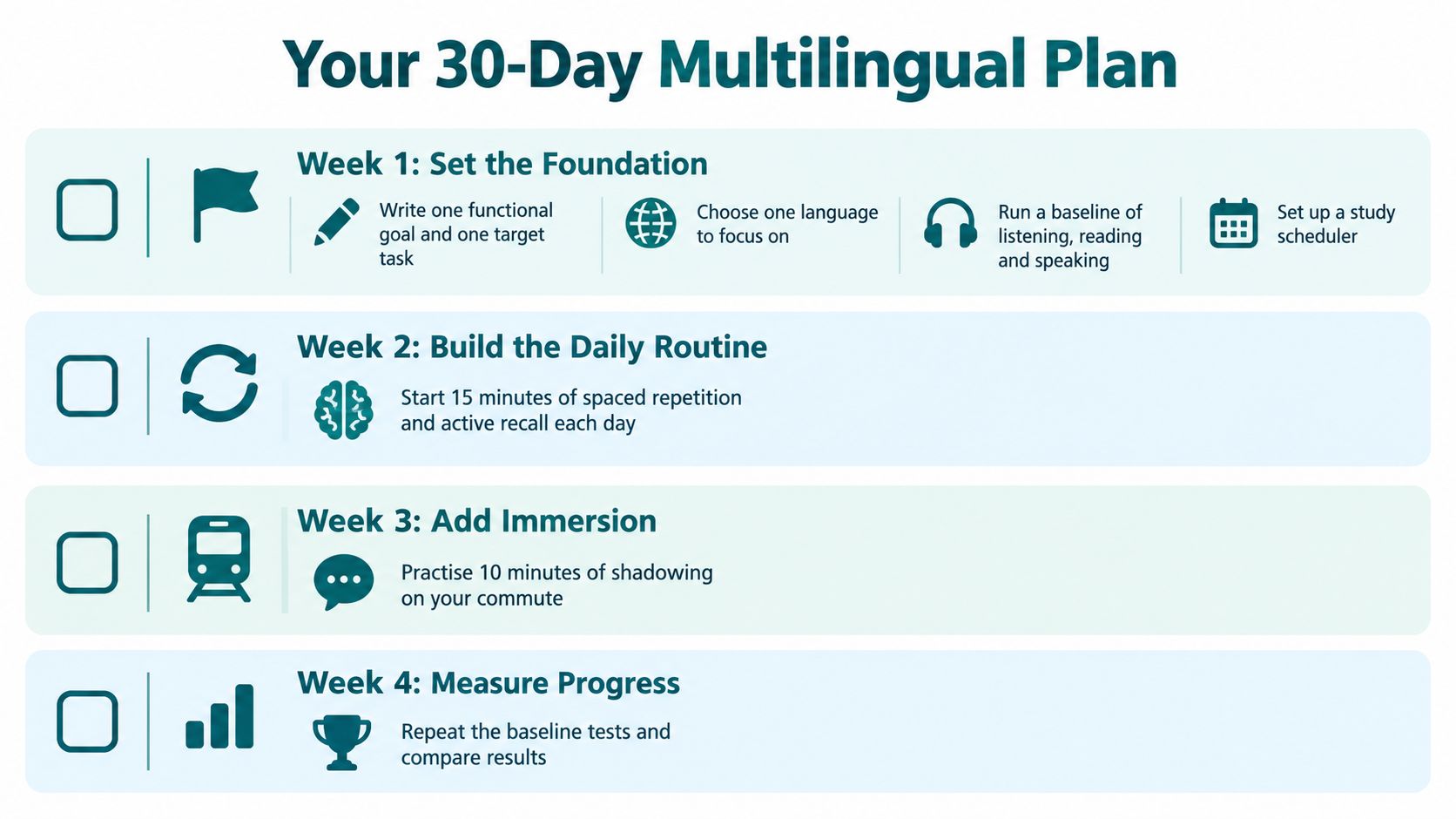
- Week one, establish the starting point. Write the target task, attempt listening, reading and speaking samples, and set up your review system. Save a recording or written result before studying.
- Week two, make practice repeatable. Begin the retrieval-and-production routine and keep the error log. Cut new material if your review queue becomes unmanageable.
- Week three, add realistic listening. Introduce shadowing and use a suitable part of an existing routine for audio practice. Keep it inside your study allowance rather than doubling the workload without notice.
- Week four, check transfer. Attempt fresh versions of the original tasks. Decide whether you need a harder task, a narrower task or more practice with the current one.
Put maintenance in the calendar
The British Council's discussion of languages studied by UK adults reports that only 9% maintained the foreign language studied at school, while 64% wished they'd continued. Build a standing session into the period after your initial plan rather than treating maintenance as optional.
Maintenance check: Decide where you'll use the language next before you finish the current learning goal.
Record the baseline now. A month later, compare what you can complete, not how much material you've collected.
Frequently Asked Questions About Becoming Multilingual
Can adults learn how to be multilingual?
Yes. Adults can learn languages for practical use, such as asking for help, speaking with customers or taking part in conversations at local venues. Early exposure is a separate question: UCL Institute of Education research involving more than 3,000 pupils, with Birkbeck, found that children exposed to multiple languages before age three outperformed monolingual peers through GCSE level. That finding concerns childhood exposure, not an adult learning deadline.
How long does it take to become multilingual?
Set a weekly study allowance, then test what it lets you complete. For example, try three to five hours a week for a month, tracking completed tasks such as handling a shop exchange or following an audio direction. If tasks remain difficult, adjust the hours or narrow the goal. Progress depends on the language, your starting point and the situations you need to manage.
Can apps alone make me multilingual?
Apps can support practice, but real participation also calls for listening and speaking in context. Use audio lessons during commutes or while walking, then try the language in a shop or venue. A translation management system helps organisations manage translated content; it does not teach you to use a language.
Do I need equal fluency in every language?
No. Choose a practical role for each language, such as reading research in one and handling visitor questions in another. The British Academy's report on multilingual research skills describes benefits including access to sources, research topics and international collaboration. Measure whether you can complete those tasks, not whether every language feels equally fluent.
What should I do if my progress stalls?
Pinpoint the step that breaks down: understanding an announcement, finding a word or replying aloud. Practise that step in a similar real setting, then try the task again. If it is still difficult, simplify the task or change its context.
We offer precision navigation with audio instructions and multilingual guidance to help people participate in real places, rather than language lessons. Visit Waymap to discuss your venue's routes, language needs and accessibility requirements, and identify the visitor tasks your guidance needs to support.
