
Oasis Hotel Cancun Mexico: Accessibility Guide 2026

Arriving at Oasis Hotel Cancun Mexico can feel straightforward on paper and overwhelming in real life. You land in Cancun, reach the Hotel Zone, and then discover that the resort you booked isn't a compact building at all, it's a sprawling, multi-structure property where a simple trip to breakfast, the beach, or check-in can turn into a long walk with no clear landmark in sight. For travellers with visual impairments, limited mobility, children, luggage, or a tight itinerary, that gap between “booked” and “navigable” is where the stay either works or becomes draining.
The issue matters because Oasis Hotels & Resorts is not a small player. Travel Weekly describes its Cancun footprint as close to 3,100 guestrooms across seven properties, and Hosteltur shows how the brand has shaped the destination's resort area over time, including 5,952 hotel places in Cancun and nearby Riviera Maya properties in that historical snapshot. That scale helps explain why so many guests keep encountering the same complaint, the resort is large enough that wayfinding becomes a real part of the travel experience, not a minor detail. For a UK audience, that's especially relevant because the Office for National Statistics estimates around 24% of the UK population had a disability in 2023/24, so accessibility-aware trip planning is not a niche concern.
One practical resource worth reading alongside this guide is Top 1 Rank visitor insights, especially if you want to compare how travellers describe large hospitality environments and what they notice once they arrive. The hidden cost of getting lost is not just time, it's energy, confidence, and the sense that a holiday has already started asking too much.
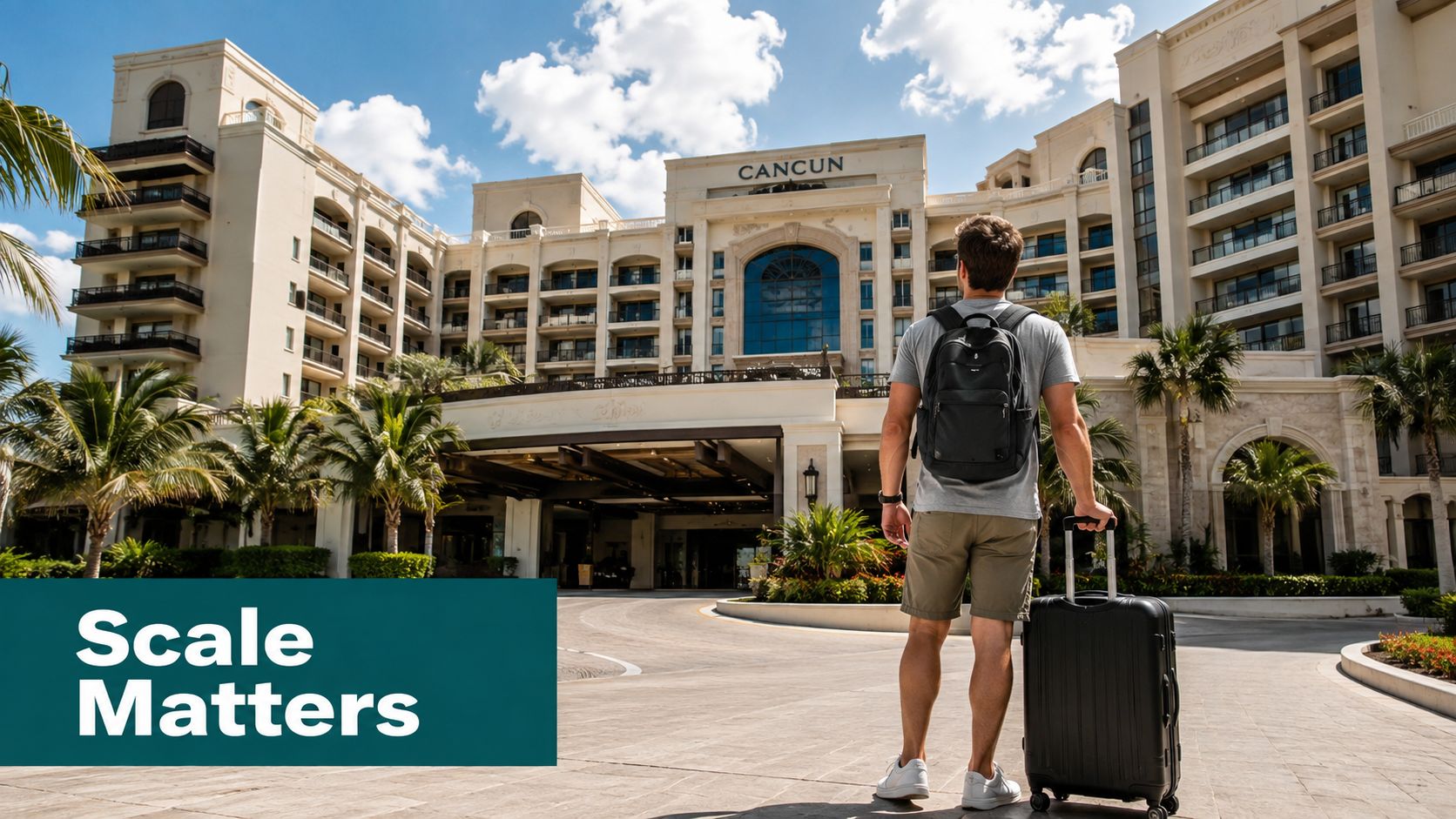
The hidden price of getting lost is a useful lens here, because the main problem at a resort this size is rarely the beach or the room. It's the friction in between.
Why Navigating Oasis Hotel Cancun Matters More Than You Think
You land in Cancun, reach the Hotel Zone, and then discover a sprawling, multi-structure resort where a quick trip to breakfast, the beach, or check-in can turn into a long walk with no obvious landmark in sight. At Oasis Hotel Cancun Mexico, the physical scale changes the basic maths of a holiday. You are not dealing with a boutique lobby and a short corridor. You are dealing with a resort network where distance, density, and repeated decision points matter as soon as you step inside.
Why scale becomes an accessibility issue
That matters most for people who cannot afford to wander. A person with low vision needs reliable cues. Someone using a mobility aid needs routes that reduce unnecessary backtracking. A parent pushing a buggy, or a traveller carrying bags after a late arrival, needs the quickest line between point A and point B, not the most picturesque one. Large resorts often assume the guest will find their way, but that assumption breaks down when the site is extensive and the signs do not answer the practical question of what comes next.
Practical rule: if a resort makes every key journey feel like a scavenger hunt, it has a wayfinding problem, not a guest problem.
The difference between a pleasant resort and a tiring one is often whether navigation is obvious, not whether the lobby looks impressive. That is why the accessibility conversation cannot stop at ramps and room features. It has to include how people move from reception to restaurants, from restaurants to bars, and from bars back to their room without needing repeated staff help.
For travellers who want a broader hospitality context on visitor flow and service expectations, Top 1 Rank visitor insights offers a useful comparison, and Waymap's article on the hidden cost of getting lost gets to the heart of the issue.

Understanding the Oasis Hotels Portfolio in Cancun
Oasis is best understood as a destination operator, not a one-property hotel. Travel Weekly says its Cancun portfolio represented close to 3,100 guestrooms across seven properties, and it identified the 736-room Grand Oasis Cancun and the 1,008-room Oasis Cancun as flagship properties. That is a different proposition from a single hotel with one front desk and one set of facilities, because the brand's reach shapes how the whole Hotel Zone functions.
The scale behind the brand
Hosteltur's historical snapshot adds more context. It reported that Oasis had 5,952 hotel places in Cancun across Grand Oasis Cancun, Oasis Cancun, Oasis Playa, Oasis Beach, Oasis Viva, Oasis América, and Oasis Akumal. It also said the company exceeded 88% occupancy in the first eight months of that year, with 1,461,000 stays sold. Those figures show long-standing demand, but they also show why wayfinding and guest movement matter so much. When a group operates at that size, the navigation challenge is systemic, not accidental.
Oasis Hotels & Resorts was founded in 1987, which gives it nearly four decades of operating history in Mexican hospitality. That history matters because it explains why the company knows the Cancun market so well, but it also raises the expectation that the physical guest experience should match the brand's scale.
Why this matters for planning
For guests, the practical takeaway is simple. A name like Oasis can cover multiple properties with different layouts, different dining footprints, and different access patterns. That means confirmation emails, maps, booking platforms, and taxi drop-offs all need a careful second look before travel. For operators, it means accessibility is not a line-item fix, it's a portfolio issue.
If you want to see how large venue networks are framed in practice, Waymap's waymapped venues page is a useful benchmark for understanding what structured navigation looks like when a property has to serve many different user needs.
A resort group this large can't treat wayfinding as decoration. It has to be part of the service model.
Room Types, Amenities and the Casino Feature
Grand Oasis Cancun is built around a broad inventory, not a handful of suites. The resort is listed with 1,231 rooms and suites, which tells you right away that this is a high-capacity operation designed for volume as much as for comfort. That scale shows up again in the food and beverage mix, with one Cancun property listing 12 restaurants and 15 bars, while another lists 318 rooms, 7 restaurants, and 10 bars on Oasis Hotels' own Cancun page. Those counts matter because they shape the guest journey just as much as the decor does.
What to expect from the room mix
The room offer is best thought of in practical categories rather than a long list of suite names. Travellers will usually be comparing standard all-inclusive accommodation, larger rooms, and upgrade tiers that change the experience more through location and convenience than through novelty. At a property this size, being near the facilities you use most can be more valuable than a minor room embellishment.
The beachfront setting is another core part of the appeal. Multiple independent travel listings place the resort directly on the beach in Cancun's Hotel Zone, so the hotel is structured around both resort life and coastal access. That makes it attractive for people who want to stay on property, but it also means the on-site circulation needs to work well, because guests are moving between room blocks, dining, entertainment, and the beach throughout the day.
The casino is a real differentiator
Grand Oasis Cancun is repeatedly described as the only hotel with a casino in Cancun's Hotel Zone, and the resort's own site says it offers a 24-hour casino. That sets it apart from the standard family-orientated all-inclusive format. It also adds another destination point to an already large property, which increases the need for clear navigation when guests are trying to reach evening entertainment without confusion.
Practical rule: the more amenities a resort packs in, the more important it becomes that guests can find them without asking for help every time.
The trade-off is easy to see. A long list of restaurants, bars, beach access, entertainment, and casino facilities gives guests variety. It also creates more internal movement, more decision points, and more chances to lose time if the site isn't intuitive to cross.
Location, Transport Options and Nearby Attractions
Grand Oasis Cancun sits at Blvd. Kukulcán Km 16.5, Lote 45, 46 y 47 in Cancun's Hotel Zone, and the property is about 16 km from Cancun International Airport according to independent travel listings. That's a straightforward arrival pattern for most travellers, but the last mile still needs planning, especially if you're arriving late, carrying luggage, or trying to coordinate several people at once. The hotel zone address also matters because it places the resort in the same corridor as other major beachfront properties and resort attractions.
How to get there without unnecessary stress
The common options are taxi, ADO bus, private transfer, and ride-hailing services. ADO is often the budget-conscious choice, while private transfer is usually the easier option when you want to reduce friction after a flight. If you want a practical comparison before you book, compare ADO bus vs private transfer is a useful planning reference, even if your trip ends at the resort rather than in central Cancun.
The hotel listing also notes a city tax of USD 4.94 per accommodation, per night on some booking platforms, so it's worth checking the final total before you pay. That's the kind of small charge that can catch travellers out when they compare package rates with direct bookings.
What the area around the hotel means for planning
Cancun's Hotel Zone is built for beach access, dining, and resort hopping, so the resort is not isolated from activity. That is convenient, but it also means guests often move between property life and off-site plans in the same day. When the arrival journey is already long, the internal navigation challenge inside the resort becomes even more important.
For broader arrival and transit planning, Waymap's public transportation directions guide offers a useful framework for thinking about how visitors move from point of arrival to point of stay.
The Navigation Challenge Inside the Resort
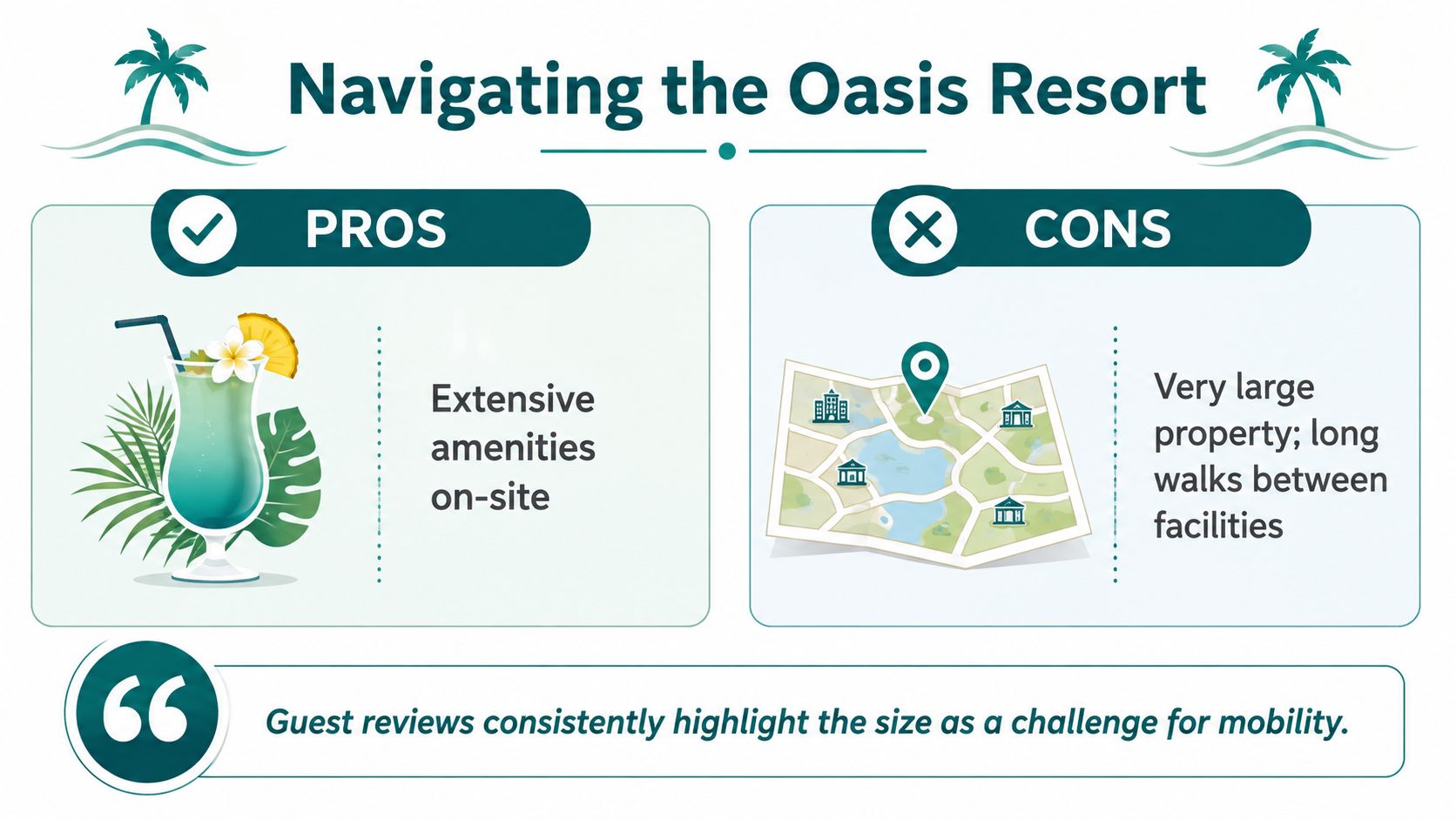
Independent guest reviews keep returning to the same practical issue. The resort is very large, everything is far away from everything, and visitors should expect a lot of walking. This is the defining operational friction of the property. Once you add check-in waits that some guests describe as 1 to 1.5 hours and long lines for restaurants and bars, the movement problem stops reading like an isolated complaint and starts to look structural, especially since does GPS work indoors is a common misconception at properties this size.
What guests are actually reacting to
This kind of feedback matters because it comes from the lived experience of moving through the site, not from brochure copy. A hotel can advertise restaurants, bars, entertainment, and beach access, but guests still have to reach each of those spaces in real time. For a traveller with low vision, reduced stamina, or limited mobility, every extra turn and long corridor changes the shape of the stay. For a family, the same layout means more stops, more waiting, and more chances that someone gets tired before dinner even starts.
The gap in the market is obvious. Most content about Oasis Cancun talks about the beach, the rooms, or the food. Much less content answers the question that matters once you're on site, how hard is it to move around without wasting energy? That omission is exactly why accessibility-minded travellers need a different kind of guide.
Guest reviews consistently highlight the size as a challenge for mobility.
The problem is documented, and it repeats across reviews. If multiple guests describe the same navigation burden, operators can't treat it as a one-off complaint. They need to see it as part of the guest journey that affects satisfaction, confidence, and whether people want to return.
A useful way to think about the resort is not “How much does it offer?” but “How efficiently can people reach what it offers?” The answer to that question is where accessibility, service design, and wayfinding meet.
Booking Tips and What to Expect
Booking the right stay starts with the basics, because this property has enough moving parts to create confusion if you click too quickly. Standard check-in is from 3:00 p.m., and check-out is at noon on multiple independent listings. Expedia also notes a Spring Break cash deposit of USD 30 per stay for guests under 26 during 1 February to 30 April, and the same listing notes the USD 4.94 city tax per accommodation, per night.
What to verify before you pay
Start by confirming which Oasis property you're booking. Cancun has several similar-sounding options, and the difference between them can affect everything from room layout to how far you'll walk for meals. Then check whether the rate you're comparing already includes taxes, resort charges, or deposits, because those can change the total considerably.
It also helps to look at the booking channel itself. Direct hotel pages can be good for property-specific details, while major travel platforms often surface the practical conditions that matter at checkout. Neither replaces reading the small print. That's especially true at a large all-inclusive resort where the headline rate can look simple but the stay itself contains several variables.
A simple pre-arrival checklist
- Confirm the exact property name: Cancun has multiple Oasis-branded options, so the label on the booking page needs to match the hotel you expect.
- Check the timing rules: Standard check-in and check-out times affect transfers, meal planning, and room access.
- Review payment conditions: Taxes and any seasonal deposits should be visible before you finalise the booking.
- Match the stay to your mobility needs: If walking distance matters, ask about room placement and proximity to the facilities you'll use most.
The aim here isn't to overcomplicate the booking process. It's to avoid arriving at a large resort with assumptions that don't hold once you're on property.
Waymap's article on hotel guest experience is a good reference if you want to think beyond rate and room type, and consider how the layout itself affects satisfaction.
How Waymap Can Transform Accessibility at Large Resorts
Large resorts run on movement. Guests need to go from entrance to lobby, lobby to room, room to restaurant, restaurant to beach, and back again. That's where infrastructure-free navigation becomes practical, because it helps the venue solve a real operational problem without adding hardware across a constantly changing site. Waymap uses device-native smartphone sensors and dead reckoning to guide people with sub-3-metre accuracy in environments where GPS, Wi-Fi, or installed beacons aren't a reliable answer. For a property like Oasis Cancun, that matters because the layout is big enough that static signage alone won't solve every route.
Why infrastructure-free guidance fits resort operations
This is the point where accessibility and operations overlap. Physical beacon systems can be difficult to roll out in a resort environment, especially where layouts change, staff turnover is high, and every new installation has to be maintained over time. That friction is why navigation projects often stall at the planning stage. In practice, venue teams need something they can update without reopening walls, re-running cables, or creating more maintenance work for engineering staff.
The regulatory context also matters. The Equality Act 2010, ADA Title III, and BS 8300 all create pressure on venues to make access more usable, not just nominally compliant. The challenge for many operators is that compliance still has to be funded, maintained, and explained internally. NHS estates teams face capital spend restrictions, transport operators face the burden of maintaining hardware in high-footfall environments, and retail and leisure venues need a case that speaks to both compliance and dwell time. A navigation layer that doesn't depend on fixed infrastructure is easier to deploy across those realities.
Waymap's live deployments at WMATA, SBS Transit, and Lord's Cricket Ground show that the model works in complex public environments where visitors need accurate guidance and operators can't afford brittle hardware stacks. That same logic applies to a large Cancun resort with multiple destinations inside one property.
What good resort wayfinding should do
It should replace guesswork with route clarity. It should let staff spend less time giving repeat directions. It should make it easier for disabled visitors to move independently. It should also be updateable when dining spaces, entrances, or points of interest change.
For smaller hospitality teams looking for early wins in digital transformation, ScanStay's quick wins for small hosts is a useful comparison point, because it shows how practical improvements can start before a full-scale redesign.
Waymap is one option that turns static signage into a dynamic, updateable wayfinding layer, which is the kind of change that supports guest satisfaction and strengthens ESG credentials at the same time. For a resort as large as Oasis Cancun, that's not an accessory. It's the difference between a property people admire and a property people can move around with confidence.
If you manage a large hotel, resort, or leisure venue, Waymap can help turn confusing spaces into routes guests can follow independently. It's built for places where static signs fall short and where accessibility has to work in the world, not just on a floor plan.
