
A Guide to Magnetometer Accuracy for Indoor Navigation in 2026
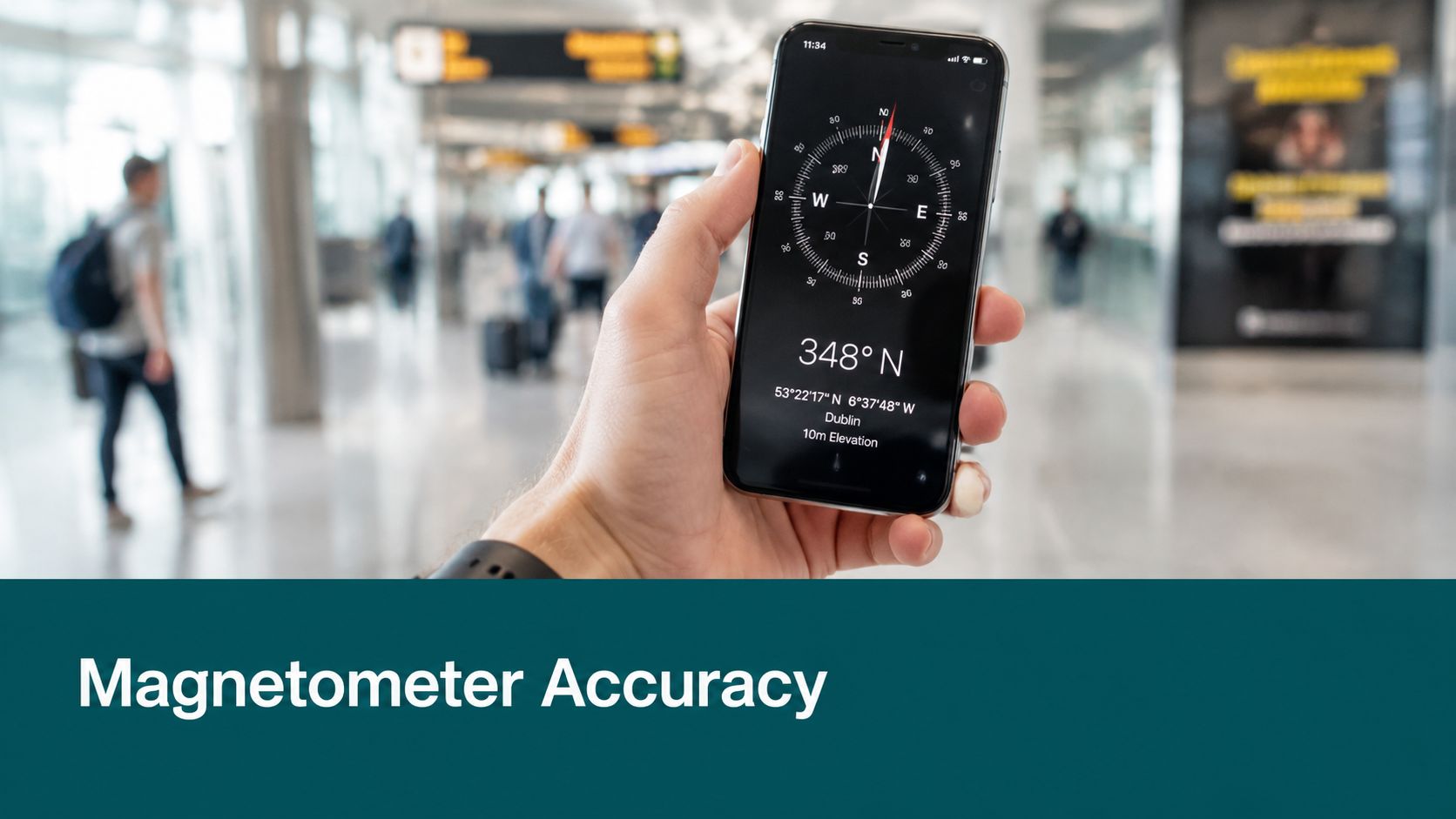
For anyone running a large, complex venue—be it a bustling transit hub or a sprawling shopping centre—the visitor experience is everything. A huge part of that experience now relies on dependable wayfinding, especially when a visitor, perhaps someone with a visual impairment, is using a smartphone for step-by-step audio directions. But how does the phone know which way you’re facing? That all comes down to its built-in magnetometer.
Think of the magnetometer as a tiny digital compass inside every smartphone. It’s the sensor that tells an app your ‘heading’, or the direction you’re pointing. When it works, it’s brilliant. When it doesn’t, the whole navigation experience can fall apart, failing to meet crucial accessibility obligations under standards like the Equality Act 2010 or ADA Title III. Understanding magnetometer accuracy is the first step to providing a truly inclusive visitor experience.
What's the problem with magnetometer accuracy in large venues?
Magnetometers are notoriously sensitive and prone to errors, particularly inside modern buildings. This weakness leads to a persistent problem for indoor navigation known as ‘drift’.
Drift is what happens when small, compounding errors in heading make the blue dot on your map slowly but surely stray from your real-world position. An error of just a few degrees can be enough to send a user dozens of metres off course, turning a simple trip into a confusing and frustrating ordeal.
This sensitivity is a major headache for venue operators. The magnetic field inside a building is a chaotic mess of interference from structural steel, electrical systems, and moving metal objects like lifts and escalators.
To help visualise the problem, here are some of the most common culprits that throw magnetometers off course in public spaces.
Key Sources of Magnetometer Error in Public Venues
| Error Source | Description | Example in a Transit Hub or Shopping Centre |
|---|---|---|
| Hard Iron Distortion | Caused by permanent magnets or magnetised metals near the sensor, creating a constant, fixed magnetic offset. | Speakers in PA systems, security tag deactivators at store entrances, or even the small magnets in a phone case. |
| Soft Iron Distortion | Caused by materials that become temporarily magnetised when in the Earth's magnetic field, distorting it locally. | Structural steel beams, rebar in concrete floors, metal door frames, lifts, and escalators. The effect changes as you move. |
| Environmental Noise | Interference from electrical currents, which generate their own magnetic fields. This is often unpredictable. | High-voltage power cables in walls and ceilings, large digital advertising screens, Wi-Fi routers, and HVAC systems. |
As you can see, the very things that make a modern venue functional are often what make a magnetometer unreliable. This inherent conflict puts venue managers in a tough spot.
Why a hardware-first fix creates more problems
Many technology vendors see this problem and propose what seems like a logical solution: install more hardware. They suggest blanketing the venue with physical devices, usually Bluetooth beacons, to constantly correct the phone’s position and override the faulty magnetometer data.
This approach, however, simply trades one problem for another.
- Massive Upfront Cost: Buying and installing thousands of beacons across a large site is a major capital investment. This is a significant friction point for budget holders, particularly in sectors like the NHS where capital spend is heavily scrutinised.
- Constant Maintenance: This hardware isn't 'fit and forget'. Batteries die, units get damaged or moved during cleaning and refits, and firmware needs updating. It all adds up to a significant operational burden and recurring cost.
- A Constantly Changing Environment: The magnetic 'map' of a venue is never static. A new shop fit-out, a temporary metal construction hoarding, or even a parked cleaning vehicle can warp the magnetic field, making previously reliable areas suddenly inaccurate.
For places like unmanned buildings, where accurate indoor navigation is vital for maintenance or security, the hardware-first approach is often a non-starter. As specialists in deploying smart building sensors in the UK point out, sensor reliability is the bedrock of any smart infrastructure.
The constant need for maintenance makes hardware-heavy solutions impractical for dynamic, high-traffic venues. This is precisely why the real innovation lies in overcoming magnetometer flaws without needing to bolt more expensive, high-maintenance kit to the walls. It’s about building a system that’s smart enough to work with the sensors already in everyone's pocket, which is how we ensure we can track the blue dot's true position.
How do you measure and define magnetometer accuracy?
When it comes to indoor navigation, “high accuracy” is a phrase that gets thrown around a lot. But what does it actually mean? For anyone managing a large venue like a transport hub or a shopping centre, understanding the real-world implications of magnetometer accuracy is the first step towards asking the right questions of a navigation provider.
Vague claims are meaningless without the data to back them up. The real goal is to measure how closely a smartphone’s sensor output matches the true, local magnetic field. It’s a complex technical discipline, and it starts by understanding the common errors we need to correct.
The Core Metrics of Magnetometer Performance
Think of calibration as teaching the sensor how to properly see the magnetic world around it. This process corrects for tiny flaws in the hardware and its installation. There are three crucial errors that absolutely must be addressed.
- Zero-Gauss Offset: In a perfect world, a sensor in a zero-magnetic field would read zero. But due to tiny manufacturing imperfections, it rarely does. Calibration finds this built-in offset and subtracts it from all future readings to get a true baseline.
- Scale Factor Error: This error affects the sensor's sensitivity. It’s about whether the sensor’s output scales correctly as the magnetic field gets stronger or weaker. An uncorrected error means the sensor might overreact or underreact to magnetic changes, throwing off direction.
- Non-Orthogonality Error: A magnetometer uses three separate sensors mounted on what should be perfectly perpendicular (orthogonal) axes—X, Y, and Z. If they aren't at perfect 90-degree angles, the directional reading gets distorted. Calibration mathematically fixes this misalignment.
While anyone can perform a basic calibration by moving their phone in a figure-eight pattern, truly characterising a sensor’s performance demands scientific rigour. This is often done in highly controlled environments using specialised equipment like a Helmholtz cage, which creates a known, uniform magnetic field for testing.
This level of precision isn't just an academic exercise; it’s fundamental to building reliable navigation. For instance, the UK Space Facilities at Imperial College London have achieved incredible benchmarks, recording a scale factor better than 0.01% and alignment precision better than 0.1°. As you can see in the UK Space Facilities' magnetometer testing data, these standards show what’s possible with serious calibration.
For Waymap, this level of technical understanding is crucial. Our algorithms are built on a deep appreciation for sensor limitations. We don't just hope a magnetometer is accurate; our system is designed to work even when it isn't.
Once you understand these error sources, it becomes clear why relying solely on raw magnetometer data is a flawed strategy. A robust indoor navigation system has to intelligently combine this data with other sensor inputs. You can find out more about how we blend these inputs in our guide to the sensor fusion algorithm.
This is the sophisticated approach that separates a truly functional navigation tool from one that fails in the complex, magnetically noisy environments of public spaces.
What causes magnetometer errors in smartphones?
If you’ve ever tried to build an indoor navigation system that relies on a user's own phone, you’ll know the single biggest headache is the magnetometer. While these sensors are incredible feats of miniaturisation, they are notoriously flaky, especially inside the magnetically chaotic environments of public venues. To truly understand why you can't just trust their raw data, you have to dig into where the errors come from.
These errors generally fall into two buckets: distortions caused by magnetic materials in the world around you, and the inherent flaws in the sensor technology itself. These aren't just abstract problems; they are practical, everyday challenges that affect every single smartphone.
How do hard vs soft iron distortions affect accuracy?
The most common gremlins in the machine are hard iron and soft iron distortions. They sound similar, but they mess with magnetometer readings in completely different ways.
Hard Iron Distortion: This comes from objects with a permanent magnetic field that are attached to, or part of, the phone itself. Think of the tiny magnets in your phone’s speakers, the vibration motor, or even that magnetic clasp on your phone case. This interference is constant and moves around with the phone, adding a fixed offset to every reading it takes.
Soft Iron Distortion: This is a much trickier problem. It's caused by nearby ferrous materials that aren't magnetic on their own, but which warp and bend the Earth's natural magnetic field as it passes through them. In a large building, these sources are everywhere: structural steel beams, reinforced concrete, metal door frames, lifts, and escalators. The effect changes as you move, warping the local magnetic field in unpredictable ways.
For a venue operator, this is a crucial distinction. You can often correct hard iron errors with a one-time calibration routine—the old "figure of eight" motion. But soft iron errors are part of the environment itself and are constantly changing. Someone walking past a steel pillar or riding an escalator will see their magnetometer's readings go haywire, causing their navigation to drift off course.
How do inherent sensor and device flaws impact performance?
Even if you could create a magnetically perfect environment, the hardware itself brings its own set of challenges. This is a massive point of friction for any 'bring your own device' (BYOD) navigation solution.
Two key issues are sensor noise and device-to-device variation. Every electronic sensor produces a small amount of random, electronic "fuzz" that can obscure the true signal. More importantly, the quality, placement, and factory calibration of magnetometers vary wildly between different smartphone models—and even between two identical phones off the same assembly line.
This means a navigation app can't just assume the data from a brand-new iPhone is anything like the data from a three-year-old Android device. Each phone has its own unique error profile. Any system that can't account for this incredible variation is doomed to be unreliable for a huge number of its users.
These challenges really drive home the need for a system that doesn't just blindly trust the magnetometer. Instead, it must actively interpret, question, and correct the data using other sensors, a concept we explore in our article on how inertial measurement units work.
An intriguing approach to navigating without GPS is to turn a building’s magnetic interference from a problem into a solution. This technique, known as magnetic mapping or ‘fingerprinting’, involves using those unique distortions as a sort of invisible map. The idea is to meticulously survey a venue, creating a detailed chart of its magnetic ups and downs, which a smartphone could then follow to find its position.
On the surface, it’s a clever way to tackle a tricky problem. But when you start to consider the reality for venue operators, especially in busy, ever-changing places like shopping centres or transport hubs, the practical drawbacks quickly become apparent.
The Problem of a Constantly Shifting Landscape
The heart of the issue is that a building's magnetic fingerprint is anything but static. It’s in a constant state of flux.
- The Initial Burden: Creating that first magnetic map is a huge undertaking, both in terms of time and cost. It requires specialists to physically walk every square metre of the venue with highly sensitive equipment.
- The Never-Ending Upkeep: Worse yet, any change to the building's structure or contents demands an immediate, and equally costly, re-survey. A shop refitting its interior, a temporary metal wall going up for construction, or even just moving large metal display units can make the magnetic map useless overnight. This creates frustrating ‘no-go’ zones where navigation simply breaks down.
These distortions are the direct result of how different materials interact with the Earth's magnetic field.
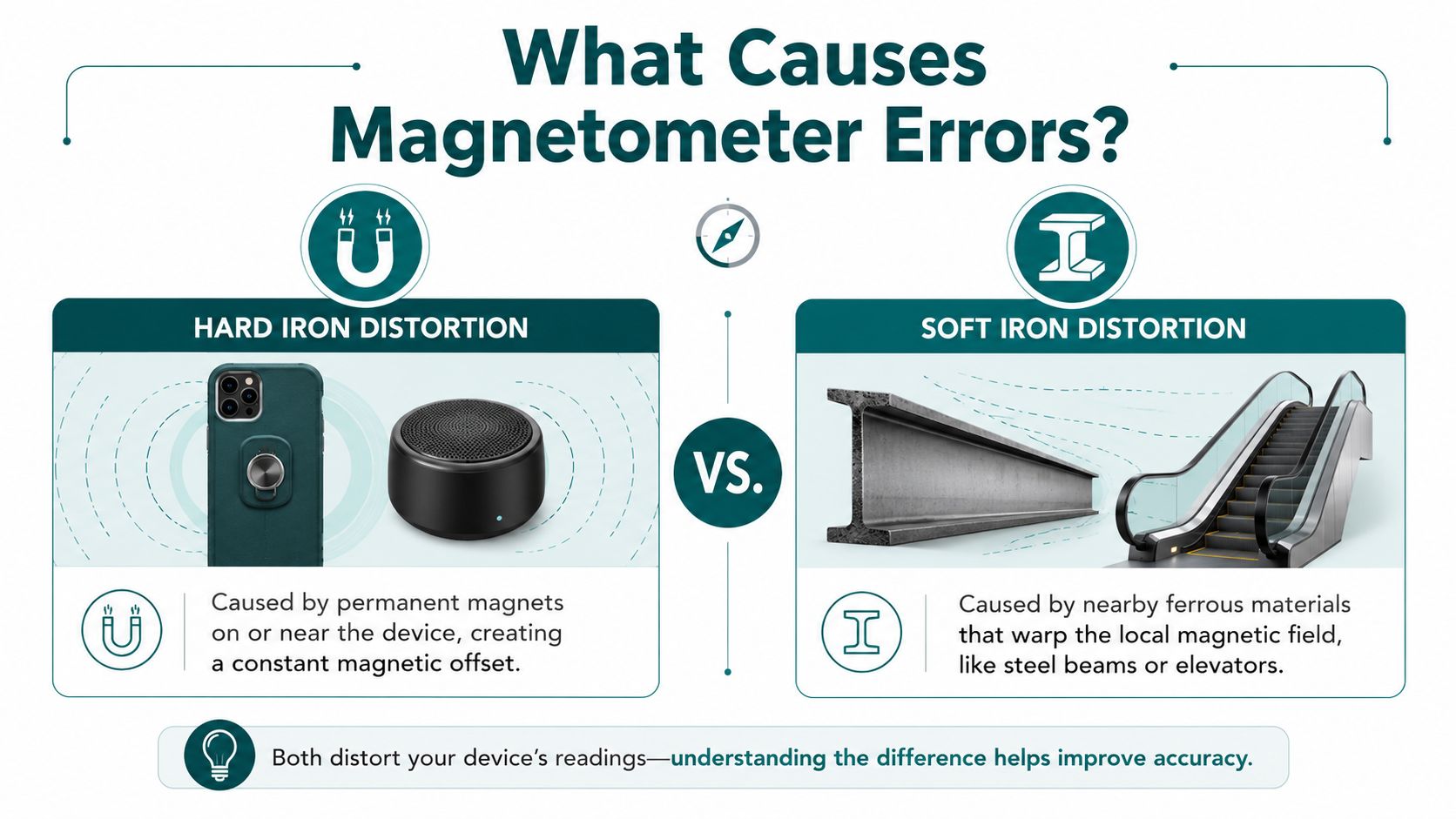
As the graphic shows, both permanent (hard iron) and temporary (soft iron) magnetic distortions mean that any physical change, from installing a new vending machine to relocating a security scanner, will warp the magnetic map and throw off positioning accuracy.
While the core concept has merit, the immense maintenance overhead makes magnetic fingerprinting impractical for the vast majority of real-world public spaces. The technology is just too fragile for dynamic environments that need to adapt and evolve. This is precisely why our own approach to mapping and navigation focuses on building resilience, rather than relying on an environmental factor that can change at a moment's notice.
Seeing the Bigger Magnetic Picture
Looking beyond individual buildings, the quality of background magnetic data on a national scale is improving dramatically. A great example is the UK's 2023 initiative to deploy five quantum magnetometers across the country. This network provides complete national coverage with sensors capable of detecting changes 100 times smaller than standard devices.
For a system like Waymap, which often guides people through signal-dead zones like underground stations, this higher-quality reference data is incredibly valuable. It allows us to continuously refine and enhance our algorithms, making our own system even more robust.
How Waymap Achieves High Accuracy Without Relying on the Magnetometer
If you try to build an indoor navigation system by relying on a phone's magnetometer alone, you’re setting yourself up for failure. The magnetic chaos inside any modern building, combined with the wild variations between smartphone sensors, means a simple compass heading will quickly lead you astray. This is why so many other systems fall back on expensive and high-maintenance hardware like Bluetooth beacons.
We decided to take a different path.
Our system was designed from the ground up to handle poor magnetometer accuracy. We see it as a low-trust, sometimes useful, piece of the puzzle. Instead of trying to fix the sensor, we built a smarter system that works around its flaws.
This is all possible thanks to a world-first algorithm that uses dead reckoning, fusing data from the sensors already built into every smartphone.
Proprietary Technique: Fusing Sensors to Find the Truth
Our proprietary algorithm combines information from a phone's accelerometer and gyroscope. Together, they create a highly accurate picture of your movement—your steps, your speed, and every turn you make. This is our dead reckoning engine. The magnetometer’s heading data is just one input, and our system is smart enough to down-weight or even ignore it when it contradicts the more reliable motion data.
This sensor fusion is then anchored by a detailed digital map of the venue. The algorithm knows you can’t walk through walls, jump between floors, or turn down a corridor that doesn’t exist. By constantly cross-referencing the fused sensor data with the map's layout, Waymap corrects for drift in real time.
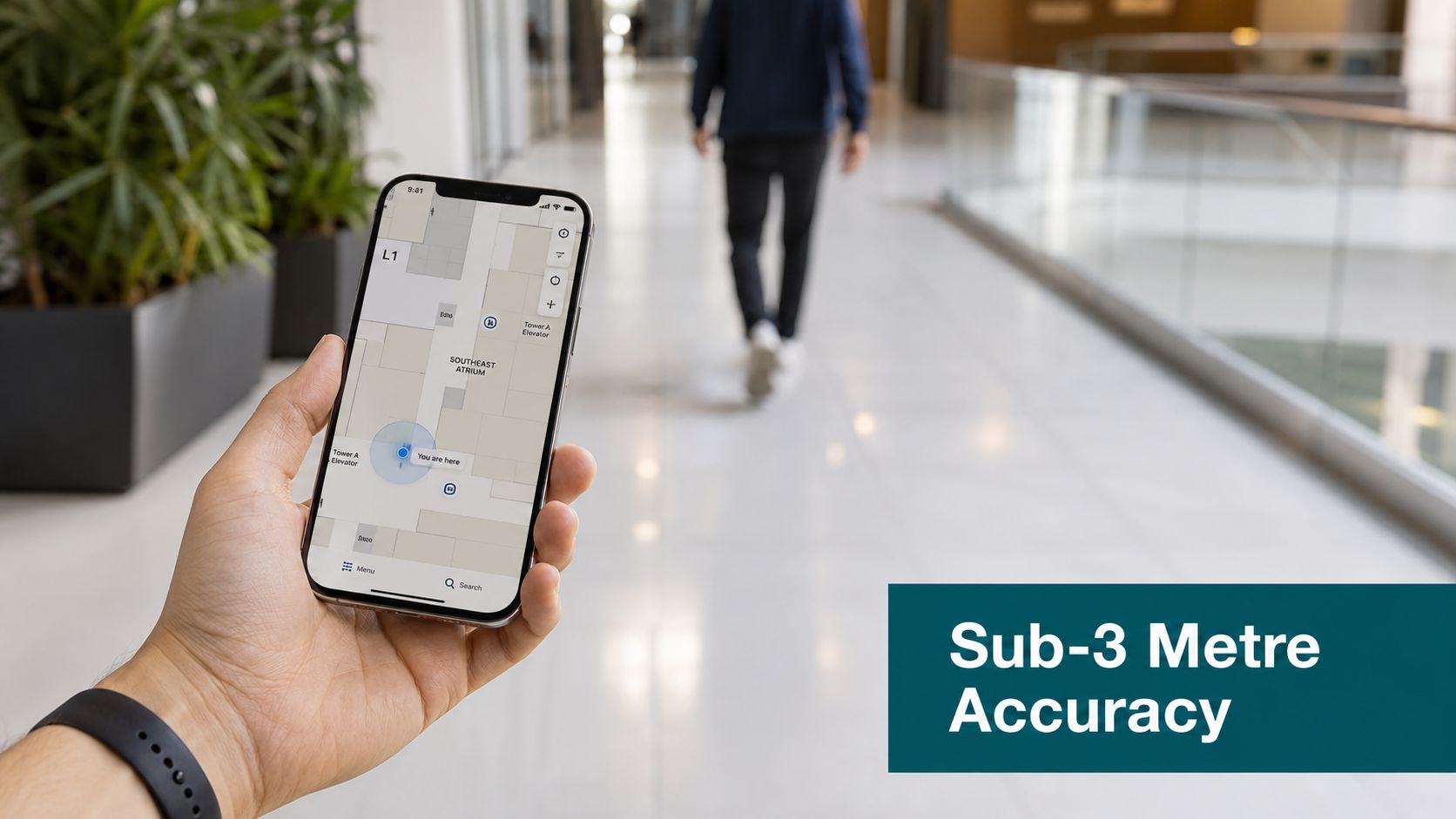
This unique approach allows Waymap to achieve consistent sub-3-metre accuracy in infrastructure-free environments. We don’t need beacons, Wi-Fi, or magnetic fingerprinting to deliver reliable, step-by-step navigation.
Named Deployment: Delivering on Accessibility in Complex Environments
This isn’t just a technical achievement; it’s fundamental to meeting crucial accessibility obligations under standards like the Equality Act 2010 and BS 8300. Our technology was built first for blind and visually impaired users. For them, a navigation error isn't just an inconvenience—it can be a serious barrier that shatters confidence and independence.
An inaccurate heading can send someone into a wall, towards a staircase, or into a restricted service area. By engineering a system that is robust against magnetometer errors, we provide a tool that people can genuinely trust. Our work with major transport operators like WMATA in Washington D.C., where we provide audio navigation across 15 Metrorail stations, proves this model works in the most complex, real-world environments.
This focus on software-led accuracy gets rid of the cost and operational headache of physical hardware—a major pain point for venue managers and transit operators. It delivers a more dependable experience for every visitor while fulfilling essential accessibility standards. To dive deeper into this approach, you can learn more about our signal-free location technology.
What questions should I ask a navigation provider about magnetometer accuracy?
When you’re looking at different indoor navigation providers, it’s all too easy to get swayed by vague promises of “high accuracy.” As a venue operator or transit manager, though, you need to dig deeper. You have to ask the right questions – the ones that cut through the marketing jargon and really get to the heart of how robust and cost-effective a solution truly is over the long term.
The right questions will quickly expose systems that are fragile, expensive to maintain, or too dependent on the often-flawed data from a smartphone's magnetometer. Before you even think about a contract, make sure you get clear, confident answers to the following. These are designed to uncover the hidden technical weaknesses and operational costs that many vendors would rather not talk about.
Questions About Technical Resilience
Start by testing how the system copes with the real world's magnetic chaos. The answers will show you if the tech is genuinely resilient or if it just works well in a pristine lab environment.
How do you handle the soft iron interference from escalators, lifts, and structural steel? This is a deal-breaker. Any system that leans too heavily on magnetometer readings will falter in these magnetically messy areas, which are simply a fact of life in any large venue.
What’s your calibration process for a new user? Do they have to do the awkward "figure-eight" dance every time? Or does the system calibrate itself, automatically and continuously, in the background? A solution that demands constant manual calibration is going to create a frustrating and inconsistent experience for your visitors.
How does your system perform when a phone's magnetometer is poorly calibrated or just low quality? Smartphone hardware varies wildly. A robust system must be able to deliver accurate navigation even with poor sensor data. If it can't, it's going to fail a huge chunk of your audience.
Questions About Lifetime Cost and Maintenance
It’s not just about the initial setup fee; you need to understand the total cost of ownership. The biggest costs are often the ones hidden in long-term maintenance, particularly for systems that rely on physical hardware.
The most crucial question is often the simplest one: What is the operational cost of maintaining your system's accuracy over five years?
This simple question forces a vendor to be honest about the real-world costs of battery replacements, hardware failures, and the labour needed for re-mapping and upkeep.
This is where you see the stark difference between software-first and hardware-first approaches. Systems that don't need beacons or magnetic fingerprinting have a dramatically lower lifetime cost. They're immune to the constant environmental changes that can plague other technologies.
For instance, a 2018 UK educational project proved that even low-cost sensors can achieve incredible precision when the software behind them is intelligent enough. It's a clear demonstration that smart software, not expensive hardware, is the real key to accuracy. You can read more about how accessible technology can deliver precise results on the NORA repository.
Your Questions on Magnetometer Accuracy, Answered
We often get questions about the tiny compass inside our smartphones—the magnetometer—and how it works for indoor navigation. Here are some of the most common queries, with straight-talking answers from our experts.
How accurate is a smartphone magnetometer?
A smartphone magnetometer’s accuracy is highly situational. Outdoors, away from magnetic interference, it can be quite reliable for determining heading. However, indoors, its precision is easily degraded by structural steel, power lines, and electrical equipment, making its raw data unsuitable for reliable step-by-step navigation.
What is the best way to improve magnetometer accuracy?
The most effective method for improving magnetometer accuracy is through software using sensor fusion. This technique intelligently combines the magnetometer’s heading data with more reliable motion data from the phone's accelerometer and gyroscope. By cross-referencing these inputs against a known map, the system can correct for magnetic interference in real time, a far more robust solution than temporary fixes like manual calibration.
Does magnetometer accuracy affect battery life?
A magnetometer sensor itself uses very little power. However, the software algorithms needed to constantly process its data, filter out noise, and fuse it with other sensors can significantly impact a phone's battery life. A key differentiator for an indoor navigation provider is the efficiency of their algorithms; a system like Waymap is optimised to deliver sub-3-metre accuracy without causing excessive battery drain.
Ready to provide truly reliable, hardware-free navigation in your venue? Contact the Waymap team to learn how our software-first approach delivers step-accurate directions for every visitor. Find out more at https://www.waymapnav.com.
