
London Underground Accessibility Guide 2026
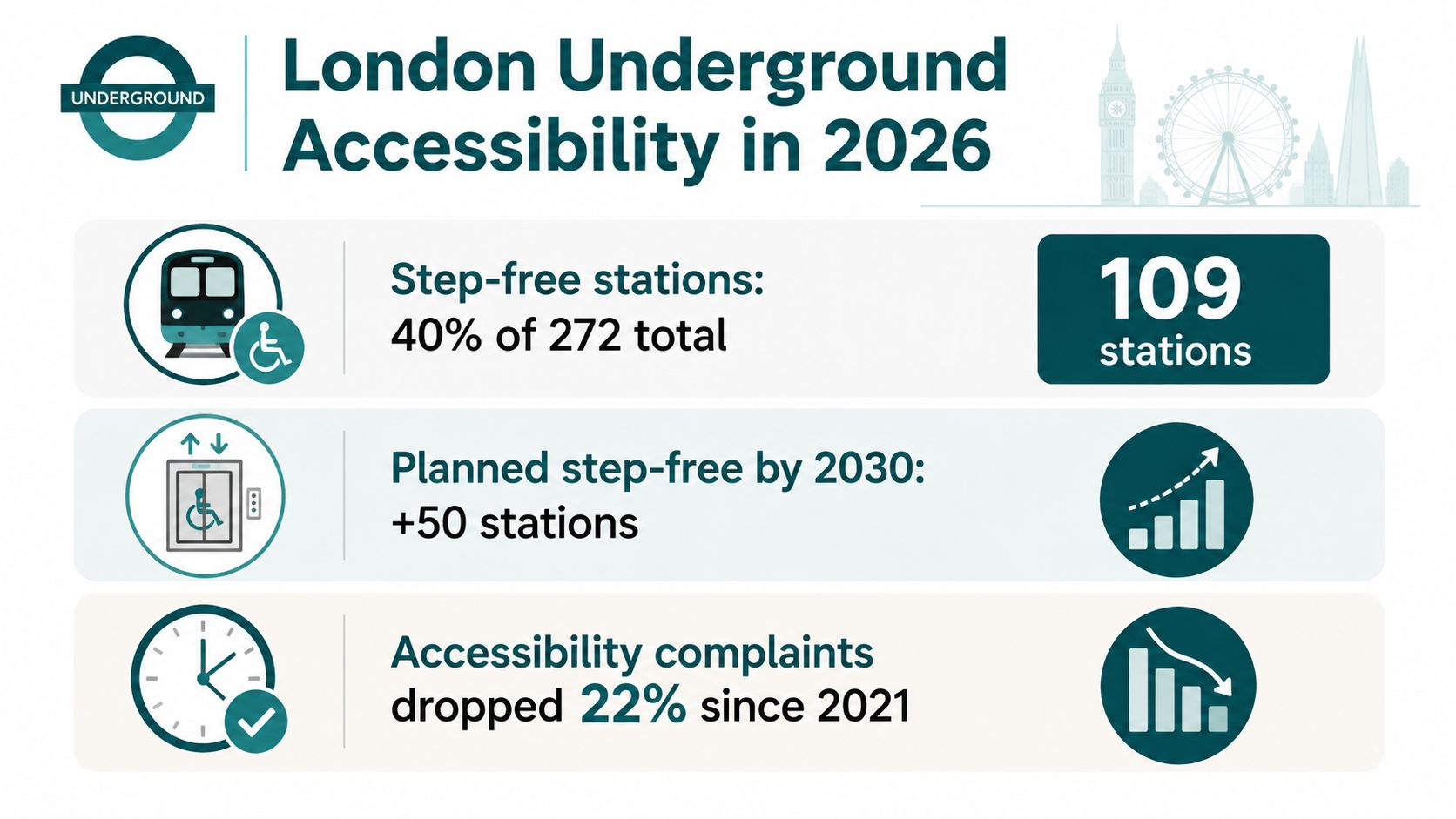
London Underground accessibility is no longer a story of total exclusion, but it's still nowhere near universal. 94 of 272 stations were step-free from street to platform by December 2025, which is 34% of the network, and that headline matters only if you read it alongside the harder truth, step-free access still doesn't guarantee independent boarding, clear wayfinding, or a journey that survives a lift outage (TfL accessibility overview).
For wheelchair users, blind and low-vision passengers, and people travelling with prams or heavy luggage, the Tube still behaves less like one network than several overlapping systems. Some stations are straightforward. Others are technically accessible on paper, then become difficult or impossible in practice because the route depends on staff support, ramps, lifts, signage, or digital wayfinding that breaks down when the station gets busy.
The State of London Underground Accessibility in 2026
Transport for London's current position is clear enough. 94 of 272 stations are step-free, which puts the network at 34% accessible from street to platform. That is a material change from earlier years, but it still leaves most of the Tube outside independent step-free travel.
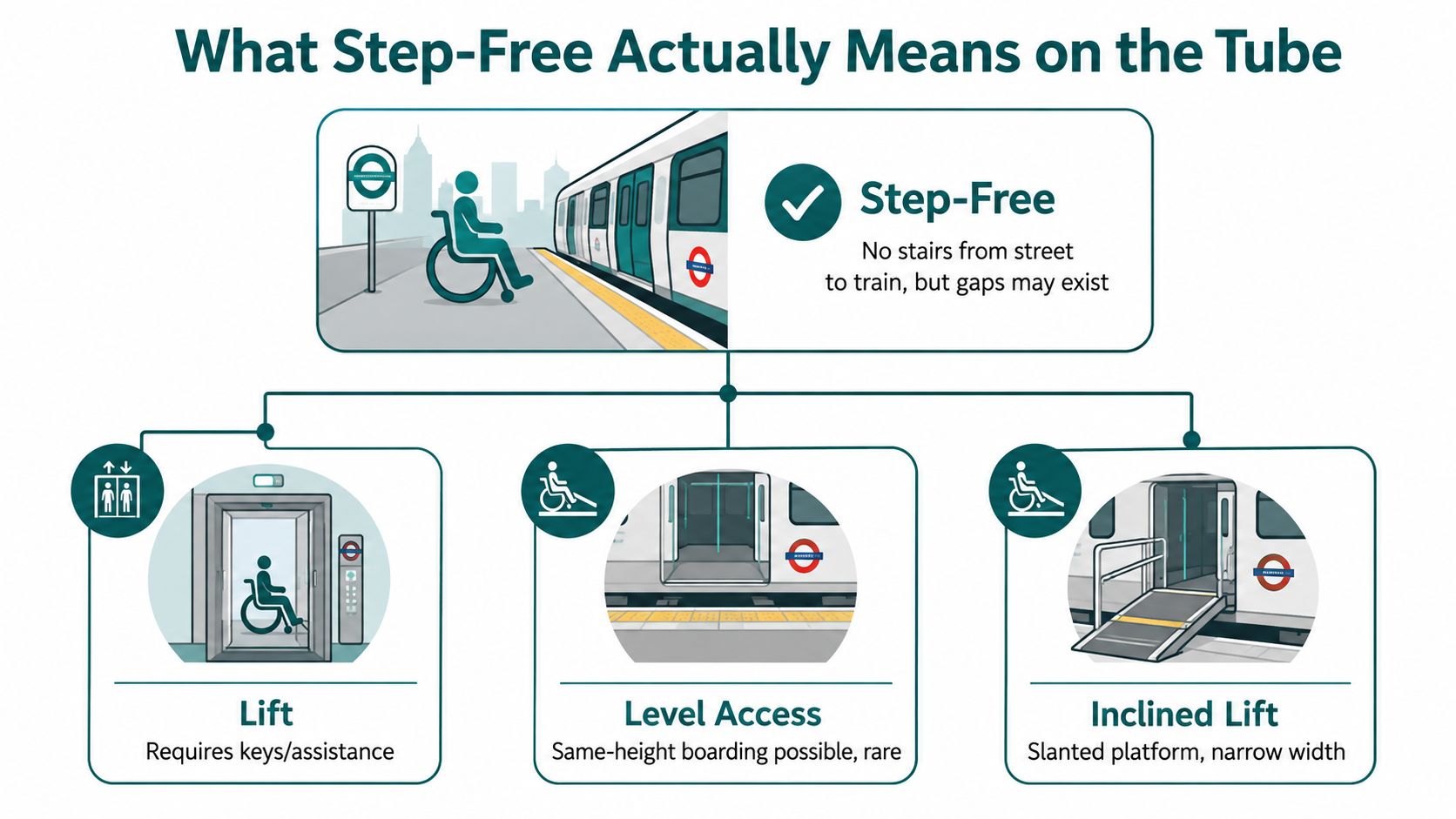
The more important point is that step-free does not describe a single passenger experience. TfL's own guidance says it can mean lifts, inclined lifts, level access, ramps, or manual boarding ramps, depending on the station (TfL accessible travel policy). A station can therefore count as accessible on paper while still requiring assistance at the platform edge, on the train, or at the gateline.
The headline count hides the passenger experience
A Tube station can meet the formal definition and still fail the journey when a lift is out of service, when a platform gap is too large, or when signs send a passenger the wrong way. Visit London notes that some London Underground trains can require a step up or down of as much as eight inches, or 20 cm, when boarding (Visit London guide). In engineering terms that is a small gap, but in lived experience it can decide whether a trip is possible at all.
That gap is only one layer of the problem. For blind and low-vision passengers, the challenge is often the station itself, multiple entrances, platform changes, crowded concourses, and unreliable GPS underground turn station-scale movement into a separate task from getting through the lifts. Wayfinding is also where policy meets legal duty, which is why the public sector equality duty matters in practice, not just in principle (EIT Urban Mobility navigation testing).
Practical rule: if a station page only says “step-free”, read further. You need to know whether that means lift access, ramp access, or boarding that still depends on staff assistance.
The network has improved, but the basic conclusion remains the same. London Underground accessibility is still a mix of real progress and partial completion, and the gap between those two states is where most journeys are won or lost. For readers looking at policy, procurement, or design, that gap is the part that changes how the system works.
How the Tube Got Here
The Tube's accessibility story is a retrofit story. The network began operating in 1863, long before inclusive design was part of transport planning, so today's progress has been added onto a system that was never designed for universal access (TfL accessibility overview). That history still shapes what can be changed, because deep tunnels, narrow station footprints, and legacy structures limit how far each upgrade can go.
The policy shift came late
Until 1993, wheelchair users were barred from the Underground under fire regulations, which makes clear how recent access on the network really is (Disability Grants history). The policy break came with the Jubilee line extension in 1999, when accessibility started to be treated as a design requirement rather than an afterthought (Disability Grants history).
That shift did not create a fully accessible system overnight. It began a long retrofit cycle that has moved station by station, not network-wide. By 2010, only 61 of 270 stations were step-free, roughly one-third, and by 2017 that had risen to 71 of 270 (TfL accessibility overview). TfL later reported 84 fully accessible stations in August 2021, then 92 step-free stations in 2021/22, before reaching 94 of 272 by December 2025 (TfL accessibility overview; Disability Grants history).
The pattern matters more than any single milestone. London Underground accessibility has advanced, but only through layered upgrades that leave large parts of the network unchanged for long stretches. For a passenger, that means the difference between a usable journey and a blocked one often depends on which station they need, not on the line as a whole.
Modern design sets a different benchmark
The contrast with the Elizabeth line shows what happens when access is built in from the start. All 41 Elizabeth line stations are step-free, while only around a third of Tube stations are accessible (TfL accessibility overview). The gap is not cosmetic. It shows how much easier inclusive access becomes when lift space, circulation routes, and platform interfaces are planned together rather than inserted into existing geometry.
The retrofit era also creates a second problem once vertical circulation is solved. A station can be step-free and still leave passengers guessing about entrances, platform changes, boarding points, and the right route through a complex site. As Waymap has argued in why stop at step-free access, accessibility does not end at the lift door. The operational issue for London is not only adding accessible stations, but making the whole journey legible for passengers who do not want to rely on staff assistance or trial and error.
Each improvement remains local, costly, and constrained by live operations. A lift shaft has to fit around utilities, structures, and moving trains. A station upgrade can solve one barrier without fixing the rest of the journey. That is why London Underground accessibility still reads as partial in 2026, even after years of steady retrofit work.
What Step-Free Actually Means on the Tube
“Step-free” sounds absolute. On the Tube, it usually describes a route that avoids stairs somewhere in the journey, not a guarantee that every part of the trip is barrier-free. TfL's own policy sets out several different access types, including lifts, inclined lifts, level access, ramps, and routes that still require a manual boarding ramp before someone can board the train (TfL accessible travel policy).
Street-to-platform is not the same as boarding the train
The phrase step-free from street to platform matters, but it does not mean level boarding. A passenger can reach the platform without stairs and still meet a gap between the platform edge and the train. That is the point at which the journey can shift from independent movement to assisted boarding, and Visit London's guidance makes clear that some boarding movements can still involve a step of up to 20 cm (Visit London guide).
That distinction matters because station pages often compress several different realities into one accessibility label. A route may be usable in principle, yet still depend on timing, staff assistance, or a ramp being available when the train arrives. For a passenger planning a trip, the difference between “can reach the platform” and “can board without help” is not a technicality. It is the gap between a journey that feels manageable and one that may fail at the last metre.
What to check before you travel
A useful habit is to open the station page and look for the access type, not just the accessibility badge.
Check for these details every time:
- Access mode: lift, inclined lift, level access, or ramp.
- Boarding note: whether a manual ramp is needed for the train.
- Interchange route: whether changing lines means leaving the accessible path.
- Lift status: if the journey depends on a single lift.
- Exit choice: whether the entrance you need is the one with step-free access.
The useful lesson is simple. Step-free is a category, not an outcome. If the boarding gap, the lift, or the interchange route fails, the trip still fails.
Why step-free access is only the start makes the same point from another angle. For operators, the issue is broader than adding accessible stations. The passenger experience is shaped by the weakest link in the chain, and the station page only helps if it tells the truth about that chain.
Three Journeys Through the Same Station
A busy Zone 1 interchange can look accessible on the map and still break apart in use. Three passengers can pass through the same station in the same hour, and each one can meet a different failure point in the same system.
The wheelchair user hits the lift, then the gap
The wheelchair user starts with the route that TfL describes as accessible. Then the lift is out of service, so the plan changes at the station entrance. If there is another lift, the journey may continue, but the platform edge can still leave a gap that needs a boarding ramp or staff assistance. The station is accessible in principle, yet independence disappears the moment a piece of equipment fails.
The blind passenger loses the route before the platform
The blind commuter can enter through a step-free entrance and still struggle immediately, because the problem is wayfinding. Large stations have multiple exits, overlapping corridors, platform changes, and busy concourses, while GPS is unreliable underground. Fast-scrolling screens and poor signage make the station feel like a moving target, especially when a lift failure forces an unplanned exit. The station floor-plan problem is not abstract. It becomes the difference between a route that can be followed and one that has to be worked out under pressure.
The parent with a buggy meets the same friction in a different form
The parent with luggage and a buggy does not need the same support as a wheelchair user, but the barriers add up in a similar way. A stair-only entrance adds time, a crowded passage makes the buggy harder to steer, and a station with weak tactile or visual guidance increases stress before the train has even arrived. That passenger may never file an accessibility complaint, but the station still loses convenience, confidence, and repeat use.
TfL's Turn Up and Go assistance can help, and staff do step in. The point is not that support does not exist, it is that goodwill cannot be the operating model for a network this large. A passenger can only use the infrastructure they can find, and if the route is unclear the service is incomplete.
Operational reality: when access depends on staff improvisation, the network has not really solved the journey. It has only made the journey negotiable.
The Tube's accessibility challenge is therefore not one barrier, but a chain of them. The same station can be usable, confusing, fragile, and exhausting, depending on who arrives, which entrance they use, and whether the route still works that day.
The Reliability Problem Nobody Plans Around
Step-free coverage on paper overstates step-free coverage in practice. A station can be accessible in the abstract and unusable in the moment, because the accessible route may depend on a lift that is out of service, a boarding device that needs staff, or a station layout with little room for alternatives. TfL's public reporting records how many stations are step-free, but passengers still do not get a simple, machine-readable view of live availability across the network.
Why one lift can make a whole journey collapse
That matters most at deep-level interchanges. If the only accessible route into or out of a station depends on a single lift, an outage does more than delay a trip. It can remove the trip altogether.
Staff may offer an escort, a different exit, or a ramp. Those responses help in the moment, but they are workarounds, not reliable network design.
The Elizabeth line shows a different baseline. All 41 stations are step-free, which gives passengers a cleaner level of certainty than the legacy Underground can offer without sustained capital work (TfL accessibility overview). The comparison is useful because it separates design intent from retrofit reality.
A selected view of the retrofit story
| Year | Step-free stations | Network total | Share | Source |
|---|---|---|---|---|
| 2010 | 61 | 270 | about one-third | TfL accessibility overview |
| 2017 | 71 | 270 | about one-third | TfL accessibility overview |
| 2021 | 84 fully accessible | 270 | about 31% | Disabled World summary of TfL data |
| 2021/22 | 92 | 272 | about one-third | TfL accessibility overview |
| 2025 | 94 | 272 | 34% | TfL accessibility overview |
The step-free rollout is best read as a long retrofit story, not a finished transformation. Coverage has grown, but the remaining gap is no longer just about vertical circulation. Once lifts, ramps, and boarding assistance exist, the next failure mode is whether passengers can trust the route itself.
The Bluetooth access point problem shows why fixed hardware does not solve that second problem. Any system tied to installed devices inherits maintenance burden and breakage risk when station layouts change, engineering work starts, or equipment fails. A station that is technically accessible but operationally fragile still fails the passenger.
The harder conclusion is that accessibility is partly informational. If passengers cannot trust that the route they planned will still be available when they arrive, then step-free coverage becomes a best-case estimate rather than a reliable promise.
Why Infrastructure-Free Wayfinding Matters for Operators
Transit estates teams already know the problem with adding fixed wayfinding hardware across a Tube-scale network. Bluetooth beacons, installed screens, and station-specific devices all create installation work, ongoing maintenance, and extra fragility when layouts change for engineering or refurbishments. On a network built around live operations, every extra box on the wall is another item to inspect, replace, and update.
What infrastructure-free navigation changes
Waymap's technical approach is different. It uses dead reckoning with the smartphone's own motion sensors, fusing accelerometer, gyroscope, and barometer data against detailed venue maps, with no need for GPS, Wi-Fi, Bluetooth beacons, or other installed hardware. The value for operators is straightforward, because the route can be updated digitally without ripping into station fabric or closing areas to install equipment.
That matters for accessibility compliance as well as operations. The Equality Act 2010 creates a reasonable-adjustment duty, and BS 8300 sets expectations for inclusive environments. The public-sector equality duty also pushes operators to show that they are not just recording accessibility goals, but delivering them in ways that work for real passengers. One practical deployment is Lord's Cricket Ground, where Waymap went live in June 2025, showing how an infrastructure-free model can work in a complex venue without fixed hardware.
Procurement rule: if a supplier needs beacons before the route works, budget not just for the pilot, but for every future change to the station.
A Tube operator doesn't need another fragile device layer. It needs a wayfinding layer that can survive maintenance, works, crowding, and a changing station plan. That's the operational case for infrastructure-free navigation, and it's why accessibility and asset management belong in the same conversation.
Procurement, ESG and the Mandate Gap
Procurement still trails what the technology can already deliver. Many framework documents remain hardware-first, so the solution set still lags the problem set, especially in stations where fixed infrastructure is expensive to install and awkward to maintain. That gap leaves accessibility teams specifying workarounds instead of specifying outcomes.
The policy case is already there. Public-sector procurement needs this update because templates built around installed kit often leave infrastructure-free solutions outside the main decision path, even when those solutions better fit changing stations and mixed passenger needs.
What decision-makers should ask for
A serious procurement round should ask for evidence on journey completion, not just a checklist of installed kit. It should ask how a supplier handles station changes, lift outages, and mixed-mode journeys for blind passengers, wheelchair users, and people with prams. It should also ask how the supplier's data can support accessibility KPIs in annual reporting, because ESG claims are weak if they do not map to a real passenger experience.
The reporting gap matters as much as the hardware gap. Accessibility metrics often describe access in broad terms, but they rarely show whether a passenger could complete the route on the day they travelled. The common benchmark for Accessibility of transport in London has helped frame the debate, but procurement still needs to test whether a solution works after a lift fails, a platform changes, or a station layout shifts.
The right question is not cost, it's friction
A transit authority can keep paying for ad hoc staff intervention, ramp deployment, and station-by-station workaround planning, or it can specify a navigation layer that reduces those recurring tasks. Wayfinding that works without installed hardware turns accessibility from a one-time build issue into an updateable service layer. That is a more useful procurement model for a network that changes every week.
Waymap was founded by Dr Tom Pey, a blind accessibility technologist, and that matters because the product's technical choices come from lived experience as well as engineering. The opening statistic still stands, 94 of 272 stations step-free, but the challenge is broader than civil works. It is a procurement and information-design problem as much as a construction one.
If you are responsible for Tube access, venue navigation, or transport procurement, ask what happens when the lift is down, the route changes, or the station plan shifts overnight. Waymap's approach is built to support underground journeys without GPS, Wi-Fi, or installed hardware, and the public-sector procurement case for that model is that it fits the gap between policy ambition and passenger reality.
