
Access Solutions Tasmania: Your 2026 Guide

Meta description: Access Solutions Tasmania now means more than lifts and ramps. This guide explains how Tasmanian venue managers can assess physical and digital access needs, understand legal duties, and choose a hybrid wayfinding strategy.
You're probably in a familiar position. A lift upgrade, ramp works, or entrance review is on the agenda, budgets are tight, and “accessibility” is being treated as a building project.
That's only part of the job.
For many Tasmanian venues, the harder problem starts after a visitor gets through the door. They still need to find reception, the right clinic, the platform, the lecture room, the accessible toilet, or the correct exit without confusion or reliance on staff. That's where most access plans become thin. Physical access gets funded. Navigational access gets left to signs, assumptions, and goodwill.
As the Waymap team, we see this gap repeatedly across transport, healthcare, education, retail, and public venues. The strongest accessibility strategy in Tasmania isn't physical or digital. It's both.
Why Traditional Access Solutions Are Only Half the Story
A visitor arrives at your venue using the accessible entrance, takes the lift to the right level, then stops. The signs are crowded, the department has moved, and the route to the accessible toilet or reception is not obvious. At that point, the building meets part of the access brief, but the visitor still cannot complete the journey on their own.
That is the practical limit of treating accessibility as a lifts-and-ramps project.
In Tasmania, that focus is understandable. Lifts, ramps, door upgrades, and compliant entries deal with real physical barriers, and they are rarely cheap. Older buildings, split levels, heritage constraints, and tight capital budgets force venue managers to make hard choices. Physical works still need to be done. A person cannot use a digital tool to get past a flight of stairs with no alternative route.
But physical access only solves one layer of the problem.
Physical access solves movement barriers. It does not solve orientation.
A venue can install a lift and still leave visitors dependent on staff for the last 50 metres. I see this in hospitals, transport sites, campuses, and civic buildings. The route exists, but it is not clear. Signs compete with each other. Temporary closures are poorly communicated. The accessible path may be available in theory and confusing in practice.
Practical rule: If a first-time visitor needs staff intervention to find key services, your venue still has an accessibility problem.
That gap creates operational pressure as well as user frustration. Front-desk teams end up giving directions all day. Clinical and customer-facing staff get interrupted. Visitors arrive late, stressed, or in the wrong place. For people who are blind, low vision, neurodivergent, unfamiliar with the building, or under time pressure, those failures are not minor.
The business case for a hybrid approach is stronger than many teams expect
Venue managers often assume the answer is more signage or another building project. Sometimes it is. More often, the smarter answer is to pair physical access infrastructure with a digital layer that gives people turn-by-turn guidance inside the venue.
That is the case for a hybrid strategy. Keep investing in the lifts, ramps, and entry works that remove physical barriers. Then add infrastructure-free wayfinding to cover the part that concrete and steel cannot fix. Our view matches the argument in Why stop at step-free access. Step-free design gets people into the building. It does not reliably get them to the exact destination, especially in complex or changing environments.
Digital wayfinding changes the economics. It can improve independence without the cost, disruption, approvals process, and lead times that come with major building alterations. It also handles problems physical works cannot address well, such as temporary room moves, alternate routes during maintenance, or guidance through multi-entrance sites.
For a Tasmanian venue manager, that is the key point. Lifts and ramps remain necessary. They are only half the story if people still cannot travel from arrival to destination with confidence and without asking for help.
How to Assess Your Venue's Real Accessibility Needs
Most accessibility reviews fail because they audit assets, not journeys. They count ramps, check door widths, and confirm whether a lift exists. They don't ask whether a person can arrive, orient themselves, travel to the right place, and leave without confusion.
A useful assessment starts with the whole trip.
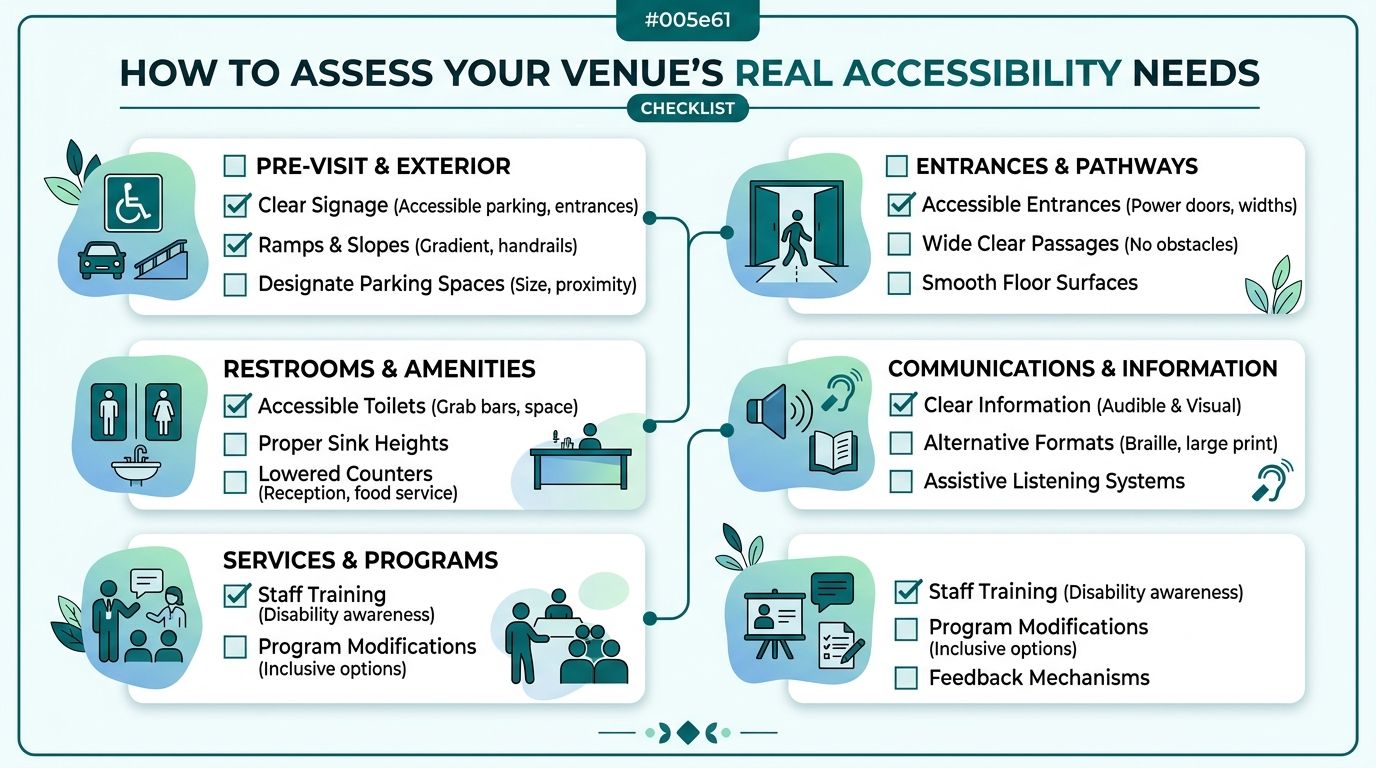
Map the visitor journey from street to service
Start outside your front door. The right question isn't “Is the building accessible?” It's “What happens from the moment someone decides to visit us?”
Work through the route in sequence:
Arrival point
Where does a person get dropped off, park, or step off public transport? Is the accessible entrance obvious from there?Entry and orientation
Once inside, can a first-time visitor identify reception, ticketing, the lift, stairs, toilets, and the main destinations?Vertical and horizontal movement
Can someone move between levels and along corridors without backtracking, dead ends, or ambiguous signage?Decision points
Where does someone have to choose left or right, one building or another, one lift core or another? These are where navigation often breaks down.Departure
Can they find the right exit, pickup point, or return path without asking for help?
Look for hidden friction, not just visible barriers
The most expensive barriers are often obvious. The most common ones usually aren't.
A venue can be technically compliant and still be difficult to use.
When you audit, separate physical obstacles from navigational obstacles.
| Barrier type | Typical example | What it means in practice |
|---|---|---|
| Physical | Steps at an entrance | Someone can't enter or change level |
| Physical | Heavy manual door | Someone needs assistance to pass through |
| Navigational | Similar-looking corridors | Visitors choose the wrong route repeatedly |
| Navigational | Inconsistent naming | Room numbers, department names, and signs don't match |
| Navigational | Poor landmarking | People can't confirm they're in the right place |
These hidden frictions often affect more people than managers expect, including blind and low-vision visitors, older users, people with cognitive differences, and anyone under time pressure.
Ask stakeholders better questions
A proper review includes the people who use the building, run it, and support those who struggle in it. That means front-of-house staff, facilities teams, transport coordinators, and local disability stakeholders.
Use questions like these:
- For staff: Where do visitors most often stop and ask for directions?
- For operations: Which routes change often because of works, closures, or room reallocation?
- For users: Which part of the journey feels uncertain or stressful?
- For leadership: Are we funding access only where it's visible?
- For community groups: What barriers aren't appearing in our current audit process?
A customer journey lens is more useful than a compliance-only lens. Our team has written more on this in customer journey mapping for accessible environments.
A good Tasmanian access review doesn't end with a snag list. It produces a ranked picture of where people lose independence, where staff time gets consumed, and where investment will have the biggest practical effect.
What Are Your Accessibility Legal Duties in Tasmania
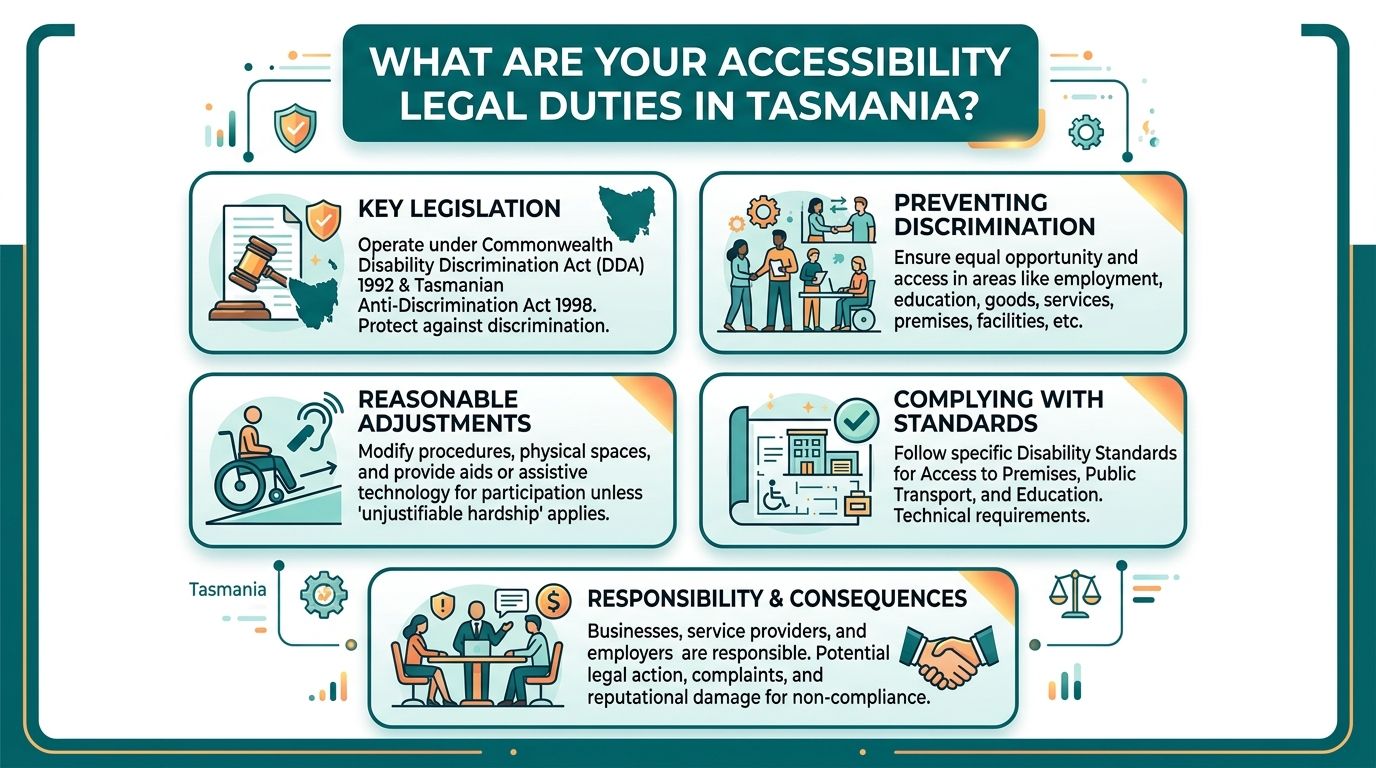
A visitor reaches your venue, finds the ramp, gets through the door, then has to ask staff how to reach reception, the accessible toilet, or the correct clinic room. From a legal risk perspective, that is not a minor wayfinding problem. It is a service access problem.
For Tasmanian venue managers, the starting point is usually the Disability Discrimination Act 1992. The practical test is broader than whether a lift, ramp, or compliant doorway exists. It asks whether a disabled person can access and use the service on reasonable terms, with dignity and as much independence as the setting allows.
Transport policy points to the direction of travel
Tasmania's transport planning is useful here because it treats accessibility as a whole journey issue. The Tasmanian Transport Access Strategy focuses on improving public transport access through infrastructure, information, and service design rather than treating compliance as a single building element.
Venue managers should read that as a practical signal. Regulators, users, and complaints processes tend to look at the complete experience. A compliant entrance helps. It does not solve uncertainty once someone is inside, especially in hospitals, campuses, civic buildings, arts venues, and multi-entrance sites.
That matters in Tasmania because many sites are constrained by age, topography, or heritage controls. A new lift may be justified. A regraded path may be required. Both can also take months, trigger approvals, and absorb a capital budget fast. Digital wayfinding does not replace those works, but it can close a different gap much faster by helping people follow the accessible route that already exists and by keeping guidance current when rooms, entrances, or temporary paths change.
Best practice goes past minimum compliance
The common mistake is to treat accessibility as a construction checklist. That approach can still leave a venue exposed if the service remains confusing, staff-dependent, or inconsistent day to day.
Standards and guidance such as BS 8300, PAS 78, and BS EN 17210 are useful because they push project teams to examine the full user experience, including approach, arrival, orientation, circulation, and information. Estates teams often focus first on widths, gradients, doors, and lifts because those items are visible and expensive. They matter. They are only half the job.
A route that meets dimensional standards but cannot be followed confidently is a weak outcome for the user and a poor use of the capital spend.
For a practical compliance view, see building code compliance and accessible navigation. The strongest position usually comes from pairing physical access works with an information layer people can use on the day.
That hybrid approach also gives managers a better business case. Physical upgrades remove hard barriers. Digital guidance reduces missed appointments, repeated direction queries, escorted movement, and the operational mess that appears whenever layouts change. The same logic sits behind other access technologies that remove friction without major building work, including tools such as Apple CarPlay gate control.
If you run a public-facing site in Tasmania, the legal duty is not satisfied by hardware alone. The safer and more workable standard is this: people need a route they can find, understand, and use with reasonable independence.
Should You Invest in Physical or Digital Access Solutions
A venue manager in Tasmania usually faces this decision at the point where the budget gets real. The front entry still needs work. A lift modernisation quote has landed. Staff are also spending too much time escorting visitors who cannot find reception, toilets, clinics, seating, or the correct exit once they are inside.
The right answer depends on the barrier in front of you.
What physical access solutions do well
If a customer cannot get through the door, cross a threshold, or move between levels, physical works come first. Ramps, lifts, platform access, compliant doors, and circulation upgrades deal with barriers that software cannot remove.
That spend is often substantial. It can also be slow.
In Tasmanian sites, the trade-offs are familiar. Heritage restrictions limit what can be changed. Steep sites create difficult gradients. Lift work brings design, approvals, contractor access, shutdown periods, and a maintenance commitment that lasts long after installation. None of that is a reason to avoid physical upgrades. It is a reason to reserve them for the barriers only physical infrastructure can fix.
Physical investment is usually the right call for:
- Level changes: stairs, split-level entries, mezzanines, raised boarding points
- Access points: thresholds, gates, door sets, and other non-compliant entry conditions
- Primary circulation: passenger lifts, platform connections, and routes that define whether the building is usable at all
What digital access solutions do better
A different problem appears once the route is technically accessible but still hard to follow in practice. That is where digital wayfinding earns its place.
A hospital can have lifts, compliant corridors, and good signage, yet visitors still miss appointments because the campus is confusing. A stadium can provide step-free entry, but the route to an accessible bay, toilet, or concession may still require staff help. A museum can meet physical access requirements, then change galleries, close routes, or move services faster than printed signs can keep up.
Digital guidance handles those moving parts far better than construction projects can.
| Problem | Physical infrastructure solves it | Digital wayfinding solves it |
|---|---|---|
| No step-free route between levels | Yes | No |
| Finding the correct entrance | Partly | Yes |
| Following a long internal route confidently | No | Yes |
| Responding to temporary closures or event-day changes | No | Yes |
| Updating route information without building work | No | Yes |
The practical advantage of an infrastructure-free system is straightforward. It avoids adding another hardware estate for your team to maintain. No beacons to service. No installed devices to fail across a large site. That matters in venues where estates teams are already stretched and every new asset adds cost, fault risk, and procurement friction. For a closer look at the difference between hardware-heavy and infrastructure-free models, see this comparison of indoor navigation technologies.
Operational test: If the solution creates another maintenance burden for estates or facilities, the lifetime cost is higher than the initial proposal suggests.
The same procurement logic shows up in adjacent access categories. Teams responsible for car parks, gates, and arrival routes often prefer lower-friction tools such as Apple CarPlay gate control because they reduce dependence on added physical hardware for the user.
The strongest business case is usually hybrid
Venue managers do not need to choose sides. They need to match the tool to the failure point.
Use capital works where the building blocks access outright. Use digital wayfinding where people get lost, need escorting, miss services, or lose confidence once inside. Combined properly, lifts and ramps make the route possible, and digital guidance makes it usable on the day.
That hybrid approach usually gives the clearest return. Physical upgrades deal with fixed barriers. Digital layers improve day-to-day independence, reduce repeated direction queries, and keep route information current without reopening a building project. For many Tasmanian venues, that is the difference between compliant access on paper and access people can effectively use.
A Practical Plan for Deploying Wayfinding Technology
Most venue teams overestimate the complexity of digital wayfinding projects. They imagine a long capital programme, procurement delays, installed hardware, and weeks of disruption.
Infrastructure-free deployment changes that. The work is still serious, but it's closer to an operational rollout than a building project.
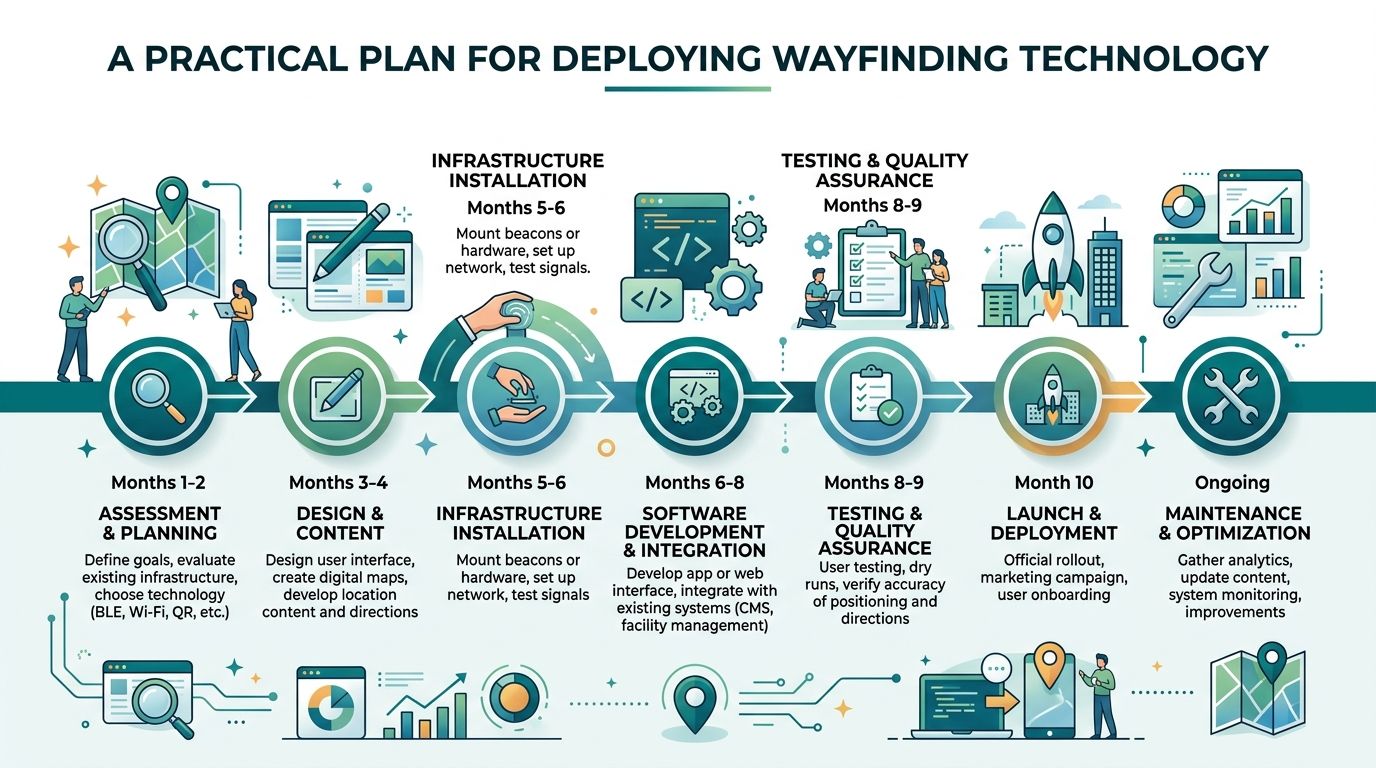
Start with the routes that matter most
Don't begin by trying to digitise every corner of the estate. Start with the journeys that generate the most confusion or have the greatest inclusion impact.
A sensible first phase usually covers:
- Public arrival routes: car park to entrance, bus stop to reception, station to venue entry.
- Core internal paths: reception to clinics, concourses to platforms, foyer to seating block.
- Essential amenities: accessible toilets, help points, exits, lifts, and customer service desks.
This staged approach lets managers prove value quickly while keeping scope controlled.
Build operations into the rollout
Wayfinding technology works best when estates, front-of-house, and communications teams are aligned. Three deployment tasks matter more than commonly realized.
Route validation
Someone needs to confirm that mapped routes match the actual environment, including accessible alternatives.Staff readiness
Frontline staff should know what the system does, where it helps most, and how to direct visitors to it.Change process
Moves, closures, event layouts, and room renumbering need a clear update path.
A venue should treat wayfinding like any other live visitor information layer. It needs ownership.
If route information changes often, the deployment model must make updates easy for operators, not just accurate for users.
Use named deployments as your benchmark
This isn't theoretical technology. Waymap has been deployed in real public environments where signal reliability, complexity, and footfall all matter. WMATA is a useful example because transit systems expose exactly the problems static signage can't solve well. In environments like that, people need precise guidance to platforms, exits, and interchange points in places where GPS may be unreliable and infrastructure maintenance is a constant concern.
The deployment lesson for Tasmanian managers is straightforward. Choose a platform that doesn't create a new maintenance headache, and launch it first where missed turns create the most friction.
There's also value in thinking about communications alongside deployment. If you're planning on-site promotion, visitor prompts, or app adoption messaging, this Splash Access location marketing guide is a useful reference for how location-based tools are introduced to the public without overwhelming the user experience.
For a clearer view of what the user-facing rollout can look like, see Waymap's wayfinding app overview. The strongest deployments aren't the most technical. They're the ones users can understand immediately and staff can support without extra friction.
Frequently Asked Questions About Access Solutions in Tasmania
What does Access Solutions Tasmania usually mean in practice
It usually means physical accessibility works such as lifts, escalators, and related mobility infrastructure. In Tasmania, that term is strongly associated with established building-based access provision rather than digital navigation layers.
Are lifts and ramps enough for an accessible venue
No. Lifts and ramps are essential where structural barriers exist, but they don't solve the problem of finding the right route, department, platform, or service point inside a complex venue.
When should a venue choose digital wayfinding instead of construction work
Choose digital wayfinding when the barrier is navigational rather than structural. If people can physically use the building but struggle to orient themselves, follow the correct route, or adapt to changing layouts, a digital layer is often the more practical intervention.
Is a hybrid approach better than choosing one type of solution
Yes. A hybrid approach is usually the strongest option because physical works remove structural barriers and digital wayfinding removes informational barriers. Together, they make the accessible route easier to use in real life.
What about heritage-listed buildings in Tasmania
Digital wayfinding is often especially useful in heritage settings. Where major alterations are difficult, slow, or heavily constrained, a non-invasive navigation layer can improve usability without introducing new installed hardware throughout the building.
Does digital wayfinding require beacons or venue hardware
Not necessarily. Infrastructure-free systems avoid the upkeep associated with installed beacon estates, which is one reason they appeal to venues that already have stretched facilities teams.
Is digital wayfinding only for blind and low-vision users
No. It's especially important for blind and low-vision users, but it also helps first-time visitors, older people, neurodivergent users, people under stress, and anyone navigating a large unfamiliar venue.
How should a Tasmanian venue manager prioritise spend
Start with the barriers that stop access entirely. Structural issues such as inaccessible entrances or lack of vertical circulation come first. After that, address navigation problems that prevent independent use of the routes you already have.
Can digital access support ESG goals
Yes. Inclusive navigation supports the social dimension of ESG by improving how people access services and public spaces. It can also reduce reliance on additional installed hardware, which helps some organisations pursue lower-maintenance operational models.
How do we know whether our venue has a navigation problem
Look at staff direction requests, missed appointments, late arrivals, repeated visitor confusion, and complaints about finding key destinations. If visitors regularly need escorting or verbal instructions, there's likely a navigation gap.
Is this relevant only for transport sites
No. It's highly relevant for transport, but the same issues appear in hospitals, shopping centres, universities, stadiums, civic buildings, offices, libraries, and mixed-use estates.
What should we do first if we're reviewing access solutions in Tasmania
Begin with a user-journey audit. Review the trip from arrival to destination to departure, identify where people lose confidence or independence, and then decide which issues need construction, which need better information, and which need both.
If your venue is reviewing access solutions in Tasmania, don't stop at lifts, ramps, and signs. Waymap helps organisations add precise, infrastructure-free navigation across indoor, outdoor, and underground spaces, so accessible routes are not just available but effectively usable.
