
How to plan, build, and run an effective hot desking solution in 2026
The assigned desk is a relic of a past working model. Hot desking solutions offer a more flexible approach where staff use any available desk. This isn't a post-pandemic trend; it's a strategic response to the demands of a hybrid workplace, helping organisations optimise their real estate while supporting how people work now.
Why does a hot desking strategy matter?
The shift to hybrid work is permanent. For most organisations, staff now split their time between home and the office. This leaves facilities directors and operations leads with a significant problem: the traditional one-desk-per-person model is now profoundly inefficient. It represents a large fixed cost that no longer delivers proportional value.
Hot desking addresses this directly. By removing assigned seating, organisations can reduce their physical footprint. The savings on rent, utilities, and maintenance are immediate and substantial.
However, viewing this solely as a cost-cutting exercise misses the larger opportunity. The real value is in transforming the office from a static container into a dynamic hub for collaboration, innovation, and connection.
Before examining the technology, it's useful to review understanding the core concepts of hot desking. This foundation clarifies how the strategy works in practice.
How does hot desking create strategic advantage beyond cost savings?
A well-executed hot desking strategy builds a more resilient and agile organisation. It allows the business to scale its workforce up or down without being constrained by a rigid floor plan.
When a new project starts, teams can occupy a cluster of desks and create a temporary 'neighbourhood'. This encourages the cross-functional collaboration and spontaneous problem-solving that is less likely to occur when staff are siloed at permanent stations.
This flexibility also benefits employees. Giving staff the freedom to choose a workspace that suits their task—a quiet pod for deep focus or a collaborative zone for a team brainstorm—is a major driver of satisfaction and productivity.
In a competitive market for talent, a flexible, tech-enabled workplace is no longer a perk; it is essential for attracting and retaining skilled professionals. A successful hot desking model signals that an organisation is a modern employer that trusts its people.
Ultimately, effective hot desking solutions are about more than just desks. They require a thoughtful combination of key elements:
- Clear Policies: Fair and simple rules for booking, using the space, and general etiquette are necessary to ensure smooth operation.
- Supportive Technology: User-friendly booking software is essential. Pairing it with occupancy sensors provides real-time data, eliminating friction and guesswork.
- Thoughtful Design: A successful hot desking environment requires variety. Different work settings must be created to support the diverse activities and working styles of employees.
When these components are aligned, hot desking ceases to be a simple space-saving tactic. It becomes a cornerstone of a forward-thinking workplace strategy that improves efficiency while building a more engaged, collaborative, and productive workforce.
How to build the business case for dynamic desking
For any facilities director or operations lead proposing a significant operational change, the business case must be built on quantitative data. Shifting to a dynamic desking model is no different.
The conversation begins with a direct truth about the modern office: it is often underutilised. Even before hybrid work became standard, UK surveys showed that 40% of dedicated desks were unused on any given day. That represents a substantial inefficiency.
With office vacancy rates now between 20% and 50% in major cities like London and Manchester, those empty chairs represent a massive, and often unnecessary, cost. Hot desking addresses this by unchaining employees from assigned seats. It allows an organisation to match its real estate footprint to how its team actually uses the office, with an immediate financial impact.
How do you quantify the return on investment?
By implementing smart hot desking solutions, an organisation can strategically reduce the number of workstations it needs. Instead of the traditional 1:1 employee-to-desk ratio, a leaner ratio of 0.6 or 0.8 is achievable. This typically translates to a 20-40% reduction in total seats, while still maintaining a comfortable buffer for peak demand days.
This is a strategic, data-led decision, not just an exercise in downsizing. The infographic below outlines why this approach is critical for modern businesses.
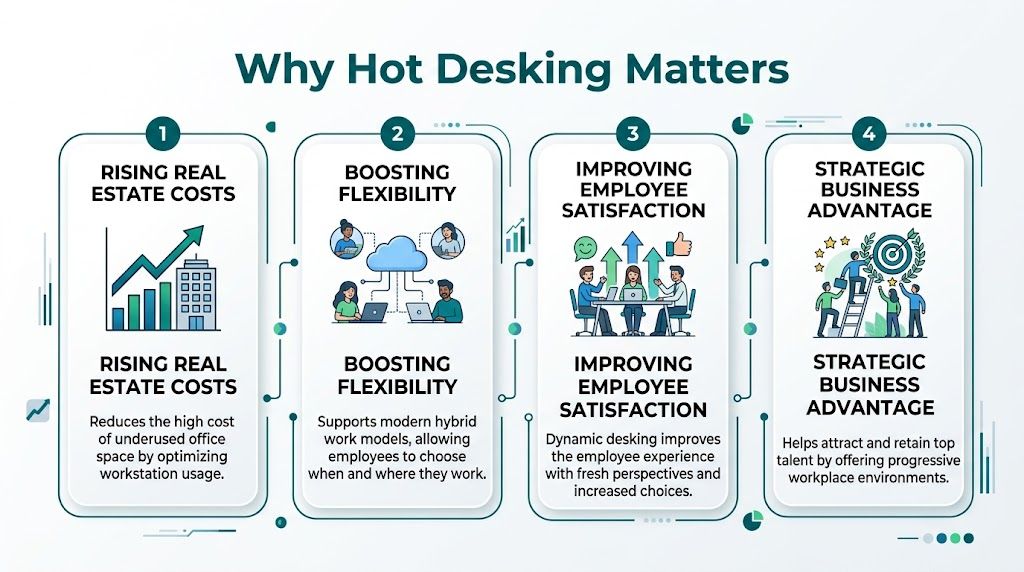
These drivers transform hot desking from a simple space-saving tactic into a cornerstone of business strategy.
These are not just theoretical figures. UK businesses have reported slashing overall office operating costs by up to 30% after adopting hot desking. The direct savings on real estate alone often fall between 15% and 25%. These are the kinds of metrics that build an undeniable internal business case with a clear, predictable return. You can examine more statistics on how companies are using this to their advantage and get ahead in a flexible work environment.
How can savings be reinvested for strategic growth?
The capital saved by optimising office space is compelling on its own, but the real opportunity lies in strategic reinvestment. The capital unlocked from lower rent and utility bills can be funnelled directly into initiatives that improve the employee experience and strengthen the business.
A common objection to hot desking is the perceived loss of personal space. However, when savings are reinvested into better technology, improved amenities, and a greater variety of workspaces, the office often becomes a far more attractive and functional environment than it was before.
This reinvestment can fund:
- Technology Upgrades: Sophisticated booking systems, occupancy sensors, and high-quality AV equipment for meeting rooms—all the tools that make a flexible office work effectively.
- Enhanced On-Site Accessibility: A crucial area for reinvestment is making the workplace truly inclusive. That freed-up capital could fund the integration of advanced indoor navigation tools, for instance.
- Creation of Varied Work Zones: Purpose-built zones for deep focus, lively collaboration, and informal social interaction can be designed to support the different ways people need to work.
This approach reframes the conversation. The objective is not to "shrink the office" but to "reimagine the workplace" as more efficient, technologically advanced, and better suited to the team's needs. By directly linking cost savings to tangible upgrades in technology and accessibility, the case for hot desking becomes a win for both the balance sheet and the workforce.
What technology is required for effective hot desking?
A successful hot desking implementation depends on a smart combination of technologies. For any facilities director, understanding these components is the first step toward creating a system that delivers a positive employee experience and provides powerful insights into space utilisation.
The objective is not merely to acquire a booking tool, but to build an intelligent system that helps actively manage and improve the workspace in real time.
At the core of any setup is desk booking software. This is the application your team uses to reserve a desk. The system's true power, however, is realised when this software is connected to sensors and integrated into a building-wide management platform.
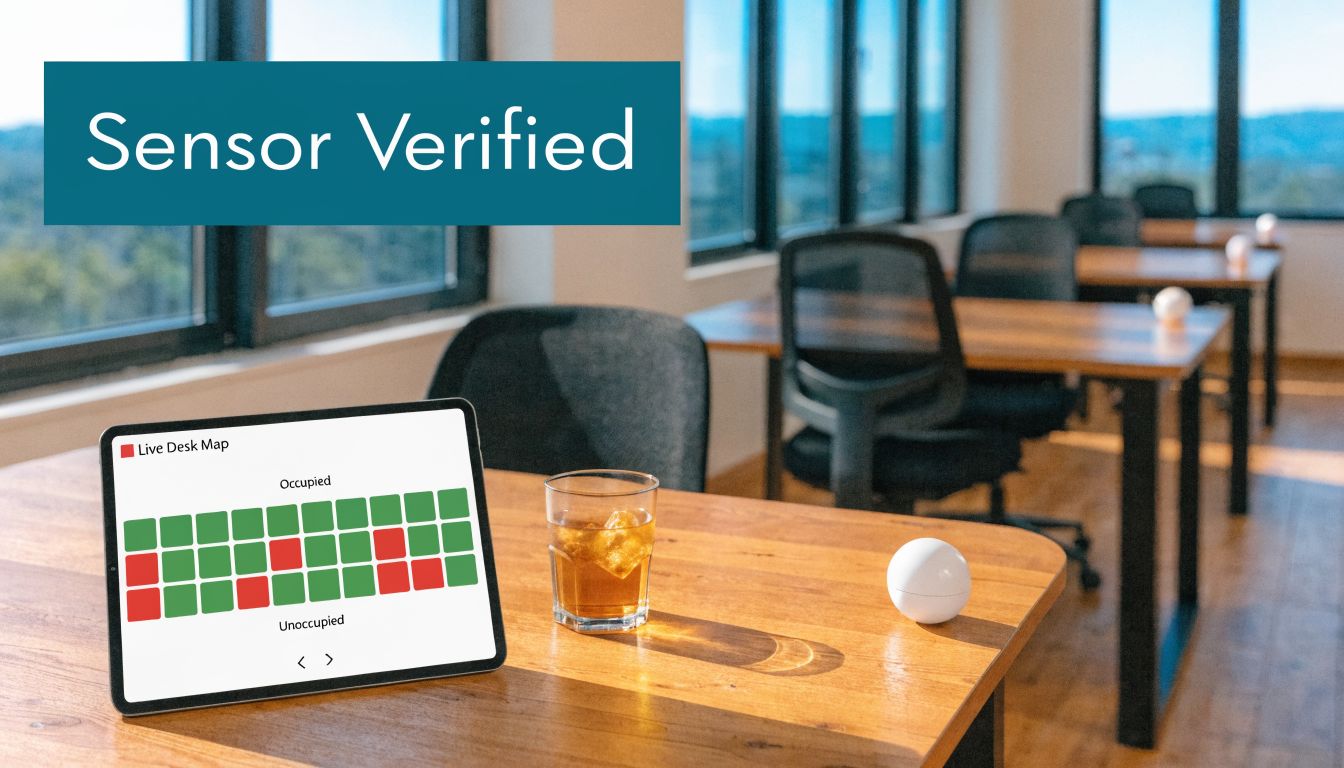
Why are occupancy sensors essential alongside booking software?
Relying on booking software alone is a common failure point. It leads to "ghost bookings"—desks that are reserved but remain empty. This wastes valuable space, skews utilisation data, and frustrates employees searching for a workspace. Occupancy sensors provide the necessary ground-truth data automatically.
Making an informed technology choice requires understanding the role of each component. The following table compares the main elements of a modern hot desking ecosystem.
Comparison of Hot Desking Technology Components
Technology ComponentPrimary FunctionKey Considerations for ImplementationScalabilityDesk Booking AppEmployee-facing interface for reserving desks and meeting rooms.User experience (UX) is critical for adoption. Must integrate with other systems.High. Most are cloud-based and scale easily with user numbers.Infrared (IR) SensorsDetects presence at a specific desk using heat and motion.Cost-effective and privacy-friendly. Simple binary (occupied/unoccupied) data.Excellent. Easy to deploy across thousands of desks.Computer Vision SensorsUses cameras and AI to count people in larger zones or areas.Provides richer data (dwell time, flow). Privacy must be managed carefully.Good. More complex to install and calibrate than IR sensors, but covers wider areas.IWMS PlatformCentralises data from all sources for analysis and reporting.The 'brain' of the operation. Requires robust integration capabilities.High. Designed to handle large, complex property portfolios and data streams.
The choice of technology must align directly with organisational goals. If the objective is simple desk availability, an app and IR sensors may suffice. For deeper analysis of space utilisation, computer vision and a comprehensive IWMS will be necessary.
Why integrate with a central workplace system?
Data from booking apps and sensors becomes truly valuable when fed into an Integrated Workplace Management System (IWMS). An IWMS acts as the command centre for the entire office, consolidating disparate data into a single, clear dashboard.
For a facilities director, this is where strategic value is unlocked. The system transforms raw data—'Desk 12 is occupied'—into actionable insights, such as 'The quiet zone reaches 95% capacity every Tuesday morning, while the collaborative area is only at 40%.'
This single view enables facilities teams to spot trends and make confident decisions about office layout and property needs. It also facilitates smart automation, such as automatically releasing a booked desk if a sensor does not detect presence within 15 minutes, returning the space to the available pool.
None of this is effective without an accurate digital map of the space. For more on this, review our guide on floor mapping software.
How does wayfinding complete the user experience?
An employee has booked Desk 42 on the third floor. In a large, dynamic office, finding that desk can be a significant challenge. This is the often-overlooked final step in the user journey.
This is where Waymap provides the missing link. By integrating directly with the hot desking platform, our system provides precise, step-by-step audio navigation to the reserved desk. It is a seamless handoff from booking to arrival.
Because Waymap does not rely on Wi-Fi, beacons, or other hardware, it works for anyone with a smartphone, guiding them accurately through the most complex floor plans.
For the employee, it closes the loop on their journey, turning a potentially stressful search into an effortless arrival. For the business, it ensures the investment in a flexible office is supported by a system that makes it genuinely easy for everyone to use.
How does hot desking affect accessibility and inclusion?
For many employees, hot desking offers welcome flexibility. For others, particularly employees with disabilities, what promises freedom can become a source of daily friction and exclusion.
Consider a colleague with a visual impairment. In a fixed-desk environment, they knew their route by heart. In a hot desking environment, their destination changes daily. What was once a subconscious commute from the entrance to their chair is now a significant navigational challenge.
This is not a minor inconvenience. It is a fundamental flaw in any flexible working model that prioritises space efficiency over the human experience. If an employee cannot independently and confidently find their booked desk, the system has failed them.
The right technology can turn a potential accessibility failure into an opportunity for genuine inclusion.
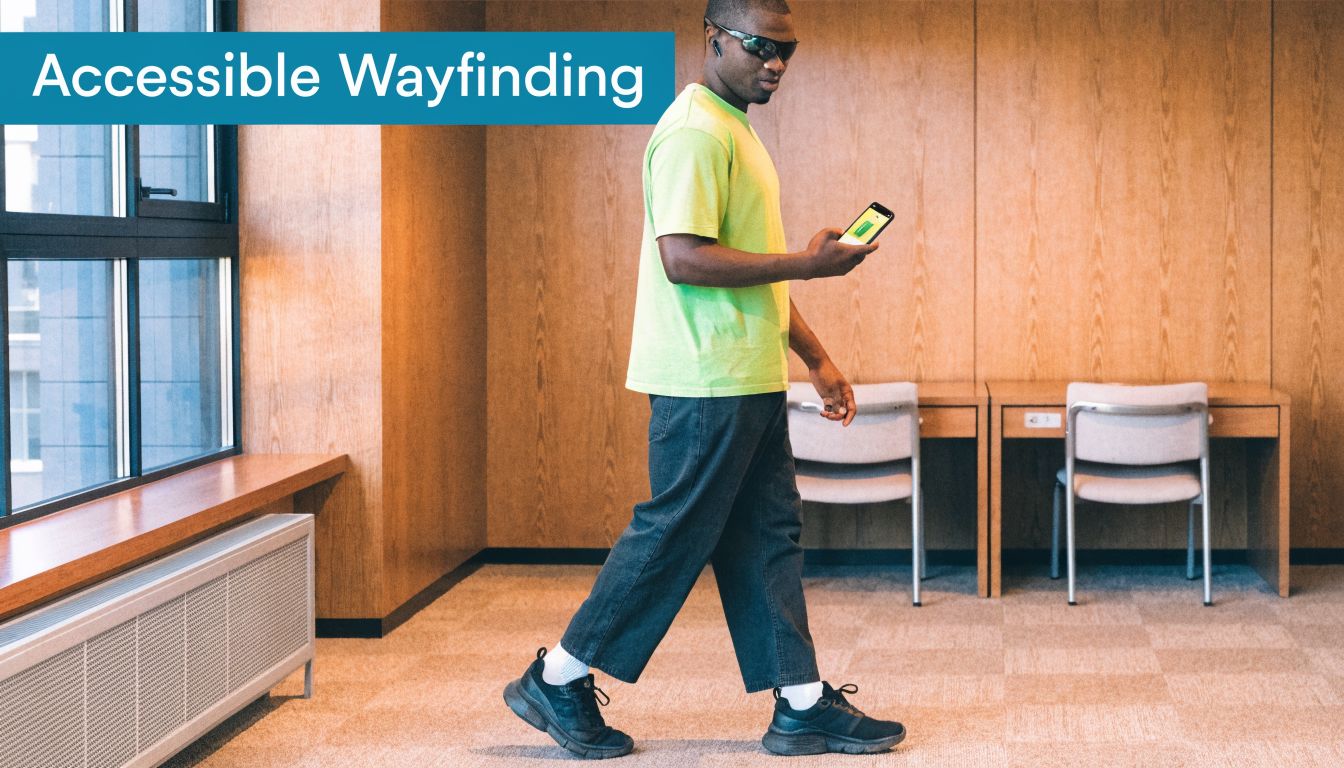
From navigational barrier to independence
The solution is to connect the booking system to a reliable indoor navigation tool. When an employee reserves a desk, the system should not just send a confirmation; it should provide a direct, turn-by-turn path to it. This simple integration is what elevates a space from being merely usable to truly equitable.
This is precisely where Waymap adds clear, measurable value. By integrating our hardware-free navigation platform with your desk booking software, any reserved desk becomes an instant, navigable destination.
Once a booking is confirmed, Waymap provides precise, step-by-step audio instructions from the building’s entrance directly to the correct desk. It’s a seamless handoff that empowers employees with disabilities to navigate the office with the same autonomy as everyone else.
How does this support an inclusive and productive workplace?
This integration does more than solve a logistical problem. It sends a powerful message that the organisation is committed to building an environment where every employee can thrive. This directly supports ESG mandates and strengthens compliance with accessibility legislation like the Equality Act 2010 in the UK.
A truly accessible workplace is not about providing special assistance; it is about designing systems that remove the need for it. Integrating navigation with hot desking solutions is a prime example of universal design in action, benefiting everyone while ensuring no one is left behind.
The impact extends beyond accessibility. Since the pandemic, UK office trends show that flexibility is a major driver of output, with 46% of workers reporting they are more productive in these setups. By making flexible spaces navigable for all, an organisation ensures these productivity gains are shared across its entire workforce.
For accessibility managers, this transforms hot desking from a potential risk into a strategic tool for creating equitable and dynamic workplaces. To learn more about how hot desking has become a standard, you can explore the trends in workplace management.
What are the key considerations for accessible hot desking?
To ensure an accessible implementation, the plan must address several key areas from the outset:
- Integrated Wayfinding: Select a navigation provider that can integrate directly with the chosen booking system. A hardware-free solution simplifies deployment and reduces maintenance costs.
- User-Centred Design: Involve employees with a range of disabilities in the pilot phase. Their feedback is invaluable for identifying friction points that would otherwise be missed.
- Clear Communication: Ensure the entire team understands how the integrated system works. Simple, clear instructions on using the booking and navigation tools together are essential.
- Accessible Workstations: Ensure that designated accessible workstations—those with specific ergonomic or assistive technologies—can be reserved and are clearly marked within the booking system.
By taking these steps, a hot desking programme becomes more than a real estate strategy; it becomes a powerful statement about the company's values. The result is a workplace that is not only efficient and flexible but also genuinely inclusive, equitable, and independent for everyone.
Here’s a look at what a successful hot desking journey looks like, broken down into manageable steps.
Phase 1: Define your strategy and policies
Before purchasing any software or rearranging furniture, you must be clear on your objectives. This is the foundation of the entire project.
Start by asking the primary strategic questions. Is the main goal to reduce the real estate footprint by 20%? Or is it to encourage more creative collaboration between departments? The answer will shape every subsequent decision.
Once goals are defined, establish the rules of operation.
- Booking Rules: How far in advance can a desk be booked? Is there a limit on how long one person can reserve a spot? Rules are needed to prevent individuals from claiming the same ‘favourite’ desk daily. Fairness is crucial.
- ‘Neighbourhoods’ and Zones: A complete free-for-all is rarely effective. Create ‘neighbourhoods’ where specific teams can cluster, maintaining team cohesion while allowing flexibility. Also, establish dedicated zones for different work modes—quiet areas for deep focus and collaborative hubs for brainstorming.
- Clean Desk Policy: This is non-negotiable. In a shared space, everyone must clear personal items at the end of the day. To support this, provide easy-to-access personal lockers.
Phase 2: Launch a pilot programme
Do not attempt to roll this out to the entire company at once. Launch a pilot programme with a single department or on one floor.
The pilot serves as a laboratory to test policies, validate technology, and observe how people actually use the space. It will generate invaluable data on desk usage, peak demand, and, most importantly, honest feedback from the team. When considering layouts, resources like this Ultimate Office Space Planning Guide can provide useful ideas for creating effective zones.
Use data from the pilot to validate the initial business case. If the numbers confirm the predicted space savings and productivity remains steady or improves, you will have a powerful, evidence-backed case for the full rollout.
The pilot is not just a technical test; it is a cultural one. Use this phase to identify "hot desking champions"—enthusiastic early adopters who can help communicate the benefits to their colleagues and ease the transition for more sceptical team members.
Phase 3: Manage the cultural shift
The most common reason hot desking projects fail is not the technology or the furniture—it is the human element. Change is difficult, and employees can feel they are losing something: their personal space, their routine, or even a sense of status.
This must be managed proactively. Communication should be clear, consistent, and frequent. Explain why the change is happening, framed around the benefits for employees, such as greater freedom and flexibility. The message is not about taking something away, but about upgrading to a more modern, adaptable way of working.
Involve people in the process. Ask for their opinions on the design of new breakout spaces or features they want in the booking app. When employees feel heard, they are more likely to support the initiative.
Finally, ensure the technology works perfectly from day one. A clunky app or faulty sensors will instantly kill any goodwill. A seamless user experience is your secret weapon for winning hearts and minds. Understanding how the right tech can be integrated to improve office spaces is absolutely critical for success.
How to measure success and choose the right partner
Launching a hot desking solution is only the beginning. The real work is in the continuous cycle of measurement, analysis, and improvement. To prove the long-term worth of this significant investment, you need to be clear on what success looks like for your business.
This means looking beyond obvious metrics. It is not enough to track desk utilisation. You must connect the dots between your new, flexible space, employee satisfaction, and the bottom line.
A successful implementation does not just cram more people into a smaller footprint. It builds a workplace that works smarter—one that is more efficient, adaptable, and genuinely inclusive. The metrics you choose must tell that complete story.
Which key performance indicators truly matter?
Relying on basic utilisation rates alone can be misleading. A desk may show as booked, but is anyone actually using it? To get a true sense of activity, you need to track metrics that balance both efficiency and the human experience.
- Reduced 'Ghost Bookings': This is the gap between desks people say they will use and the ones they actually use, verified by sensors. A low number here is a strong indicator that your technology and company culture are aligned.
- Peak Utilisation Rate: Forget averages. You need to know how the office performs at its absolute busiest. This number tells you if your desk-to-employee ratio is correct or if you are creating frustration during peak demand.
- Employee Satisfaction Scores: Use targeted surveys to ask people how they feel about the system. Is it easy to find and book a desk? Can they find the right kind of space for their work? High scores here are your best measure of user adoption.
- Demonstrable ROI: Connect the dots by calculating the total savings from a smaller property portfolio and lower overheads, and weigh it against the investment in technology and rollout.
By tracking these KPIs, you stop asking "Are the desks being used?" and start answering "Is our workplace strategy delivering real value to our people and the business?" This evidence will prove the long-term success of your decision.
How do you select a vendor who is a true partner?
Choosing your technology provider is one of the most critical decisions in this process. You are not just buying software; you are selecting a long-term partner.
A features list only tells part of the story. You must dig deeper to find a provider who understands your strategic goals and has the capability to help you achieve them.
Look past the sales pitch and ask the tough questions.
- Proven Integration Capabilities: A booking system that cannot communicate with your other tools is a dead end. Demand a live demonstration of how the platform connects with an Integrated Workplace Management System, your HR software, and—crucially—accessibility tools like Waymap to create a seamless journey from booking to arrival.
- Data Security and Compliance: How will they protect your employees' data? This is non-negotiable. They must have solid security credentials (like ISO 27001) and be fully compliant with regulations like GDPR.
- Customer Support and Onboarding: What happens after the contract is signed? You need a partner who will provide user training and technical support, not one who just directs you to a generic help desk.
- A Proven Track Record: Ask for case studies and speak to their existing clients, especially those in your industry or of a similar size. A vendor who already understands your business will have a much better playbook for success.
Finding the right partner is what transforms a hot desking solution from a standalone project into a core component of a smarter, more efficient, and more inclusive workplace.
Frequently Asked Questions About Hot Desking
When senior leaders explore hot desking, a few key questions almost always come up. Concerns about fairness, technology, and employee adaptation are common and should be addressed directly.
How do you ensure fairness in a hot desking environment?
Fairness is achieved through a combination of clear policies and technology that enforces them. Simple booking rules, such as limiting how many consecutive days a person can book the same desk, prevent individuals from monopolising desirable spots. Creating 'neighbourhoods' for specific teams ensures they can always find space near colleagues. A good booking system automates these rules transparently, so everyone understands the process.
What is the biggest challenge when transitioning to hot desking?
The biggest challenge is almost always managing the cultural shift. For many, a permanent desk is more than just furniture; it symbolises status and personal space. The transition can be unsettling. Open and honest communication is the best way to navigate this. Be clear about the benefits, like greater flexibility, and involve employees in the process. Most importantly, ensure the technology works flawlessly from day one, as a clunky app can derail the entire initiative.
Can hot desking work without occupancy sensors?
Technically, yes, but it is not recommended as you would be operating with incomplete information. A system relying solely on manual check-ins is susceptible to 'ghost bookings'—desks that are reserved but sit empty. This creates frustration for employees and provides a skewed picture of space utilisation. Sensors provide automated, real-time data, giving an accurate reading of the office. This optimises space, prevents booking conflicts, and generates the analytics needed for smarter future planning.
By integrating the right technologies, you can overcome these challenges and build a more efficient, inclusive workplace. Waymap integrates with booking systems to provide step-by-step navigation, ensuring every employee can find their reserved desk independently. Discover how you can make your flexible office truly accessible at https://www.waymapnav.com.
