
A Guide to Calgary Airport Departures

Departing from Calgary International Airport (YYC) doesn’t need to be stressful. With some planning, your journey can start smoothly before you even leave home. This guide will serve as your pre-flight briefing.
Your Pre-Departure Checklist for YYC
A successful trip starts long before you arrive at the airport. Organizing a few details ahead of time can help you remain calm and confident. This is especially true at a major hub like YYC, which served over 18.5 million passengers in 2023. With this level of traffic, planning is essential. You can read more about YYC’s passenger growth on their official site.
At Waymap, we specialize in helping people navigate complex spaces with ease. We believe a predictable, well-planned start is the foundation for any successful trip.
This quick reference table summarizes the key steps to take before you head to the airport.
YYC Pre-Departure Quick Reference
| Departure Step | Key Action/Information | Recommended Timing |
|---|---|---|
| Flight & Terminal | Double-check your airline, flight number, and departure terminal (Domestic or International). | 24-48 hours before flight |
| Baggage Rules | Review your airline's specific allowances for checked and carry-on luggage. | When you pack |
| Travel Documents | Gather your ID, passport, visas, and boarding pass. Make digital copies as a backup. | The day before you travel |
Following these simple actions will set the stage for a much more relaxed airport experience.
1. Confirm Your Flight Details and Terminal
First, about 24-48 hours before you fly, take a moment to double-check your flight details. Calgary Airport has two main terminal areas, and knowing where you need to go is a critical first step.
- Domestic Terminal (Concourses A, B, C): This is for all flights within Canada.
- International Terminal (Concourses D, E): This is for all flights to the United States and other international destinations.
A quick look at your booking confirmation or the airline's app will tell you which terminal and concourse you need. This simple check can prevent being dropped off at the wrong entrance and facing a long, stressful walk to the correct one.
2. Understand Airline Baggage Policies
Next, it's time to check the baggage rules. Every airline has its own policies for checked and carry-on luggage, including size, weight, and the number of items allowed. A quick visit to your airline's website is time well spent. You'll find out:
- Checked baggage weight limits (often around 50 lbs / 23 kg per bag in economy).
- The exact dimensions for your carry-on bag and personal item.
- The fees for any extra or overweight bags.
Knowing these details before you finish packing helps you avoid unexpected fees at the check-in counter. This small amount of preparation can lead to a much faster and smoother bag-drop process.
3. Organize Your Travel Documents
Finally, gather all your travel documents and place them somewhere easily accessible. The documents you need will depend on your destination.
For a domestic flight, you’ll typically just need a government-issued photo ID. For any international travel, make sure your passport is valid for at least six months past your planned return date. It’s also wise to have both physical and digital copies of your boarding pass, passport, and any necessary visas. This final organizational step sets you up for a seamless departure.
Getting Your Bearings: YYC Terminals and Check-In
Flying out of Calgary International Airport (YYC) can be straightforward, but a smooth start depends on knowing the layout. It's best to think of YYC as two distinct hubs connected by a walkway. Where you’re headed determines where you need to be.
Getting this right from the start saves a lot of stress.
- The Domestic Terminal (Concourses A, B, C): This is the starting point for any flight within Canada. If you're flying with major carriers like WestJet or Air Canada on a domestic route, your journey begins here.
- The International Terminal (Concourses D, E): For all flights to the U.S. or any other global destination, this is your terminal. It houses the U.S. preclearance facility and numerous international airlines.
A quick check of your flight details before you leave for the airport will tell you which terminal and concourse you need. This simple step ensures you get dropped off at the right door, ready to go.
Finding Your Airline and Check-In Area
Once you’re inside the correct terminal, you’ll find the departures level is a busy place. A significant portion of the airport's passengers fly domestically, while others head to the U.S. or abroad. This creates different flows of people, so finding your zone quickly is key.
Look for the large overhead signs that clearly point the way to each airline's check-in counters. Whether you're with a major airline or a smaller one, finding your spot is straightforward. As you navigate the crowds, it's worth remembering how much goes into making the experience a pleasant one, including good airport sanitation, which sets the tone for your entire trip.
Your Check-In Options
Fortunately, the days of being forced to wait in long lines are mostly gone. YYC offers several ways to check in, each designed to save you time.
This simple diagram breaks down the three essential stages before you get to security.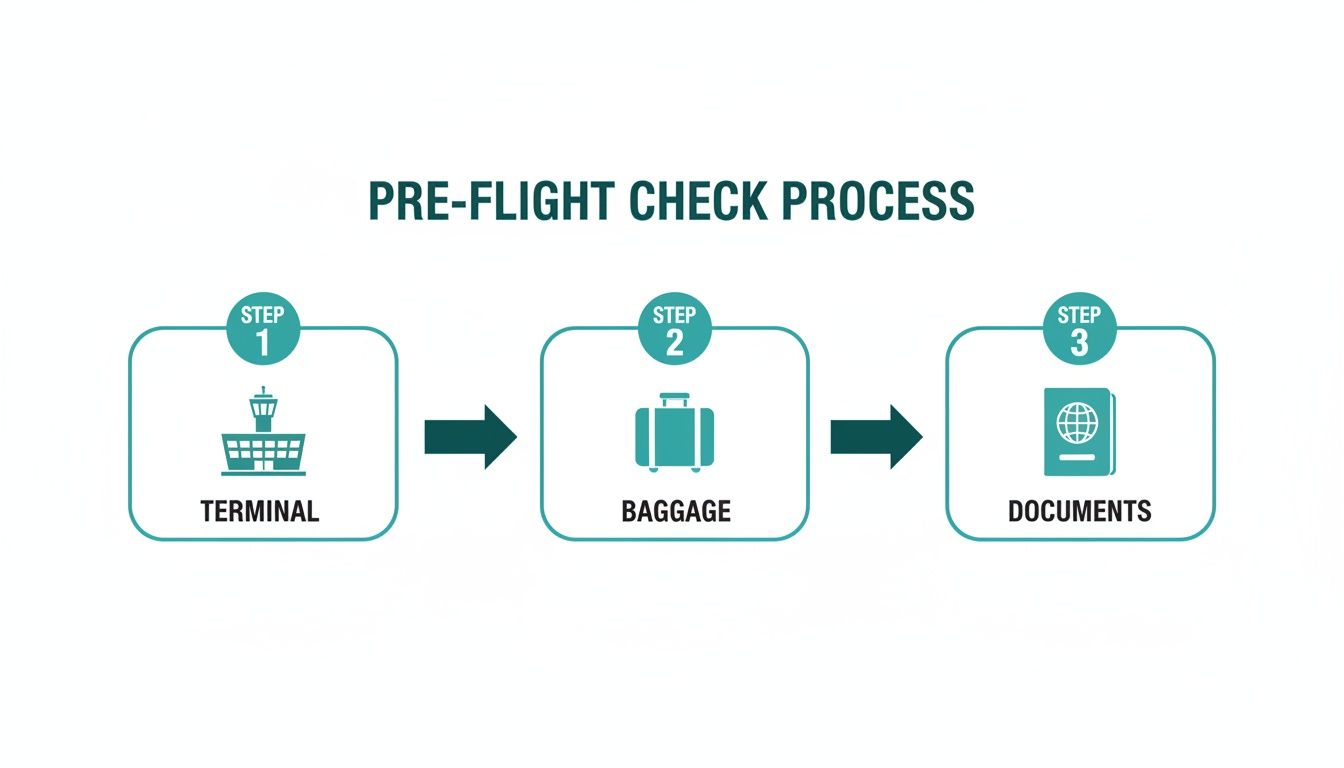
Completing these three checkpoints—Terminal, Baggage, and Documents—is the foundation for a stress-free departure.
Here are the modern check-in methods you’ll find:
- Self-Service Kiosks: You'll see these throughout the departures hall. They're a fast option for checking in, printing your boarding pass, and tagging your own bags.
- Mobile Check-In: Most airlines open online check-in 24 hours before a flight via their app or website. If you're traveling with only a carry-on, you can get your digital boarding pass on your phone and head straight for security.
- Airline Counters: Of course, if you need special assistance, are traveling with a large group, or just prefer to speak with a person, the airline counters are always available to help.
Key Takeaway: If you check in online but have luggage, look for the dedicated "Bag Drop" or "Baggage Drop-off" counter. The lines are almost always much shorter than the full check-in lines.
Making the right choice here sets the tone for your journey. This idea of moving confidently through large, complicated spaces is what we focus on at Waymap. We know that better navigation tools, powered by advanced indoor positioning systems, can completely change the travel experience. By providing clear, step-by-step audio guidance, technology can empower everyone to navigate airports with more independence and less anxiety.
Getting to YYC: Parking and Transit Options
How you get to the airport can set the tone for your entire trip. Making the right choice involves weighing your budget, schedule, and how many bags you’re managing. It’s the first decision you'll make, and it can make all the difference between a frantic dash and a smooth start.

For anyone involved in operating a transport hub, this is a classic "first-mile" challenge. A smooth transition from the parking lot or bus stop to the check-in desk is a fundamental part of a modern traveler's journey.
Driving and Parking On-Site
If you’re planning to drive, YYC has several on-site parking choices for different trip lengths and budgets. A little planning here can save you money and hassle.
The most convenient options are Parkade 1 (P1) and Parkade 2 (P2). These are covered lots with direct connections to the terminals, which is a great benefit in the Calgary winter.
- Parkade 1 (P1): This is right across from the Domestic Terminal. If you're flying within Canada, this is your best option.
- Parkade 2 (P2): You'll find this opposite the International Terminal, making it the ideal choice for flights to the U.S. and beyond.
For trips lasting more than a few days, the Long-Term parkade is a more budget-friendly choice. It’s a short walk from the terminals, but the lower daily and weekly rates often make it worth the extra steps. Payment is simple, with credit card readers at the exit gates to get you on your way home quickly.
Public Transit and Shuttle Services
If you're looking for a cost-effective option, public transport is a solid choice. Calgary Transit’s Route 300 BRT (Bus Rapid Transit) runs a direct line from downtown Calgary straight to the airport.
The bus runs frequently and stops at both the Domestic and International terminal areas, so it's a reliable option, especially if you're traveling light. You can avoid traffic and you don’t have to think about parking.
Many local hotels also run their own complimentary airport shuttles for guests. It’s a completely stress-free way to get to your flight if you're staying overnight in the area.
The best way to get to the airport is all about balancing cost, convenience, and time. For a solo traveler with just a carry-on, the Route 300 bus is probably perfect. But for a family juggling multiple large suitcases, the convenience of parking on-site might easily justify the extra cost.
Rideshare and Taxi Services
Sometimes you just want the simplest door-to-terminal service possible. This is where rideshare services like Uber and Lyft, along with traditional taxis, are useful. They remove the guesswork, especially when you have heavy bags or a group with you.
- Rideshare (Uber/Lyft): Simply book a ride through the app from wherever you are. YYC has clearly marked pick-up and drop-off zones at both terminals, and you’ll see the estimated fare before you confirm.
- Taxis: You'll find taxis waiting at the designated stands on the arrivals level of both terminals. It's a dependable service that's always available.
To help you decide at a glance, here’s a quick comparison of the main ways to get to Calgary Airport.
Comparing Your Transport Options To YYC
This table breaks down the main transport methods to YYC, giving you a clear overview of the cost, time, and convenience of each one.
| Transport Option | Average Cost | Typical Travel Time (from Downtown) | Best For |
|---|---|---|---|
| On-Site Parking | $28-$35/day | 25-30 minutes | Families, travelers with lots of luggage, convenience |
| Public Transit (Route 300) | ~$11 | 40-50 minutes | Budget-conscious travelers, light packers |
| Rideshare (Uber/Lyft) | $35-$50 | 25-30 minutes | Groups, travelers wanting door-to-door service |
| Taxi | $40-$55 | 25-30 minutes | Business travelers, reliability |
Ultimately, the choice comes down to your personal priorities for the trip.
For those of us thinking about the bigger picture, the challenge is connecting these different services. A traveler might arrive by bus, but their journey isn't over until they find their gate. This is exactly where technology like Waymap can bridge the gap, creating a continuous, accessible path from the curb to the gate for every passenger.
Mastering The Security Screening Process
For most people, the security checkpoint is the most stressful part of any Calgary airport departure. There are often long lines, a list of rules to remember, and the pressure to keep moving. It’s enough to make even the most seasoned traveler feel a little anxious.
The key to a smooth journey through security is simply knowing the rules before you get in line. A little preparation at home saves you from a frantic, last-minute repack at the checkpoint, which slows everyone down. Getting your carry-on sorted from the start makes a real difference.
Preparing Your Carry-On For Screening
The Canadian Air Transport Security Authority (CATSA) is the organization that sets the rules for what you can and can’t bring on board. The most common issue for passengers involves liquids, aerosols, and gels.
- The 100ml Rule: Any liquids, aerosols, or gels must be in containers of 100 ml (3.4 oz) or smaller.
- The Clear Bag: These containers must fit into a single, clear, resealable plastic bag that is no larger than one liter.
- One Bag Per Person: You are only allowed one of these bags each.
It’s not just about liquids. Any personal electronic devices larger than a cell phone—like laptops, tablets, and gaming consoles—must be removed from your bag. They need their own bin for screening, so having them easily accessible will save precious minutes at the checkpoint.
Choosing The Right Security Lane
As you approach the security area at YYC, you'll see a few different lines. Picking the right one is your first step to a hassle-free experience, as each is set up for different needs.
- Standard Lanes: This is the main line for the majority of travelers.
- Family/Special Assistance Lane: If you’re traveling with young children or need a bit more time and space, this lane is for you.
- NEXUS/Verified Traveller Lanes: These are the fast-track lanes for members of trusted traveler programs, offering expedited screening.
From a mobility perspective, the security process presents a unique challenge. The long, winding lines can be disorienting, especially for travelers with low vision or anyone who finds crowded spaces difficult. You're constantly starting, stopping, and juggling bags, bins, and personal items, which adds a layer of complexity to the journey.
This is exactly where precise, personal navigation can completely change the experience. Imagine being guided not just to the security area, but step-by-step through the right line, with audio cues telling you when to move ahead or get your laptop ready. This kind of detailed guidance reduces the mental load, turning a stressful bottleneck into a simple, manageable task.
For airport operators and their accessibility teams, this highlights an opportunity. By implementing advanced wayfinding technology, venues can create a more dignified and less stressful screening experience for everyone. It not only improves passenger satisfaction but also helps maintain a steadier, more efficient flow through one of the airport’s most critical chokepoints.
At Waymap, we believe a truly accessible journey must account for these complex, dynamic environments, providing support exactly where and when it’s needed most.
Enhancing Airport Accessibility With Waymap
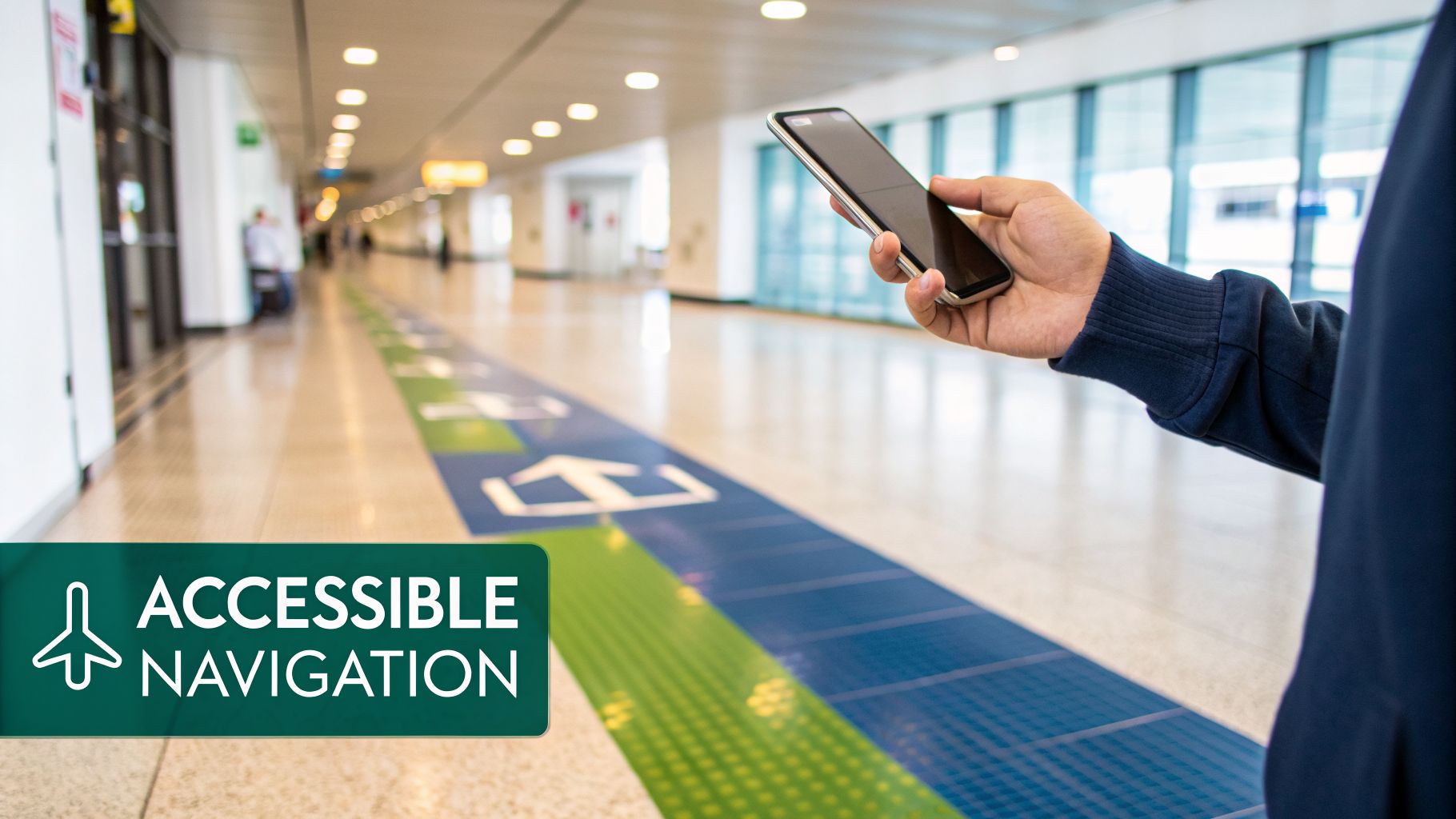
Navigating a large, bustling airport like Calgary International can be a stressful experience for anyone. For people with low vision, or even just someone feeling overwhelmed by the signs and crowds, a Calgary airport departure can feel like an impossible challenge. The journey from the curb to the gate presents numerous points of potential confusion, which can erode a traveler’s confidence.
This isn't just an inconvenience; it's a barrier to independent travel. Traditional wayfinding methods, like static signs and overhead maps, are often insufficient. Signs can be hard to read from a distance, obscured by crowds, or simply confusing in a complex building with multiple levels and sprawling concourses.
A New Approach to Airport Navigation
At Waymap, we knew there had to be a better way. Our technology was built from the ground up to solve these exact problems, providing step-accurate audio directions using only the sensors already built into your smartphone. It works flawlessly indoors without needing GPS, Wi-Fi, or beacons.
Imagine arriving at YYC on the Route 300 bus. Instead of trying to figure out which entrance to use, you just open an app on your phone. It guides you with clear, turn-by-turn audio: “Walk forward 20 meters. In 5 meters, turn right toward the Domestic Terminal entrance.”
That guidance continues seamlessly inside. The app can take you right to your airline’s check-in desk, then lead you through the terminal to the correct security line, and finally, all the way to your specific departure gate. It’s like having a personal guide in your pocket, describing your surroundings so you never miss a turn.
How Waymap Works Without Beacons
Our approach is fundamentally different from other indoor navigation systems. Instead of relying on external signals that can be unreliable indoors, we use a proprietary algorithm that combines your phone’s motion sensors with our highly detailed digital maps.
By understanding your unique stride and movement patterns, Waymap provides directions with an accuracy of one to three meters. This precision allows us to guide you to an exact spot—not just a general area, but a specific door, counter, or even a seat.
This creates a more reliable and dignified travel experience. For a visually impaired traveler, it means true independence. For an airport operator, it’s a powerful way to improve passenger flow and meet accessibility goals without a massive infrastructure project.
- No Infrastructure Needed: Because Waymap doesn't require any hardware to be installed in the venue, deployment is faster and more cost-effective.
- Always Up-to-Date: If a gate changes or a shop moves, the map can be updated almost instantly, so you always have the most current information.
- Inclusive by Design: While it was designed first for blind and low-vision users, the system helps everyone, from anxious first-time flyers to international visitors trying to navigate in an unfamiliar language.
You can learn more about our mission and even try the app for yourself when you download the Waymap app and help make your city more accessible.
The Operational Advantage for Airports
For an airport like YYC, implementing a solution like Waymap offers a clear operational advantage. It’s not just about meeting accessibility compliance; it’s about building a genuinely more inclusive and efficient airport for everyone.
Accessibility and inclusion teams get a measurable way to improve the passenger journey for those who need it most. Travelers gain a new level of autonomy, reducing their reliance on pre-booked assistance and giving them the freedom to explore the airport’s shops and restaurants at their own pace.
For example, a traveler using Waymap could easily be guided to new spots like the Mi Casa Cantina near Gate E82 or the premium Aspire WestJet Garden Lounge in the U.S. departures area. This kind of exploration helps boost airport revenue while improving the journey for the passenger.
Ultimately, by embracing this technology, airports and their partners can demonstrate a deep commitment to an inclusive guest experience. It transforms a complex, stressful space into a manageable one, reducing anxiety, improving efficiency, and ensuring every Calgary airport departure starts on a positive and empowering note.
Frequently Asked Questions About Calgary Departures
Even for seasoned travelers, flying out of a major hub like YYC can bring up a few last-minute questions. We've compiled some quick answers to the most common queries so you can finalize your plans and move through the airport with confidence.
How Early Should I Arrive For A Flight From YYC?
When it comes to timing, planning ahead is always beneficial. For domestic flights within Canada, the Calgary Airport Authority recommends arriving at least 90 minutes before your scheduled departure. This usually provides enough time to check your bags and clear security without having to rush to the gate.
If you’re flying internationally, especially to the U.S., you should aim for at least 3 hours ahead of your flight. This larger window is important because it accounts for the extra steps involved in U.S. Preclearance and international document checks. As always, it’s a good idea to check directly with your airline for their official cut-off times, as they can change during peak travel seasons.
How Does U.S. Preclearance Work At Calgary Airport?
YYC is one of a few Canadian airports that offer U.S. Preclearance, which is a significant time-saver for anyone heading to the United States. In short, you complete all necessary U.S. customs and immigration checks in Calgary, before you board the plane.
Here’s a quick rundown of the process:
- After you’ve checked in for your flight to the U.S., you'll proceed to the U.S. Preclearance area in the International Terminal, near Concourse D.
- There, you'll present your passport and other travel documents to a U.S. Customs and Border Protection (CBP) officer.
- Once you’re cleared, you can head straight to your gate.
The main benefit of preclearance is realized upon landing. Because you've already been cleared, you arrive in the U.S. as if you were a domestic passenger. This means you can bypass long customs lines and continue your journey, whether that’s catching a connecting flight or collecting your bags.
What Are My Options If I Have A Long Layover At YYC?
A long layover doesn’t have to mean endless scrolling on your phone. YYC offers a fantastic range of amenities to help you relax and pass the time.
- Dining and Shopping: You'll find a great mix of restaurants, cafés, and shops across both the Domestic and International terminals. Whether you're after a quick coffee or a full sit-down meal, there are plenty of options. For example, Mi Casa Cantina near Gate E82 is a great spot for made-to-order Mexican food in the U.S. departures area.
- Airport Lounges: If you need a quiet place to work or unwind, YYC offers several pay-per-use options, including the Aspire Lounge and the WestJet Elevation Lounge. The new Aspire WestJet Garden Lounge in the U.S. departures area is a particularly serene, premium space for travelers.
- Entertainment and Art: Listen for the YYC Music Program, which often hosts live performances by local artists. The airport also features brilliant local art installations throughout the terminals.
If your layover is several hours long, you could even visit downtown Calgary, which is just a taxi or a Route 300 bus ride away. Just be sure to leave more than enough time to return and clear security for your next flight.
Are There Pet Relief Areas At YYC Airport?
Yes, Calgary Airport provides designated pet relief areas for travelers with animals. These are located just outside the terminal buildings on the arrivals level. They offer a convenient spot for your pets to stretch their legs before or after a flight.
Remember that inside the terminal, pets must remain in their carriers at all times, except when going through security screening. It is also important to check your airline’s specific policies on traveling with pets well in advance of your flight, as the rules, fees, and carrier size requirements can vary.
For more detailed answers on airport services and facilities, you can always explore our comprehensive FAQ page. We’re here to give you the resources you need to make every journey a smooth one.
At Waymap, we believe that confident, independent travel should be for everyone. Our technology provides step-accurate audio navigation that works anywhere, without needing GPS or Wi-Fi, turning complex spaces like airports into manageable environments. Discover how we're making the world more navigable at https://www.waymapnav.com.
