
RFID in Retail: Your 2026 Strategic Guide

Inventory accuracy over 99% changes more than stock control. It changes how a retail site operates, how staff move, how orders get fulfilled, and whether customers can trust what your systems tell them is on the shelf, according to Cybra’s retail RFID overview.
That’s why rfid in retail matters to more than merchandising teams. For facilities leaders, it affects store processes, stockroom design, reader placement, compliance, and maintenance burden. For accessibility and customer experience leaders, it raises a harder question. What happens when back-of-house visibility improves, but the in-store journey for customers and staff still depends on poor signage, cluttered layouts, and guesswork?
From where we sit at Waymap, that’s the missed opportunity. RFID is already proven in UK retail. The strategic issue isn’t whether it works. It’s whether retailers use it only to count products, or whether they connect that item-level intelligence to a better in-store experience for everyone.
By the Waymap Team
How RFID Technology Actually Works in a Retail Setting
In business terms, RFID is a way to identify and locate individual items at scale without scanning each one by hand. The simplest way to think about it is as a digital barcode that can be read in bulk and at a distance.
A barcode needs line of sight. RFID doesn’t. A reader sends out a radio signal, tagged items respond, and software turns those reads into usable inventory data. That’s the practical model senior operators need to understand.
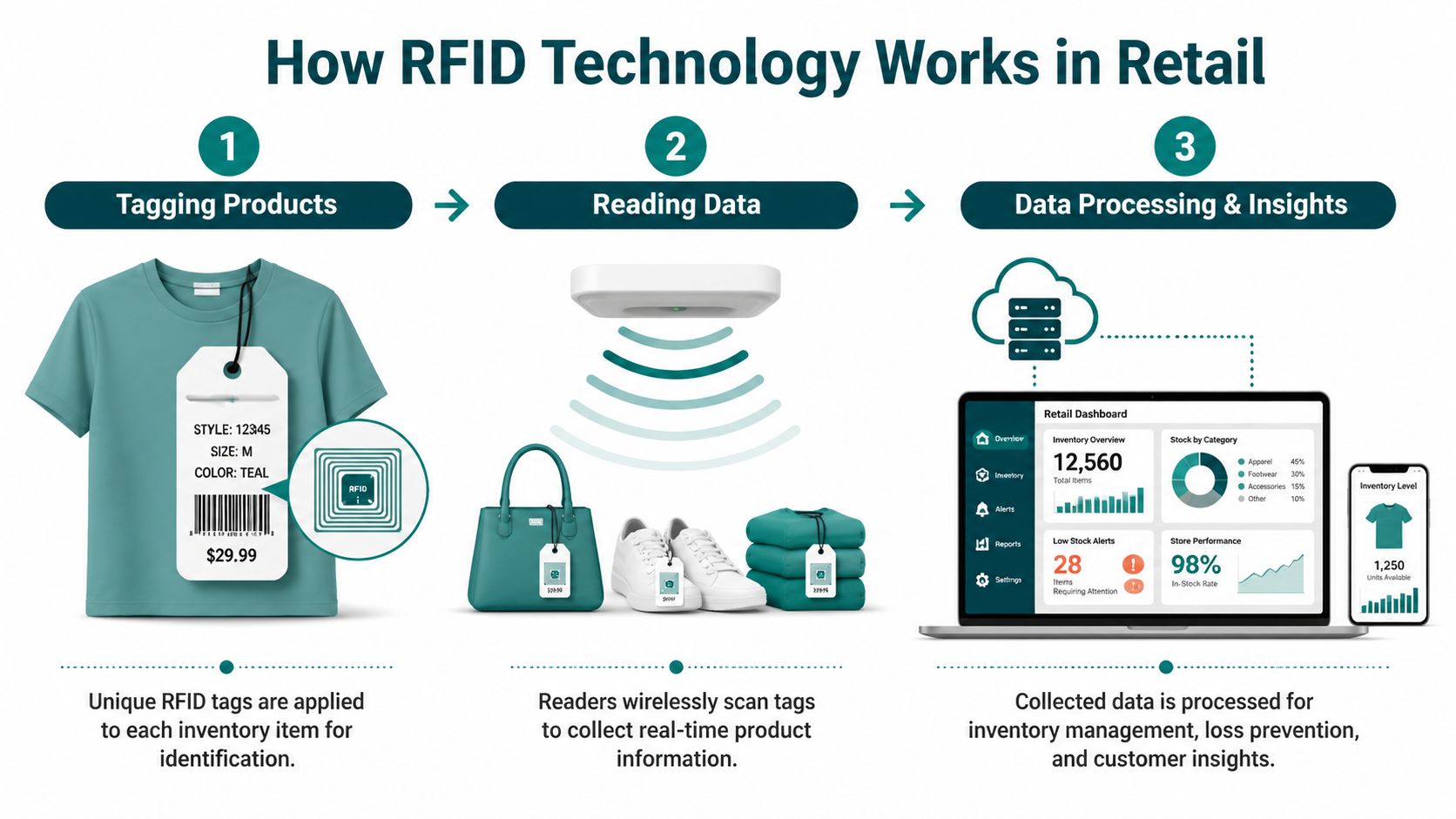
The three parts that matter
Every retail RFID deployment has three working parts.
- The tag
This sits on or inside the product label, ticket, or packaging. In most retail environments, the tag is passive. That means it doesn’t carry its own power source and only responds when a reader energises it. - The reader and antennas
These are the devices that interrogate tags. In a shop, that can mean handheld readers for cycle counts, fixed readers at back doors or stockroom transitions, or point solutions around checkout and loss prevention workflows. - The software layer
Within this layer, RFID becomes operationally useful. Software connects reads to product records, store locations, stock movements, receiving events, and exception handling.
What it looks like in a real store
A typical journey starts before the product reaches the branch. In many mature retail models, items are tagged at manufacture. When cartons arrive at a distribution centre or store, the tags are read automatically or with handheld devices. Staff can then verify what arrived, rather than what the paperwork says arrived.
From there, the same item can be read again in the stockroom, on the sales floor, during replenishment, at point of sale, or during a return. That creates a live item history. Not theoretical inventory. Actual, recent evidence that a given item is in a given place.
Practical rule: If your team still relies on annual stocktakes and ad hoc shelf walks to resolve availability disputes, you don’t have an inventory problem alone. You have a visibility problem.
That visibility is why UK retailers including John Lewis, Tesco, and M&S have adopted RFID. The technology’s roots go back to the 1970s, when tags were used to track railway carriages, but in retail it has matured into a practical operating tool. Recent UK applications, often with tags applied at manufacture, have delivered sales increases of up to 5.5% and reduced stock holding by up to 13%, as outlined by Paragon ID’s history of RFID in retail.
Why operations leaders should care about the mechanics
The mechanics matter because they shape deployment choices.
A handheld-led model is often the fastest route to proving value in apparel. A fixed-reader model may make more sense where receiving accuracy, stockroom transitions, or shrink control matter more. A software-heavy deployment matters most when the organisation wants RFID data to feed existing dashboards, replenishment logic, or store tasking.
That’s also why mapping and system structure matter more than many teams expect. If item-level data is going to support real-world decisions, the store has to be represented clearly in digital systems. The same principle applies in indoor navigation, where poor map quality undermines otherwise good technology. We’ve written about that broader issue in our work on technology in mapping.
Here’s the operational takeaway. RFID isn’t magic, and it isn’t futuristic. It’s a disciplined combination of tags, readers, and software that gives retail teams a far better answer to a simple question: what is here, where is it, and can I trust that data enough to act on it?
What Is the Real Business Case for RFID in Retail
A one-point gain in on-shelf availability can translate into meaningful revenue at store level. RFID earns its budget because it improves the operating decisions behind that availability, and it does it at a speed manual processes cannot match.
For finance leaders, the case is about margin protection, labour use, and stock productivity. For store and facilities leaders, it is about whether teams can trust what the system says is in the building, where it is likely to be, and what action should happen next. Avery Dennison’s retail RFID overview makes the point well. Better item visibility improves replenishment, fulfilment, and loss control together, not as separate projects.

Better inventory data changes more than counts
Accurate counting is usually the first benefit teams notice. It is rarely the one that justifies a full programme on its own.
The stronger commercial case comes from what accurate counts allow a retailer to stop doing. Staff spend less time checking rails, cages, and back rooms for items that are not there. Managers spend less time working around unreliable stock files. Digital commerce teams can tighten collection promises because store inventory is more credible.
That improvement reaches the customer floor. If a product is shown as available online but cannot be found in store, the immediate problem is operational. The longer-term problem is trust. RFID reduces that gap between system truth and shopper experience.
Revenue gains usually come through availability and service
Retail leaders often ask a fair question. Does RFID create sales, or does it just clean up inventory records?
In practice, it supports sales by improving availability, pick success, and response time. A tag does not sell an item. A better replenishment decision does. So does a faster stockroom search, a cleaner click-and-collect pick, or a store associate who can confirm with confidence that the right size is in the building.
That is why so much of the return sits in preventing stock outs. Stock accuracy is not only a supply chain metric. It shapes whether customers find what they came for, whether staff can help quickly, and whether a store can support omnichannel promises without adding friction.
The return improves again when RFID data feeds the in-store experience
This is the part many competitors miss.
If RFID remains a back-of-house visibility tool, it can still pay for itself in the right categories. But the upside is larger when item-level inventory supports the customer journey inside the store. That includes helping staff locate products faster and supporting digital wayfinding tools that guide shoppers to the right department, concession, or service point.
For operations leaders with accessibility targets, that connection matters. Better stock data is useful. Better stock data combined with infrastructure-free navigation is more valuable because it improves independence for blind and partially sighted shoppers, reduces avoidable staff interventions, and helps stores meet service and compliance expectations with less operational strain. The benefit is both commercial and human.
A short explainer is useful here:
Where the investment usually stands up fastest
The earliest wins tend to appear in stores and categories with a clear cost of inaccuracy.
- Apparel and footwear: High SKU counts, size variation, and frequent movement make manual accuracy hard to sustain.
- Omnichannel fulfilment locations: Cancelled picks, substitutions, and delayed collection orders expose poor stock data quickly.
- Labour-intensive stores: Teams save time when cycle counts and item searches stop consuming trading hours.
- High-service environments: Better item visibility helps staff answer customer questions faster and spend more time selling.
There are trade-offs. Tags add unit cost. Supplier compliance takes work. Process discipline matters more than many retailers expect. But where inventory errors are already causing missed sales, wasted labour, and poor customer confidence, RFID usually has a clearer commercial case than another round of manual controls.
How to Plan a Successful RFID Implementation
Successful RFID programmes don’t start with hardware selection. They start with one decision. What business outcome are you trying to prove first?
That question matters because UK retailers validating RFID investment have tended to prioritise sales uplift as the top KPI, with case studies showing a clear ROI path through improved inventory precision and reduced out-of-stocks. Apparel is a common starting point before expansion into other categories, according to ABI Research’s analysis of RFID in retail.
Start with a narrow commercial problem
Too many rollouts are scoped as technical modernisation programmes. That usually leads to diffuse ownership, muddy KPIs, and weak pilot design.
The more reliable approach is to pick one operating problem that matters commercially. Examples include inaccurate apparel counts, poor click-and-collect pick rates, high stockroom search time, or persistent shrink in a specific category.
Once that problem is defined, the implementation choices become more rational.
- If availability is the issue, focus on cycle counting cadence, replenishment triggers, and store process discipline.
- If receiving accuracy is the issue, focus on inbound reads, exception handling, and supplier tag quality.
- If shrink is the issue, design around item-level events, exits, returns, and fraud workflows.
Don’t roll out the same way in every category
RFID works differently across product types and store formats. Apparel often lends itself to quick wins because tags fit easily into labels or swing tickets and items move in large volumes. Dense, awkward, liquid-heavy, or metal-heavy categories need more testing and often more careful tag selection and reader tuning.
That’s why phased deployment usually beats a chain-wide launch. A strong pilot should answer practical questions such as:
Decision areaWhat to settle earlyCategory fitWhich product groups are easiest to tag and read reliablyReader modelWhether handheld, fixed, or hybrid infrastructure supports the operating goalIntegrationHow RFID data will connect to ERP, POS, replenishment, and reporting systemsStore workflowWho counts, who exceptions route to, and how tasks are triggeredKPI designWhich measures prove commercial value within a realistic timeframe
Integration is where many projects succeed or stall
If RFID data sits in a separate dashboard that store and regional teams rarely use, value leaks quickly. The system has to feed the tools operators already trust.
That usually means integrating RFID outputs into core retail systems, not treating them as a side platform. Receiving teams need clean discrepancy handling. Store teams need visible tasking. Digital teams need confidence in stock status. Finance needs auditable movement logic. If any of those links are weak, adoption weakens too.
Field note: The pilot isn’t just testing read performance. It’s testing whether your operating model is ready to act on better information.
Plan for security and process change together
Loss prevention often becomes a secondary benefit in RFID projects, then ultimately becomes one of the strongest drivers of value once item-level events are available. That’s where store operations and security teams need to work from the same design, especially around returns, exits, and exception workflows.
For teams reviewing that side of the estate, Overton Security's retail expertise is a useful reference point because it reflects the operational reality that shrink reduction is as much about process design as hardware.
The practical pattern is straightforward. Start where read reliability is high, commercial pain is clear, and store processes can absorb the change. Then scale only once the pilot proves that better data is changing actual behaviour on the shop floor.
How RFID Compares to Other Indoor Location Technologies
RFID gets compared with BLE beacons, Wi-Fi positioning, and Ultra-Wideband too often as if they all solve the same problem. They don’t.
RFID’s strength is item identification at scale. Other indoor technologies are usually better suited to locating people, devices, or assets in space. That distinction matters when estates teams are trying to choose the right technology stack.
Indoor Technology Comparison
TechnologyPrimary Use CaseAccuracyInfrastructure CostMaintenance BurdenRFIDItem-level inventory, receiving, stock accuracy, loss preventionHigh for identifying tagged items in defined read zones or bulk countsModerate, depends on tag model, readers, and software integrationModerate, with tag management, reader tuning, and process upkeepBLE beaconsCustomer wayfinding, proximity triggers, location-based messagingVariable indoorsOngoing due to beacon deployment across the siteHigh, because battery-powered estate hardware needs upkeepWi-Fi RTTIndoor positioning where compatible infrastructure and devices existVariable by environment and device supportOften tied to existing network investmentModerate, linked to network changes and calibrationUWBHigh-precision tracking of assets or equipmentVery high in suitable deploymentsHigher than RFID in most retail settingsModerate to high, depending on anchors and specialist setup
Why the wrong comparison leads to poor decisions
A lot of procurement confusion comes from asking one system to do another system’s job.
If you need to know whether a specific size and colour of jacket is in stock, BLE won’t solve that. If you need to guide a shopper through a shopping centre, basic RFID alone won’t solve that either. It can confirm that the item exists in a system, but it doesn’t by itself deliver a usable person-navigation experience.
That’s why a broad review helps. This enterprise guide to indoor positioning solutions is useful because it frames the technology choice around use case, not hype.
RFID is strongest when the unit of value is the item
Where RFID excels is in reading many tagged products quickly, without line of sight, and linking those reads back to business systems. That makes it especially effective for counting, verifying, locating, and securing retail stock.
By contrast, beacon and Wi-Fi systems are usually built around zones, proximity, or user-device location. UWB is a different class again, suited to very precise location problems where higher infrastructure effort is justified.
This is also why indoor navigation conversations need more precision. A retailer may need both item intelligence and human guidance, but those are separate requirements. We’ve set out that distinction in our comparison of indoor navigation technologies.
Choosing between RFID and other indoor technologies is often the wrong question. The right question is which technology is responsible for products, which is responsible for people, and where the data should meet.
For retail leaders, that leads to a clearer architecture. Use RFID where item truth matters. Use navigation technology where people need reliable guidance. Don’t expect one to replace the other unless the use case overlaps.
Connecting Inventory Data with Infrastructure-Free Navigation
Retail transformation programmes often stop at operational visibility. They improve stock accuracy, receiving, and fulfilment, then assume the customer journey will improve automatically. It won’t.
That gap is now more visible because accessibility expectations are higher, and rightly so. RFID can strengthen inventory processes, but a British Retail Consortium audit noted a 15% rise in complaints from disabled users in some UK malls after RFID implementation, highlighting a failure to connect operational technology with accessibility needs under the UK Equality Act 2010, as reported in ECR Retail Loss research on RFID in retail.
Better stock data doesn’t fix a confusing store
A visually impaired shopper doesn’t benefit much from a retailer knowing that a product is in stock if the route to that product is still unclear. The same applies to staff fulfilling online orders in a large-format store or mixed-use centre. Inventory certainty helps, but the last metre problem remains.
Many programmes often break their own logic. They invest in precision for products and tolerate imprecision for people.
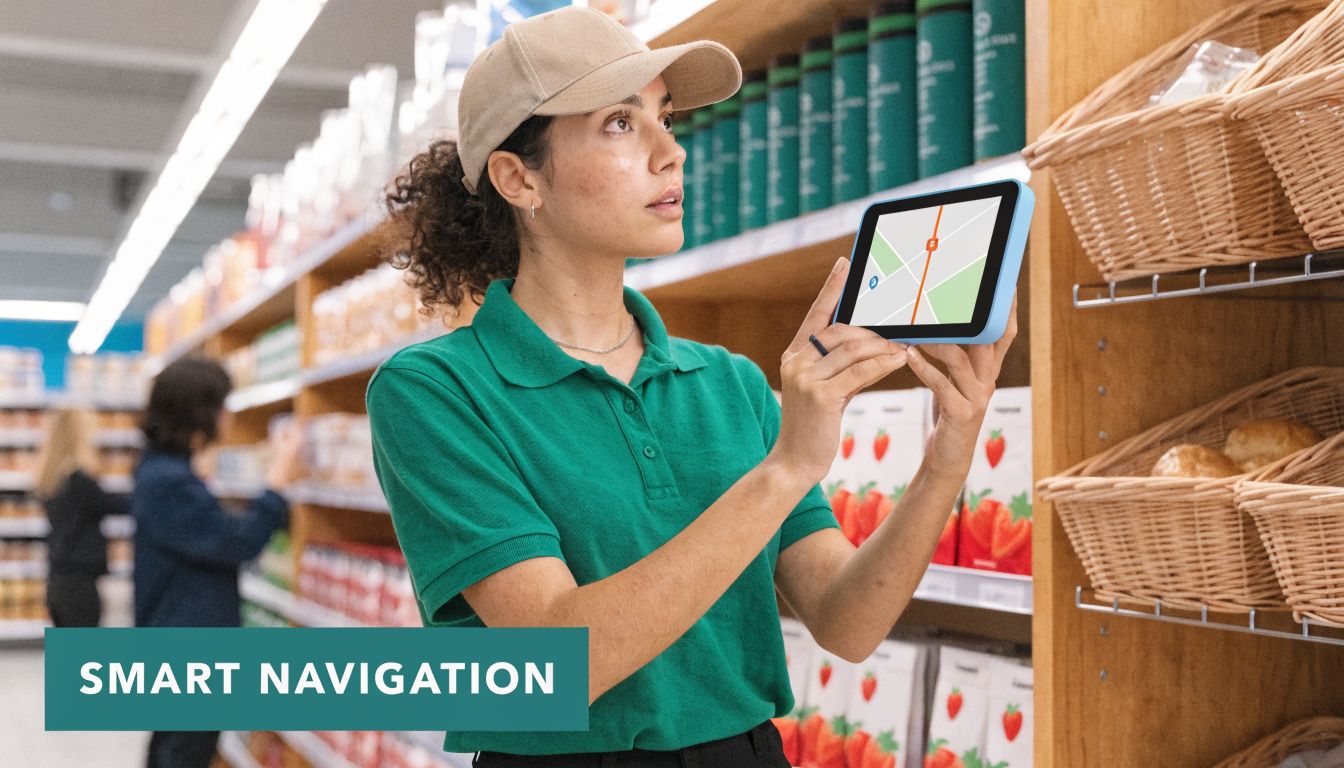
What a joined-up model looks like
A more mature model combines item-level stock visibility with navigation that works without requiring installed beacon infrastructure across the venue.
In practical terms, that means:
- The RFID system confirms the item status
It knows whether the item is received, on hand, and associated with a specific store or department workflow. - The navigation layer guides the person to the right place
It helps the user move through entrances, malls, aisles, departments, and decision points with clear instructions. - The venue gets one operational picture
Instead of treating stock visibility and wayfinding as separate projects, teams can align fulfilment, customer service, and accessibility outcomes.
This matters in shopping centres and large retail estates because the physical journey is often the primary point of failure. Customers abandon a task when the route is too confusing. Staff lose time when store layouts are inconsistent or stock locations aren’t intuitive. Accessibility fails when systems assume sighted navigation.
The operational case is broader than disability access
Accessibility is the clearest reason to connect these layers, but it isn’t the only one.
A joined-up approach improves:
Use caseWhat improves when inventory and navigation work togetherAssisted sellingStaff can confirm stock and direct customers more accuratelyClick-and-collect pickingPickers spend less time searching in large storesCross-store service in mallsCentre staff can help visitors reach the right tenant and departmentInclusive shoppingBlind and low-vision visitors can navigate with more confidenceException handlingStaff can investigate mismatches faster because the item and route context are clearer
Why infrastructure-free matters in live retail estates
From a mobility and venue operations perspective, infrastructure-heavy wayfinding is often the wrong fit for retail. Hardware estates create maintenance obligations, battery replacement cycles, calibration issues, and stale location data when the environment changes.
That’s why the infrastructure question matters just as much as the interface question. A navigation system that depends on installed hardware across every unit is difficult to scale across shopping centres, department stores, transport-linked retail, and mixed-use venues. We’ve covered that broader issue in our piece on the benefits of infrastructure-free solutions for wayfinding.
Retailers shouldn’t accept a split model where stock systems know everything and customers still have to fend for themselves.
The strategic point is simple. RFID in retail creates a valuable stream of operational truth. The next step is to make that truth usable in the physical environment. When item data and human navigation remain disconnected, stores become more efficient on paper while remaining difficult to use in practice.
What Are the Real Challenges of an RFID Rollout
RFID projects usually fail for ordinary reasons, not exotic ones. The common obstacles are cost discipline, read reliability, process change, and governance.
None of those are a reason to avoid deployment. They are a reason to scope it realistically.
The upfront investment has to be defended properly
Tags, handhelds, fixed readers, software, integration work, and pilot support all cost money. If the business case depends on a vague promise of “better visibility”, leaders will struggle to defend it when budgets tighten.
The stronger case is tied to specific loss, labour, and availability problems. That’s easier to justify because retailers using supplier compliance and item-level tracking have achieved up to 35% shrinkage reduction, according to Fulfil’s RFID implementation guide.
Physical environments still interfere with performance
Retail stores are messy radio environments. Metals, liquids, dense shelving, and awkward packaging can all create blind spots or inconsistent reads. That doesn’t make RFID unreliable overall, but it does mean testing matters.
The stores that get this right usually do three things early:
- They survey the site properly: Reader placement, stockroom flows, fixture materials, and known problem zones are tested before scale-up.
- They tune for the category: Tag type and placement are matched to the product, not chosen as a one-size-fits-all standard.
- They design around exceptions: Teams define what happens when a read is missing, duplicate, or inconsistent.
Process change is harder than reader installation
The technology can be sound and still underperform if store teams don’t change how they work. RFID creates the most value when it becomes part of daily discipline, not an occasional specialist task.
That affects cycle counts, replenishment routines, receiving checks, returns, and loss prevention workflows. If branch teams see RFID as extra work rather than a faster way to resolve uncertainty, adoption slips.
Good RFID programmes don’t just install readers. They remove old workarounds that inaccurate stock data forced teams to invent.
Security and privacy need plain rules
RFID can also trigger customer and staff concerns if governance is vague. Leaders should explain what the system tracks, where item-level data is stored, and which processes use it. In fraud-sensitive environments, encrypted tags that can be authenticated at over 1,000 tags per second help strengthen trust in the data and the control model, as noted in the same Fulfil guide.
The practical lesson is that RFID rollouts are manageable when they’re treated as operating model changes with technical components. They become difficult when teams treat them as hardware projects and hope process issues sort themselves out later.
Frequently Asked Questions About RFID in a Retail Environment
What is RFID in retail used for
RFID in retail is used to identify and track items throughout receiving, stock handling, replenishment, selling, and returns. In practice, retailers use it to improve stock accuracy, support cycle counting, reduce shrink, and make omnichannel fulfilment more dependable.
Is RFID better than barcodes for retail inventory
RFID is usually better than barcodes when the priority is counting many items quickly and accurately. Barcodes still work well for simple item identification, but RFID is stronger where teams need bulk reads and less manual scanning.
Do retailers need to tag every product
No, retailers don’t need to tag every product at the start. Many programmes begin in apparel or another category where read reliability and commercial value are easiest to prove, then expand once the operating model is stable.
What is the difference between passive and active RFID tags
Passive tags are the standard retail choice because they don’t carry their own battery and are activated by the reader. Active tags have their own power source and are usually reserved for higher-value asset tracking or other use cases where longer-range live tracking matters more than unit cost.
Does RFID speed up stock counts
Yes, that’s one of the clearest operational benefits. In mature retail use, teams can count far more frequently and with less labour than manual methods because readers can detect multiple tagged items in one pass.
Can RFID help with shoplifting and fraud
Yes, RFID can support shrink reduction and fraud control when item-level events are linked to security and returns processes. The value is strongest when store operations and loss prevention teams design those workflows together rather than treating RFID as a standalone anti-theft tool.
Does RFID improve the customer experience directly
Not by itself. RFID improves the customer experience when better inventory data leads to fewer stock errors, faster service, stronger fulfilment, and better in-store assistance. If the store layout remains complex, some customers won’t feel much benefit.
If you're planning how operational data should connect to real-world movement through a venue, Waymap helps organisations deliver precise indoor, outdoor, and underground navigation without GPS, Wi-Fi, or installed hardware. For shopping centres, large-format retail, and mixed-use estates, that means a practical way to turn digital information into journeys people can complete, especially blind and low-vision visitors who are too often left out of retail technology programmes.
