
Waymap Points the Way to the Journeys of the Future
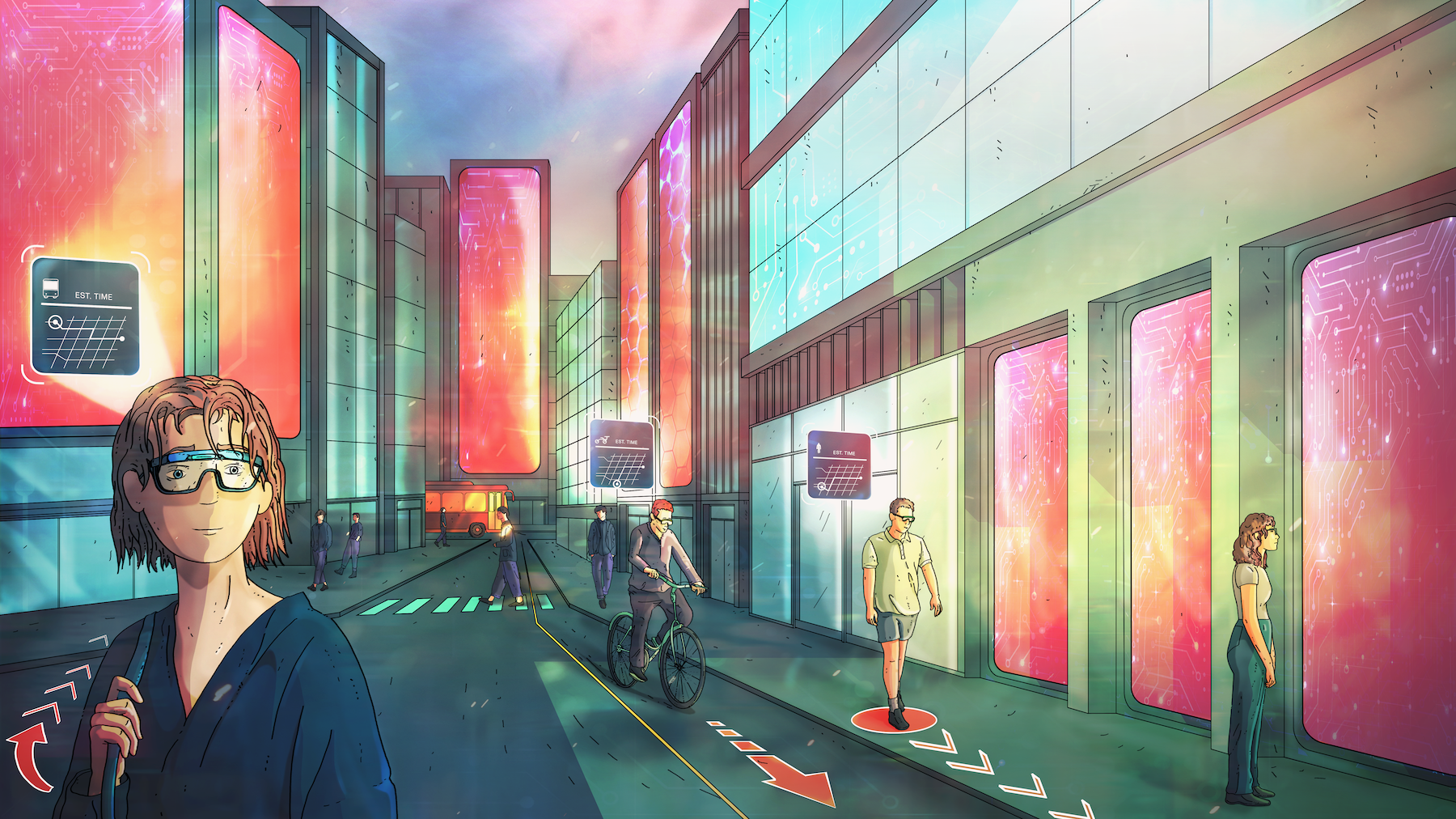
Imagine the scene: it’s 8pm and you’ve just finished indoor cricket training at Lord’s Cricket Ground in North London. Your AI assistant tells you in a soft voice, via the audio in your AI-enabled glasses, that your usual bus back to your home in Oxford has been cancelled – and suggests an alternative route using the train.
The latest version of Waymap tells you there’s enough time for the 20 minute walk to Marylebone Station, guiding you through the streets using subtle, ethereal arrows superimposed above the pavement, and adding there’s also time to grab some food at a good fish and chip shop as you approach it.
When you reach Marylebone Station the ticket barrier recognises you and opens automatically, before Waymap guides you to your reserved seat on the train. AI offers you a three minute football highlights package via your glasses, but it’s been a long day – you fall asleep, and when you reach Oxford, a reserved electric bicycle is waiting for you.
This is how an everyday journey might look five years from now – with technology like Waymap integrated seamlessly into the way we go about our lives. Crucially, this vision depends on a couple of big and exciting concepts that will soon be coming to the fore: calm computing and spatial computing.
Calm computing envisions a future where technology transitions into the background of our daily experiences, becoming more helpful, more thoughtfully integrated with our environment, and less randomly intrusive. If AI realises the buses are down, that you’ll need a new route home and will probably be hungry, why not help with all that?
Spatial computing is closely related to this idea, and is about technology and digital intelligence becoming woven into objects and locations, making the physical world more alive with possibilities. It also means being less reliant on traditional phone and computer screens – so less faffing about and getting your iPhone out of your pocket to search things up.
Some of this thinking isn’t new, but technology giants and startups alike are now working hard to make it a reality. Meta’s continuing commitment to the Metaverse is related to these ideas, and Apple is rumoured to be soon releasing next generation spatial computing hardware. These two and Nvidia, whose chips support the graphical processing power required, are pouring billions into research and development in the field.
This kind of investment isn’t just about providing more entertainment – it’s about a leap forward in how we work, learn, socialise and explore, while fostering an environment where technology serves us unobtrusively. It’s about putting in place solid foundations for the next generation of computing.
Meanwhile, companies like Waymap and Niantic – the latter already pioneers in augmented reality gaming with titles like Pokémon Go – are demonstrating how digital elements can be intricately combined with real-world experiences. Not just day-to-day journeys but the way we interact with the physical world is set for a paradigm shift.
A trip to a big sports match, for instance, could be transformed by your spatial AI device – perhaps a pair of sleek glasses which also function as a heads-up display. These would become your ticket, not only opening the turnstiles allowing you entry, but also generating arrows to direct you to bars, your seat and even your friends.
During the game, player names and stats appear above their heads when you focus your gaze on a particular player. You access replays by simply looking at the specific area of the pitch, all without breaking your engagement with the live action. Betting odds, food delivery options, and social interactions with friends watching from home can all be integrated seamlessly into your view.
A visit to a large hospital would see Waymap guide you directly to your appointment room using your preferred method – unobtrusive audio cues delivered through your noise-cancelling earphones. The doctor wears high-end clinically-approved glasses with a heads-up display, and can see your data and medical history while also looking at you and talking to you, instead of referring back to a fixed computer screen.
On your morning commute, your spatial AI glasses show a simple, green checkmark above the tracks, confirming your train is on time. You see overlays of real time traffic data and local information over the train’s windows – or the news from your favourite sources. No need to be hunched over your phone.
When you step off the train, the most efficient walking path is described to you via audio – giving fluid, context-aware guidance when needed. If there’s an unforeseen event, like a blocked street, the system immediately offers an alternative route. It will be like having a sixth sense, giving you just enough information to make informed decisions without ever feeling like information overload.
Spatial computing, leveraging AI and adopting the principles of calm computing, are about to give us “The World 2.0”. This will be more than just a technological upgrade – it represents the next evolutionary leap of the internet, moving beyond flat screens and into the vibrant, three-dimensional world we inhabit. A truly interconnected reality – a real-world web, with technology as an enhancing presence, not a demanding one – is just around the corner. And Waymap, with its accessible personal navigation app, is pointing the way.
